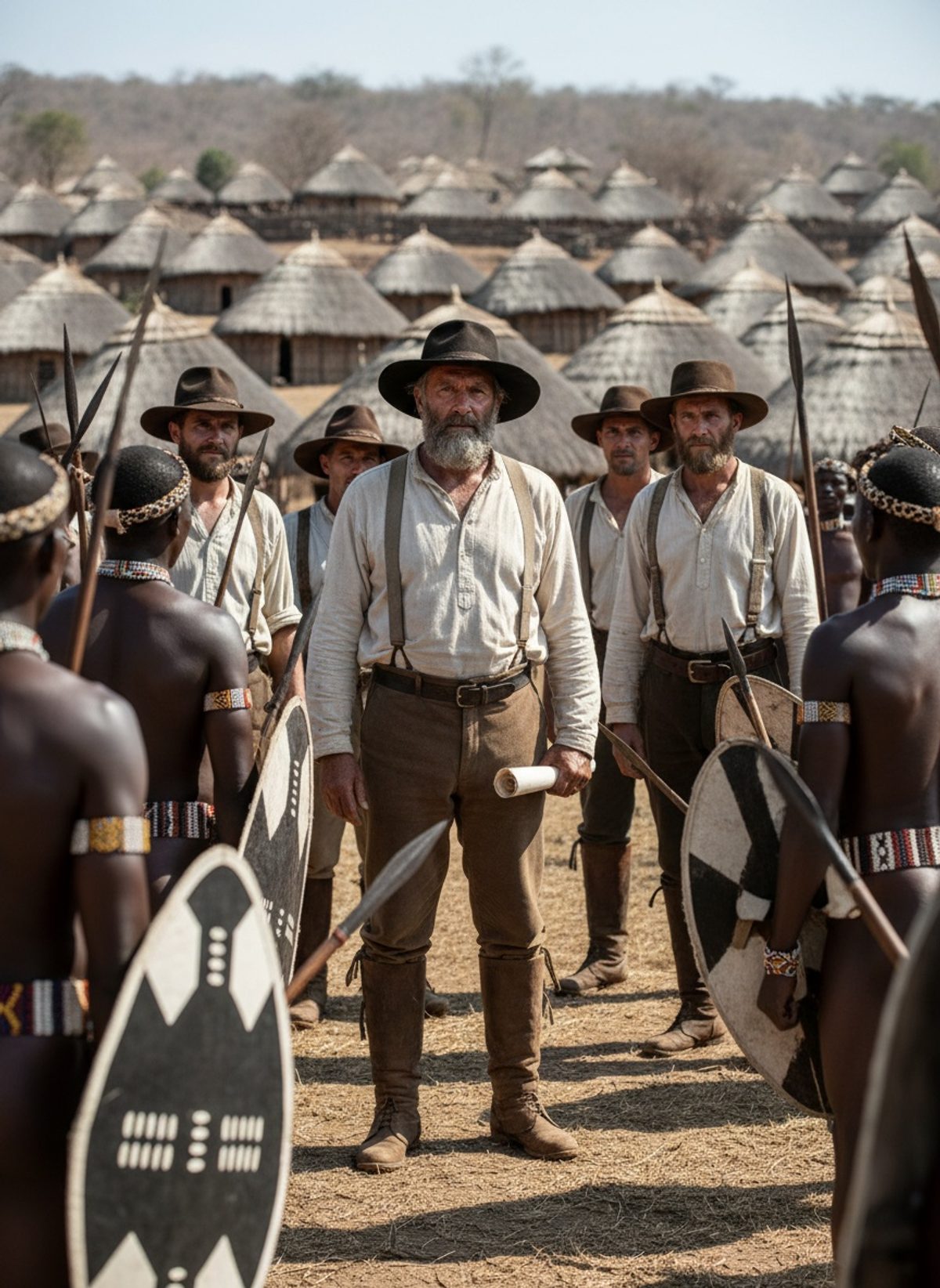
February 1838. Dust clung to the swirling breeze around uMgungundlovu.
The Unarmed Arrival
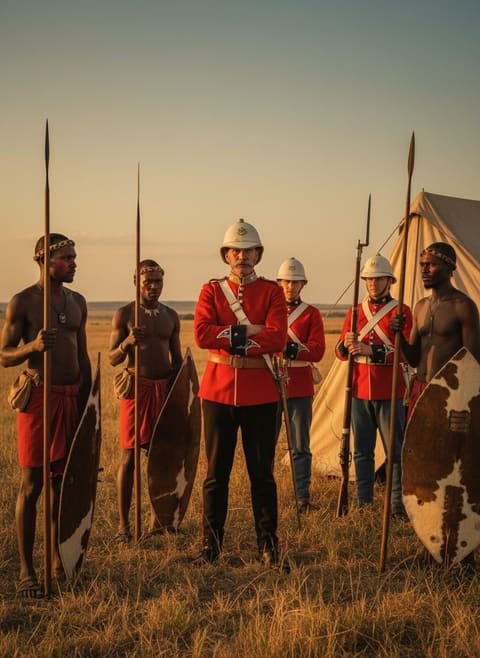
The sun had barely crested the horizon when Piet Retief and his Boer delegation made their way to Dingane's royal kraal, their horses kicking up earthy clouds beneath the clear African sky. Their hearts were filled with cautious optimism, believing that they were on the brink of a historic agreement that would secure land for the Boers and peace with the powerful Zulu Kingdom. As they approached, they left behind their weapons, a sign of trust and an attempt to foster goodwill with King Dingane.
This bold gesture of peace was reinforced by the document Retief proudly carried—a treaty promising land. Dingane’s kraal, a sprawling network of huts and cattle pens, sat nestled amongst the hills, a site both intimidating and majestic. Retief and his men, clad in their wide-brimmed hats and dust-coated garments, were determined to secure a future for their people, uninformed of the ominous plot that lurked beneath Dingane’s warm welcome.
The Deceptive Warmth
Dingane, a figure of regal authority and shrewd intelligence, greeted the delegation with a charm that belied the tension simmering beneath. His imposing presence was accentuated by the rhythmic chants of nearby warriors. Dingane's expansive kraal was more than just a home—it was the heart of his kingdom, a place where decisions of life and death were meted with grave significance.
Read next: When Khoikhoi Warriors Burned the Cape and Defied the Crown
The previous meetings between the Boers and Dingane had seemed promising. Retief was confident that their relationship had been cemented through earlier discussions and shared drinks, where they sought to establish an alliance in an increasingly volatile land. Yet, unbeknownst to Retief and his men, Dingane’s real intentions were veiled. Secretly, his spies had been observing the Boers, their reports painting them as a potential threat to his dominion.
As they imbibed in pleasantries, observers noted the subtle shifts in Dingane's demeanor, hints of uncertainty tempered by an insidious agenda. Retief presented the treaty, a document heavy with the weight of his people’s dreams. The paper crinkled in his hand, its promise crisp and hopeful. Dingane's eyes traced the words with a burning intensity, presenting a smile that masked the storm brewing beneath.
The Signal for Betrayal
With the formalities concluded, Retief and his men felt the weight of diplomacy lift from their shoulders. However, Dingane’s gaze, which had lingered on the treaty now shifted, and the atmosphere changed. The once amiable setting turned tense, charged with an oppressive silence that smothered the kraal as effectively as the oppressive heat.
Suddenly, Dingane rose, his eyes cold and determined. He clapped his hands, and the effect was instantaneous and chilling. It was an unspoken signal, an order wrapped in tradition and power. The warriors who had appeared merely as background figures exploded into action with practiced ferocity. The tranquility of the kraal shattered like glass, the harmony of diplomacy drowned by the war cries of Zulu warriors.
The Boers, unarmed and caught off guard, were quickly overpowered. Their disbelief was palpable as they realized the harrowing betrayal. Each man fell not solely as a consequence of Dingane’s decree but as victims of their own misguided trust and the harsh realities of a land that brooked no naiveté. Their deaths were swift and unyielding, a sobering punctuation to their ill-fated mission.
The Echoes of Conflict
Retief's delegation, once the embodiment of hope and goodwill, lay vanquished, sealing a bloody chapter in the tumultuous history of the Cape Colony frontier. The massacre served as a grim harbinger of the escalating conflict between the Boers and Zulus, disrupting the delicate balance that had precariously held sway in southern Africa.
Read next: When Komagata Maru Turned Back and Canada Held the Line
The repercussions of that tragic day were immediate and far-reaching. The slaying of Retief and his men became a rallying cry for the Voortrekkers, inciting a fierce determination to secure land and safety against indigenous peoples framed as obstacles in their colonial migration. The settlers fortified their resolve, and imminent skirmishes threatened to reshape the region forever.
Yet, these tensions did not arise in isolation. They were part of a broader narrative of struggle and survival, wherein the fates of numerous communities collided, each battling against the encroaching tide of imperialism and the fierce tides of indigenous sovereignty.
A Lesson Writ in Blood
The massacre at uMgungundlovu was a turning point, one that reverberated through South Africa's history with consequences that shaped its future. It serves as a chilling reminder of the dangers of miscommunication and the perils of imperial ambition, where hopes can swiftly become history’s darkest chapters. The complexities of this encounter paint a portrait of a time when trust could be as lethal as any weapon.
As we reflect upon this significant episode, we are compelled to consider how the vestiges of past conflicts echo within our modern landscapes. The tale of Retief and Dingane transcends its era, reminding us of the ever-precarious balance between trust and treachery, and the enduring human cost of broken promises.