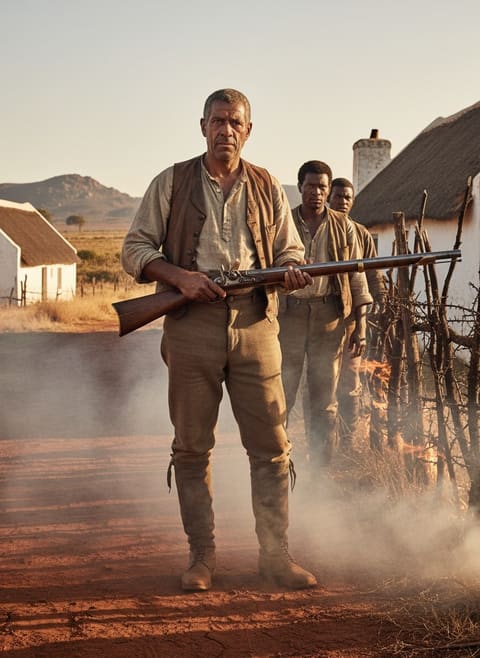
Manie Maritz squinted into the relentless African sun, the horizon stretching endlessly across the arid plains of German South West Africa. The smell of gunpowder clung to the air as the clatter of his men setting up camp filled the space around him. Their uniforms, dusty from travel, bore an insignia that was no longer welcome under the Union Jack. Yet, Maritz knew he was exactly where he wanted to be. The air was thick with anticipation and quiet murmurs of rebellion. The thousands of miles they had traversed led to this moment, and every step resonated with conviction and defiance. It was October 1914, and South Africa stood on the precipice of its most turbulent year.
A Divided Allegiance
To understand why General Manie Maritz turned against the British when war broke out in 1914, one must look back a mere dozen years to the end of the Second Anglo-Boer War in 1902. The British had imposed harsh terms upon the weary Boer fighters, and the resulting Treaty of Vereeniging left many Boer veterans, like Maritz, with resentment simmering just beneath the surface. Despite forming the Union of South Africa in 1910, the scars of conquest were still raw, the Boers' independence now a memory overshadowed by British dominion.
When World War I erupted, the British Crown expected loyalty from its dominion in South Africa. Many Boers begrudgingly agreed, swallowing their pride to serve a foreign king in distant lands. However, for Maritz, the idea of fighting alongside the empire that had vanquished the Boers less than two decades earlier was unconscionable. His loyalty was not to King George V but to the lost cause of the Boer Republics. His choice to defect was a defiant roar against colonial subjugation, a call not of allegiance but of rebellion.
Crossing the Line
Maritz's defection was not a mere whisper in the night but a brazen shout across battle lines. With roughly 1,000 men under his command, Maritz's forces were strategically positioned along the border of German South West Africa, tasked with safeguarding the frontier against German incursions. Instead, he saw an opportunity to strike a dangerous alliance.
Read next: When Sepoy Mangal Pandey Fired the Shot That Lit India
Siding with the Germans, he raised the Vierkleur, the flag symbolic of the now-defunct Boer republic, and declared war against the Union of South Africa. Maritz radioed a bold message to Pretoria, letting the leaders of the newly-minted dominion know that the Boers were reclaiming their autonomy. He found common cause with the Germans not out of admiration, but mutual enmity towards the British. This daring pivot into the arms of those sworn enemies of his homeland was as calculated as it was shocking, signaling a bid to reignite hopes of self-governance crushed in prior decades.
The Rebellion Grows
Maritz was not alone in his defiance. As the seeds of rebellion were sown, other disaffected Boer leaders began to rally to his cause. Figures like Christian de Wet and Koos de la Rey were sympathetic to the idea of battling the British to restore their past sovereignty. Across the veldt, whispers of dissent grew louder, gaining momentum among a populace still nursing the wounds of defeat and displacement.
However, not all Boers joined the insurgent wave sweeping across the landscape. Many were torn between the desire for autonomy and the pragmatic need for peace in a land still healing from its past strife. Though anger against British rule had never fully abated, the specter of prolonged conflict loomed mightily, dissuading some from picking up arms once more. Nonetheless, the rebellion posed a significant threat to stability in the young dominion, which found itself grappling with a schism both ideological and martial.
The Empire Strikes Back
The response from the Union government was swift and decisive. Determined to quash the revolt before it could ignite into a full-fledged civil war, forces loyal to the Crown moved quickly to intercept Maritz and suppress the burgeoning insurrection. Led by leaders like Louis Botha and Jan Smuts, these loyalists set out across the plains to remind the rebels of the Union's determination and resolve.
What followed was a series of skirmishes and engagements, with the Loyalist forces determined to bring the radicals back under control. The might of a well-equipped and organized militia soon turned the tide against the rebels. By the waning months of 1914, the rebellion had been effectively stifled, its leaders imprisoned or in flight.
Read next: When Dingane's Spies Watched Retief Sign His Own Death
As swift as its flicker began, Maritz's defiance unraveled, left as a mere footnote in the saga of World War I—a brief yet potent reminder of the fissures lurking beneath the surface of South African society.
The Echoes of Defiance
The Maritz Rebellion remains a testament to the complex tapestry of allegiance and identity in early 20th-century South Africa. It encapsulated the enduring struggle for self-definition within a land forged through conquest and reconciliation. For Maritz and his compatriots, the rebellion was a last fervent cry for the independence of their forefathers' dreams—a final burst of fervor from a bygone era.
While the rebellion failed to alter the course of history or rouse a nation to arms, it shone a light on the intricate dynamics of empire and resistance, where history's narrative was not neatly segmented but woven with frayed edges and intertwined ambitions. It stands as an episode that, while omitted from many textbooks, serves as a salient reminder of the enduring legacy of imperial conquest and the indomitable spirit of those who dare defy it.
The lessons buried within the annals of Maritz's audacious uprising linger, inviting reflection on the power of belief and the costs of rebellion in the face of insurmountable odds. As they danced over the desert expanse, the ripples of defiance continued to reshape the landscape of their nascent nation, reminding each subsequent generation of the battles fought not only on open fields but within the hearts of men.