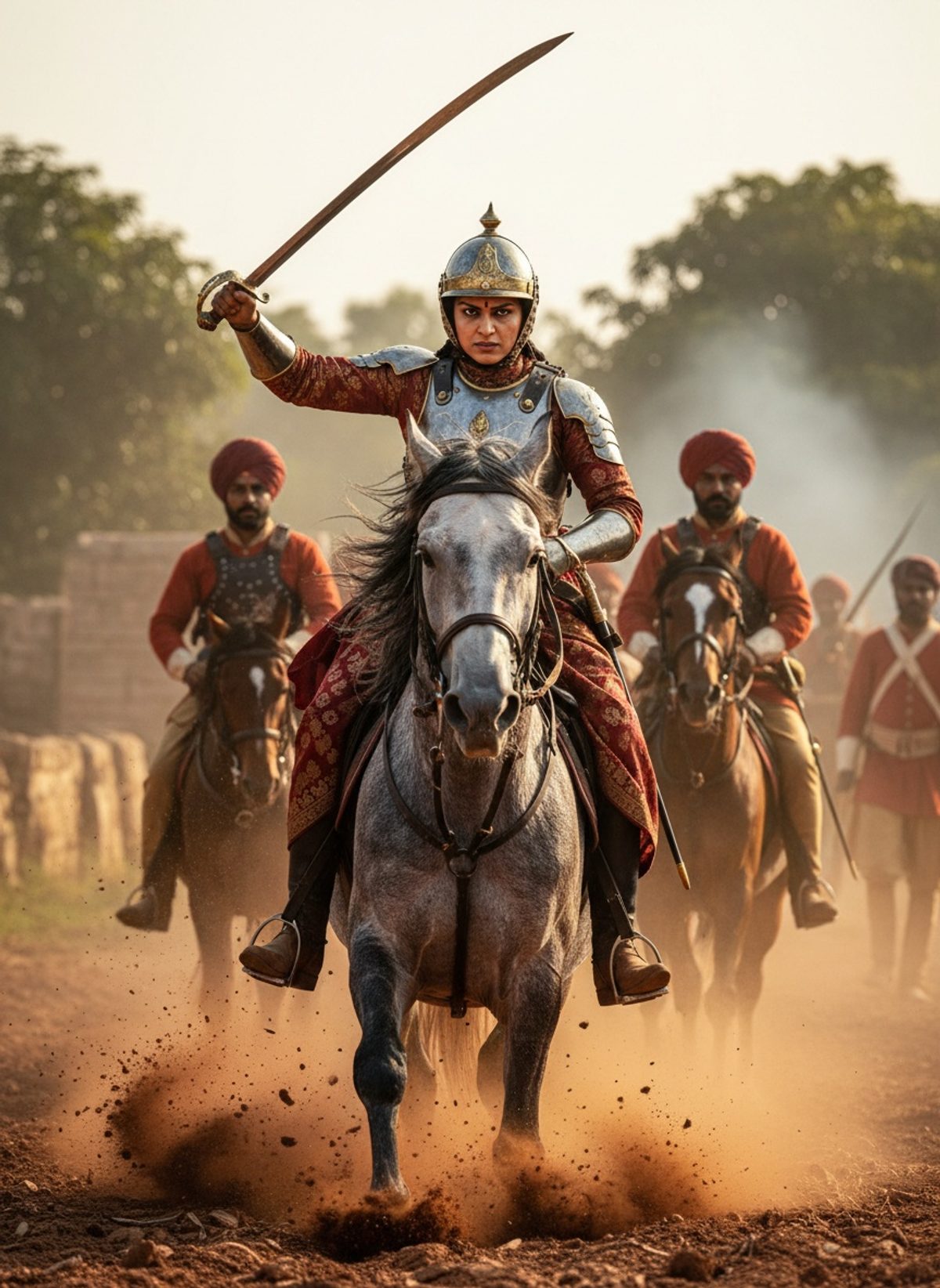
The dust stormed around her, mingling with the sweat and the fierce heat of June as she urged the horse onward. The clang of swords and the shouts of soldiers filled the air like an unending battle hymn. Lakshmi Bai, the Rani of Jhansi, was determined to fight, refusing the fate that others tried to impose upon her.
The Battle for Jhansi
Jhansi had already fallen to the British forces earlier in the spring of 1858, a prize for the British East India Company eager to expand its dominion in India. They had dismissed her adopted son, fraying the laws of succession and ignoring the strong will of the twenty-two-year-old queen. Lakshmi Bai could have been a story of resignation, folding under the weight of colonial power, but she was anything but willing to kneel.
When the British had stormed Jhansi’s fort, they expected her to surrender. Her bright armor gleamed as she drew her sword, rallying those around her with a voice that cut sharply through the chaos. She escaped the siege with strategic elegance, retreating swiftly on horseback with the young Damodar Rao, her adopted child strapped to her back. The Rani knew this was not the end.
The Queen Becomes the Warrior
At Gwalior, by June 1858, tales of the Rani riding into battle had begun to spread, and she had become the symbol of resistance against the British rule. Her skill in horsemanship and swordplay was unmatched, honed since her days as a young girl, Manikarnika, raised in Kashi. She had not been bred to wear the crown as a mere ornament — her upbringing taught her strategies of warfare, the power of diplomacy, and the resilience required to lead.
Read next: When Birsa Munda Shook an Empire From a Jungle Village
As she entered into Gwalior, aligning with Indian rebels and strategists, she was crafty and intuitive, understanding the land and its people. Her followers idolized her; she was not just a ruler to them but the embodiment of Shakti, the divine feminine power. Lakshmi Bai’s presence provided a morale boost not just to her troops but to the larger cause against colonial rule. Her name was not chanted in vain; it inspired legends even as she charged into the oncoming tides of bloodshed.
The Final Stand
By the end of June 1858, Lakshmi Bai faced perhaps her greatest peril at Gwalior. She rode into the battlefield dressed in the armor of a common soldier, her face obscured but her heart fiercely recognizable to those fighting for their homes. She charged not with reckless abandon but with the calculated ferocity of someone satisfied only by the pride of her people.
Accounts from that day describe her valor as unfathomable. The dust-filled skies darkened as she swung her sword with the precision of an artist crafting her masterpiece. Her mount, as faithful as the ancient steeds of legend, navigated the chaos with a certainty dictated by its rider’s will. Each clash of her sword against that of the enemy echoed her defiance, refusing to cower or retreat.
Eventually, amidst the ferocity of battle, her incredible run came to an abrupt end. She fell, yet even in her defeat, she ensured only her people would find her body, and thus she remained unconquered, slipping into history as a figure not taken alive, her legacy undiminished.
Read next: When Bhikaji Cama Unfurled India's Flag at Stuttgart, 1907
Beyond the Battlefield
The Rani of Jhansi’s struggle was more than just a fight against immediate oppression; it was an awakening. Her willingness to stand alone amidst the waves of imperial forces inspired generations after her. Though her reign ended on that battlefield, her spirit sparked a nationalism that changed the game in the long years that followed — not immediately, but inevitably.
She became an immortal symbol among India’s freedom fighters, with a reputation that transcended the bounds of caste and gender. Her determination lit the way for countless others who sought liberation, not only from the British Raj but from any shackles thrust upon them by power dynamics around the world.
As stories of her bravery swept across the Indian subcontinent, they carried with them the essence of human resilience against insurmountable odds. Her final ride, bloodied and heroic, carried a simple truth: Lakshmi Bai had proved unequivocally that empires could seize lands and titles, but they could never conquer the indomitable spirit of those who refused to kneel.