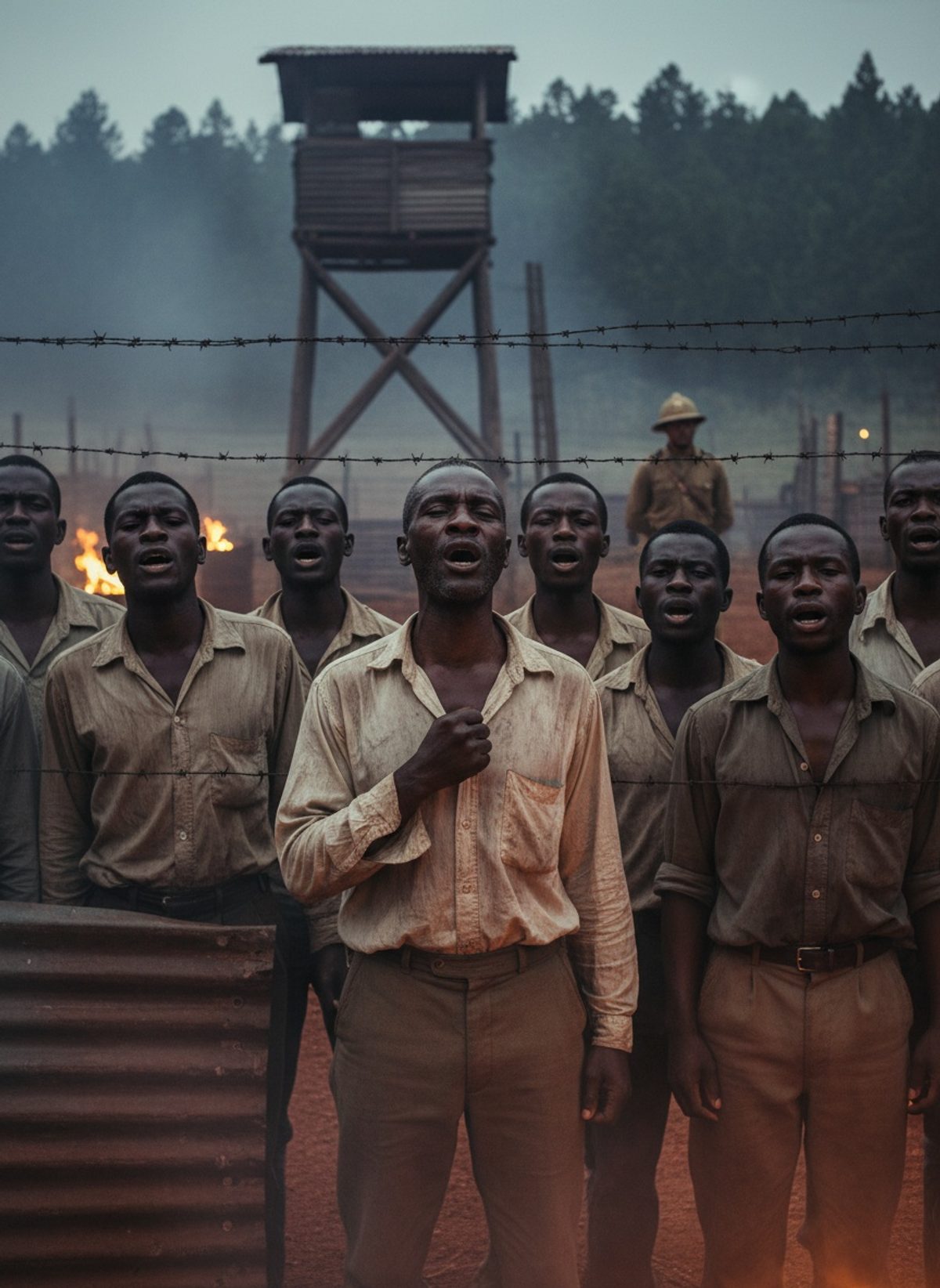
The wire fence hummed in the chilling embrace of the Kenyan night, a fragile barrier against the defiant storm that brewed within. The air pulsed with an unyielding rhythm, voices rising in a symphony of resilience and rebellion. Kikuyu prisoners, held captive in the detention camps of 1952, transformed the oppressive silence of their confinement into a chorus that rattled the consciousness of the British Empire. With each rising note, they declared that their spirit was unbroken, flowing out into the dark African night from the heart of colonial repression.
The Sound of Resistance
Under the vast African sky, the detention camps scattered across the Kenyan highlands appeared deceptively quiet. Barbed wire, watchtowers, and armed guards served as the British Empire's instruments of control, attempting to quell the uprising labeled as the "Mau Mau Rebellion." Yet, within those seemingly silent compounds, an unexpected weapon emerged—song. Each night, thousands of Kikuyu men, swept up by the State of Emergency, came together, their voices interweaving to form an indomitable tapestry of sound that overwhelmed the confines of their captivity.
These were not traditional battle cries. Rather, they were melodies deeply rooted in Kikuyu tradition, adapted to reflect their struggle against colonial oppression. With lyrics that blended coded messages, cultural references, and overt defiance, their songs served as both communication and inspiration, reminding each prisoner of his role in the larger narrative of Kenya's fight for freedom. In a place where hope was a scarce commodity, song became a vital lifeline, a nightly communion that reinforced their collective courage and identity.
Nightfall in the Camps
As the sun dipped below the horizon, painting the sky in shades of red and gold, a profound transformation began within the camps. From the confines of their crowded barracks, the prisoners would gather, forming a united front against the impending darkness. Here, in the fading light, was where the magic happened. Their voices emerged hesitantly at first, a few solitary notes echoed and twisted against the steel and barbed wire of their enclosure.
Read next: When Manie Maritz Turned His Guns on the British, 1914
With each passing minute, the voices grew stronger, more certain. Soon, harmonies cascaded over the grim compound, building a wall of sound that no physical barrier could contain. The camps vibrated with the energy of men who refused to be marginalized by their oppressors. Guards, stationed at intervals, often reported the awe-inspiring effect this nightly ritual had, a stark contrast to the somberness of their own assigned silence. Beneath the watchful eyes of the Empire, prisoners sang to the universe, demanding to be heard even when their captors could not comprehend their language.
Under Empire's Shadow
The British colonial authorities, however, could not ignore the ripple effect created by these nocturnal concerts. The power of song had carved through the apparent dominance of the Empire, infusing the camp's air with a sense of invincibility that was immune to imperial chains. It was not just about keeping spirits alive against the grim reality; it was a form of resistance that baffled and disturbed the colonial powers.
Unsettled by the nightly anthems reverberating through the camps, the British attempted various methods to silence the Kikuyu prisoners. Curfews were enforced more stringently, group formations were broken, and punishments were doled out for what was deemed unruly behavior. Yet, every attempt to diminish their resolve only added fuel to the fire of resistance. The songs became an unspoken bond between them, a reminder that although their bodies were confined, their spirits soared free.
Read next: When Bhagat Singh Walked to the Gallows Singing, 1931
Singing Until Dawn
Within the echoes of their voices lay a vision of a free Kenya—a vision that served as their compass through the oppressive night. As the calls of their songs reached their climaxes, a haunting beauty emerged from harmony and discord alike. The men sang of their ancestors, their fertile lands, and dreams of a future unshackled from colonial rule. It was cathartic, not just a rebellion but a reawakening of identity that seemed to come alive beneath the African stars.
The Kikuyu prisoners, isolated from their families and communities, found solace and solidarity in song. Time wore on, but their melodies remained a steadfast source of motivation, a constant reminder that the world beyond the wire still existed and awaited their return. With each sunrise, the songs receded into the depths of memory, only to return once more as darkness fell. Night after night, they sang until the dawn broke through the canopy of colonial power, their voices a testament to the resilience of the human spirit.
In telling the tale of the Kikuyu detainees—those men who sang through the silence enforced by empire—lies a significant lesson about the efficacy of resistance in all its forms. It serves as a moving reminder that history is not solely defined by battles and treaties but by the collective spirit of those who refuse to be silenced. The echoes of their songs continue to reverberate in the annals of history, a perpetual melody underscoring the indomitable drive toward justice and liberty.