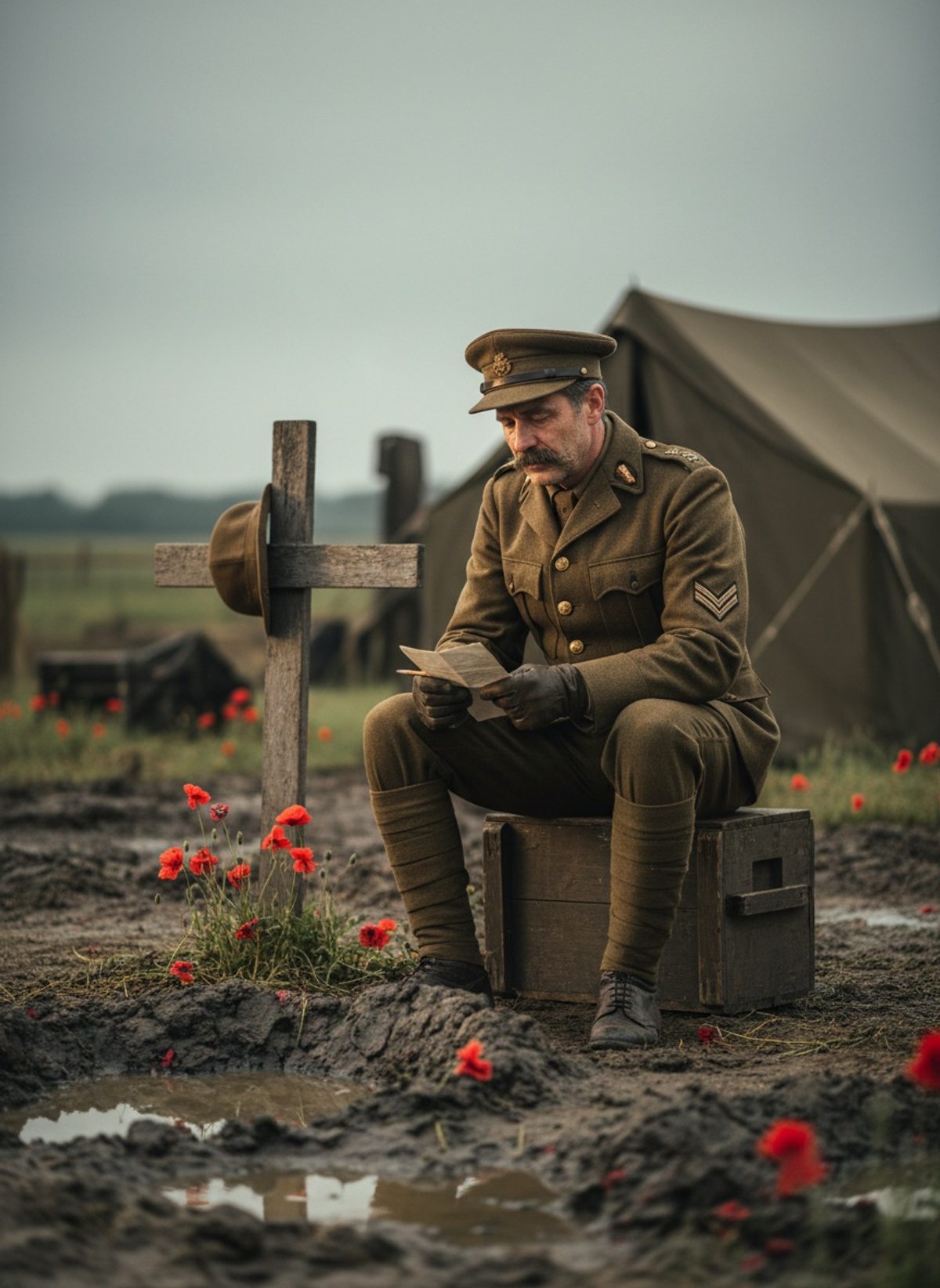
May 1915. The air over Flanders was thick with the smell of gunpowder residue and freshly turned earth.
The Birth of a Poem
The mournful landscape of Flanders Fields in 1915 was an unlikely birthplace for the enduring symbol of remembrance known as the red poppy. Amidst the cacophony of war—artillery booming across the front lines and the incessant trench mud underfoot—a Canadian doctor named Lieutenant Colonel John McCrae, weary from treating the unending stream of wounded, took a moment to honor one fallen soldier who had been his friend.
Beneath the overcast veil of the Flemish sky, McCrae sat by an open grave, pen in hand. He scribbled seventeen lines of verse, words flowing with the inescapable rhythm of grief and hope, capturing the contrast between the quiet dignity of the newly planted crosses and the relentless war raging beyond them. This creation seemed destined to be lost to the chaos of war. In fact, McCrae nearly discarded the poem, thinking it insignificant amid the great trials of the Great War.
Yet, as it often happens, human stories and their resonant truths find a way to endure. The poem, "In Flanders Fields," crossed the Atlantic Ocean shortly after McCrae penned it, instead of vanishing like the countless moments and memories obliterated by battle's ferocity. First published in a London-based magazine, those simple, poignant lines ignited imaginations and hearts, their echoes unfurling across a war-weary Empire.
Read next: When Britain Paid Two Centuries to End a World Sin
The Bloom of a Symbol
From the mud of Flanders, where poppies dotted the landscape as resilient bursts of color amidst a palette of destruction, the idea of the poppy as a symbol of remembrance took root. In the devastated fields, these vibrant flowers grew insistently, defiantly, creating a veritable sea of scarlet against the earth scarred by conflict. The red poppy came to embody both the heartbreak and hope entwined in the wartime experience.
The adoption of the poppy as a memorial emblem crystallized over the next few years, propelled by the poem's resonance. Anna Guérin, a French woman who advocated for using the poppy to support veterans' causes, famously referred to the flower as the "Poppy Day." Her influence spanned across France and toward the United Kingdom, laying the foundations for what would become an international tradition. Similarly, Moina Michael of the United States passionately championed the idea, her tireless campaigns embedding the tradition even further into the cultural consciousness.
The symbolism that the poppy carried was enriched by its delicate yet tenacious nature. These flowers had flourished on the very terrain tormented by the ravages of war, thriving on soil disturbed by the shelling and chaos that had once been rural serenity. Just as the poppies bloomed in the face of adversity, the concept of collective remembrance blossomed from individual grief, growing in spirit and significance, reaching beyond the constraints of time, nationality, and circumstances.
Read next: When English Law Walked Into a New World, 1607
The Legacy Beyond the Trenches
On every eleventh hour of the eleventh day of the eleventh month, men, women, and children across the world pause to remember. In streets, parades, and solemn ceremonies, the red poppy gracefully adorns lapels, standing as a reminder of the sacrifices of those who fought and fell, and the resilience of those who lived on. The ritual stems from those seventeen lines, penned amid the mud and misery of 1915, becoming a shared language for collective reflection.
The red poppy evokes not only the heroes of Flanders but serves as an emblem for warriors of every subsequent conflict. The legacy of McCrae's poem and the symbol it birthed reaches beyond the specific circumstances of its creation—it is a thread woven into the fabric of the historical and cultural memory, one that acknowledges the suffering wrought by war while advocating for peace.
In today’s world, where war can seem a distant echo or a near calamity emerging on another horizon, the red poppy remains a steadfast symbol. It reminds generations of the lessons hard-won on battlefields and in the quiet afterglows of those whose stories ended too soon. It invites reflection on what it means to remember, so that we might carry forward the courage and the call for peace learned from history into the future. In this sense, from a fleeting moment beside a fresh grave on Flanders Fields, a ritual emerged, binding us together across time, inviting us to never forget the cost of war and to cherish the fragile blooms of peace.