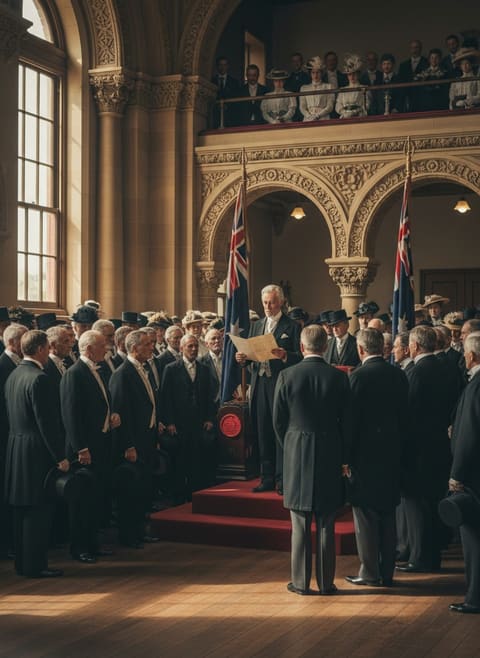
The air was thick with anticipation in the meadow at Runnymede, the murmurs of anxious barons blending with the sound of the River Thames lapping softly against its banks. Across the field, a reluctant King John stood brooding, his royal cloak dragging in the grass, as he approached the makeshift table. The quill poised in his baron's hand awaited the king's seal. It was the moment that the barons had dared to dream of but hardly dared to believe could come to pass. With a heavy heart and a reluctant hand, King John affixed his seal to the document that would ignite a legacy — the Magna Carta.
The Meadow of Discontent
In the early 13th century, the kingdom of England was a land of rising discontent, with nobles and commoners alike weary of King John's heavy-handed rule. His reign was marked by heavy taxes and failed military ventures that drained the treasury and tested the patience of those who contributed to its coffers. Tensions mounted, and a coalition of barons, aiming to rectify the grievances wrought by the crown, took an extraordinary step that would not only alter their world but eventually impact the globe.
The field at Runnymede provided the perfect neutral ground for these negotiations — fertile and open, yet symbolically situated between the royal stronghold of Windsor and the rebel base at Staines. Conceived as a means to limit the monarchy's unchecked power, the Magna Carta outlined a series of demands aimed at safeguarding the rights of the church and the feudal barons, invoking the principle of due process and establishing what would become the cornerstone of English Common Law.
The Making of a Legend
The Magna Carta was not an instant panacea, nor was it immediately successful in its ambitions. The document itself faced annulment and revision in the years that followed, yet its spirit endured. Key among its clauses was the assertion that no one — not even the king — was above the law. This radical precept planted the seed of constitutional law, setting a precedent that would echo through corridors of power far beyond England's green and pleasant land.
Read next: When English Law Gave the World Its Jury, 1215
What many might not know is that the Magna Carta went through multiple iterations, evolving with each subsequent version. Its clauses, initially focused narrowly on the interests of the barons and the church, began to echo with broader applications. It would take centuries for this legacy to unfurl fully, but the seed was planted — a challenge to the divine right of kings, laying the groundwork for the development of parliamentary democracy.
Words that Crossed Oceans
Hundreds of years later, across continents and oceans, the principles enshrined in that historic meeting at Runnymede found new life. The Magna Carta's principles inspired the founding fathers of the United States as they drafted the Constitution and Bill of Rights. The echoes of "due process" and "habeas corpus" resonated in the formative documents of nations as distant as India, Canada, and Australia. Legal minds have continually revisited the Magna Carta, citing its enduring principles almost as scripture in the courtrooms of the world. Its influence can be felt globally in the structure of modern legal systems that emphasize human rights and individual freedoms.
Read next: When the Poppy Was Born in the Mud of Flanders, 1915
In countries like South Africa and Hong Kong, the rhetoric and ideals drawn from the Magna Carta became rallying cries against authoritarianism and colonial rule. It fostered a common language of justice that rallied those seeking to challenge tyranny and underscore the universality of human dignity. It speaks to a truth far greater than the meadow it was signed upon, demonstrating how the language of liberty can breach frontiers and penetrate the foundational charters of nation-states around the globe.
The Legacy Unfurled
Today, the Magna Carta is more than a relic of medieval history; it is a living document whose principles continue to inspire and resonate. The parchment that began as a local corrective against a despotic ruler has evolved into a symbol of liberty and legal structure embraced worldwide. Trials and legal arguments still reverberate with its echoes, reminding those in power that their authority is contingent and their governance accountable.
This story, emerging from a tense and tumultuous pasture, offers a reminder that the mightiest of revolutions can have the humblest of origins. As courts in capitals from Washington to Canberra open with undertones of "justice for all," the ripple effects of that pivotal day at Runnymede highlight a profound truth: an idea, once given form, can transcend borders and epochs, altering the course of history in ways even its reluctant signatories could never have imagined.