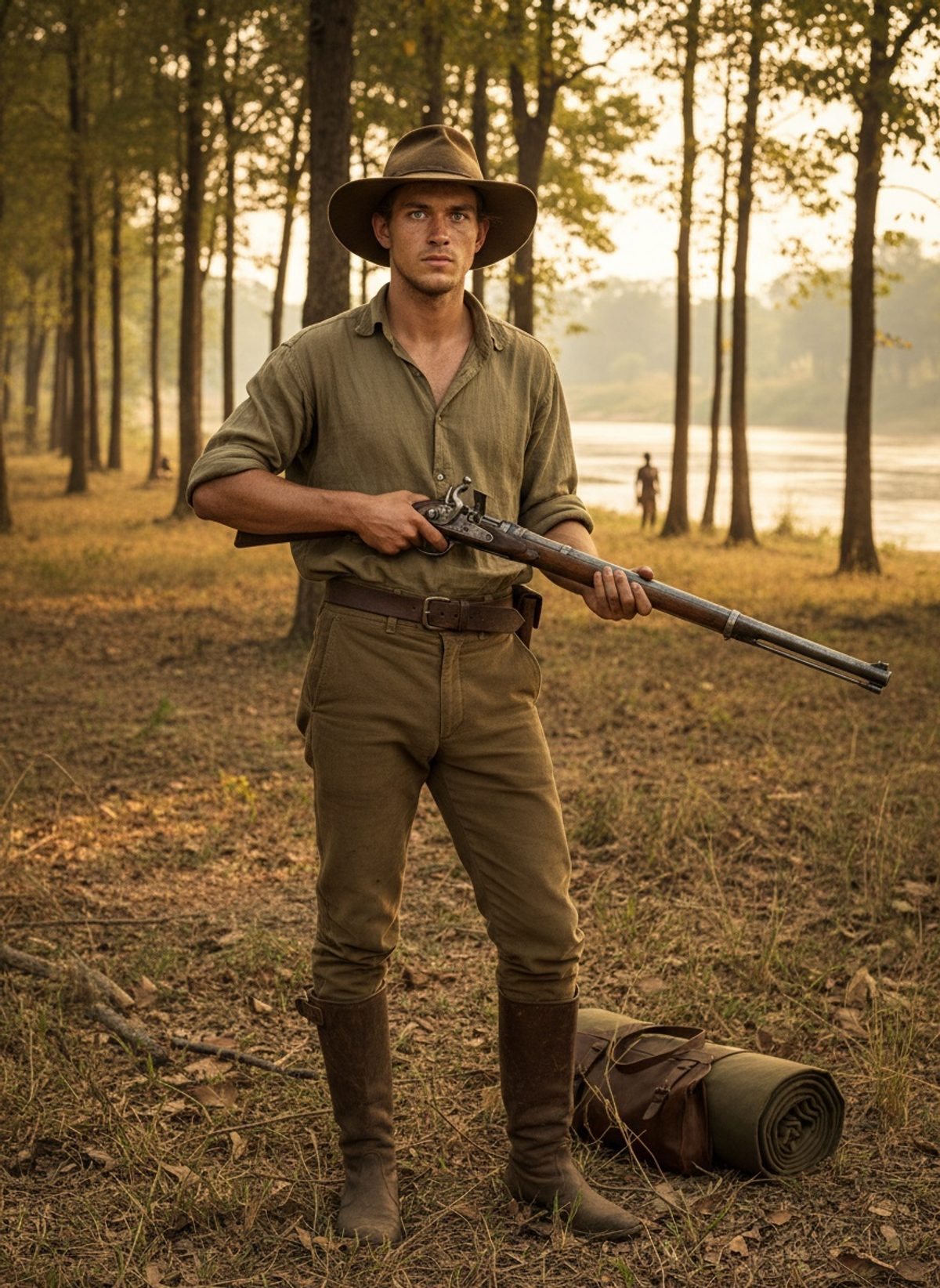
Frederick Selous was nineteen years old. Barely older than a boy, he stood on the edge of Africa armed with little more than boundless curiosity and an antiquated muzzle-loading rifle. In 1871, the young Englishman left the relative safety of the Cape Colony, embarking on a journey that would span continents, and forever alter the course of his life.
A Boy Amongst Giants
For most, setting off into the African wilderness without guides or reliable maps would seem an act of reckless abandon, especially for one barely out of adolescence. Yet Frederick Selous was not like most. Born into the comforts of Victorian England, he had inherited a hunger for adventure that surpassed the ordinary pursuits of his peers. Selous's daring aspirations placed him alongside the giants of exploration—figures like David Livingstone and Henry Morton Stanley—yet under circumstances most would not dare to face.
To venture into the heart of Africa in the late 19th century was to embrace the unknown, as both a source of intrigue and a cauldron of peril. The interior landscape he traversed was a vast, largely unmapped tapestry of savannahs, rivers, and forests—home to cultures unknown to the Western world, and wildlife that roamed free and perilous.
Equipped only with an outdated muzzle-loader and an indomitable will, Selous's entry point was north from the Cape Colony towards the mighty Zambezi. The ground beneath his feet was littered with the remnants of those who had tried and failed before him. Yet, to this youthful wanderer, the towering obstacles only fueled his determination.
Read next: When James Brooke Crushed the Pirates of Borneo, 1843
The Heartbeat of the Zambezi
The Zambezi River, thundering its path through the African landscape, would have cast an awe-inspiring shadow over the bravest of explorers. For Selous, it became a living entity, the very heartbeat of his expedition. Without maps worth their salt, he relied instead on instincts and the whispered advice of local tribes encountered along the way.
Each day by the river presented new challenges—hungry predators, diseases like malaria, and the cruel whims of the weather, all served to thin the ranks of those foolhardy enough to follow its course. Yet, it wasn't just the environment that tested Selous's mettle. His journey coincided with the tumultuous patchwork of cultures; he navigated the tense landscapes between tribes, sometimes welcomed and other times viewed with suspicion.
Yet, it was the Zambezi's rippling tapestry that granted Selous a platform to sharpen one of his greatest skills—tracking and trapping the myriad wildlife that inhabited the river's bounds. The experience gleaned during these early years would not only earn him the respect of indigenous groups, whose own survival skills were legendary, but eventually propel him into the annals of history as a legendary hunter and naturalist.
The Making of a Legend
Emerging from the ethereal mists of the African interior, Frederick Selous became a man both of myth and reality, a figure carved from the sinewy veins of the land itself. His success and survival owed as much to his burgeoning knowledge of the terrain as they did to his innate ability to adapt and connect with the indigenous peoples he met along the way.
By capturing not merely the animals he sought, but the vibrant narratives of the landscape, Selous began to piece together a intricate picture of a continent that was both ancient and vibrating with life. Over time, his treks took on a dual role—as occasions of discovery and, more significantly, preservation. His encounters and meticulous observations would later inform a wealth of studies, contributing a vital layer of understanding to Western knowledge of Africa’s ecology and cultures.
Despite countless close shaves with death, both from creatures and nature herself, Selous managed to survive and transcend the archaic weapons and simple provisions he had set out with. As his reputation grew, so did his arsenal—taking in the latest in firearms technology along with an explorer's essentials. Yet at his core, Selous remained the same irrepressible adventurer who had walked boldly into the unknown.
The Enduring Vista
The echoes of Frederick Selous’s steps continue to resound in the annals of exploration history. The path he charted opened up vistas that informed future explorations and shaped a legacy that would influence conservation efforts globally. Beyond the mythos that grew around his exploits, Selous’s journey was a testament to resilience and the human spirit, driven by an irresistible allure of the untamed.
Frederick Selous's narratives bear witness to a time when the world was an atlas of unknowns, when stories from afar sparked imaginations and stirred men to noble adventures. Today, as modern explorers navigate the complex relationships between conservation and human impact, Selous’s tale remains a poignant reminder of the intricate bond between humanity and the wild, one forged by curiosity, respect, and awareness—as relevant now as it was over a century ago.
For those who dare to venture beyond the edge of the map, Selous exemplifies the enduring dance with destiny, where courage wrestles with uncertainty, and every step awakens new possibilities. Even today, the spirit of Selous quietly whispers through the Zambezi’s currents, urging the explorers of tomorrow to embrace the unknown with wisdom earned from the past.