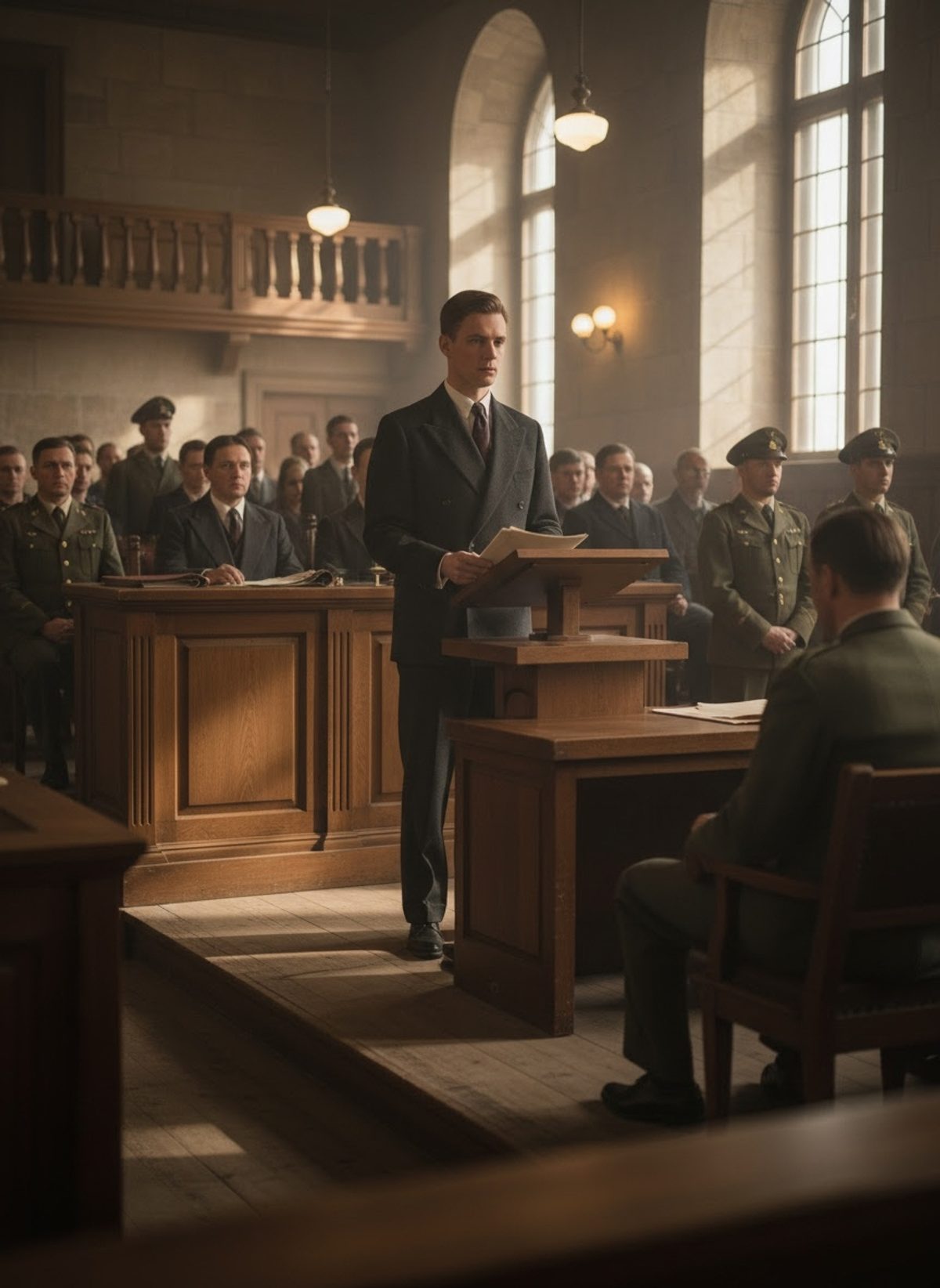
In the early winter of 1947, the chill of a Nuremberg morning crept through the hallowed halls of justice. As sunlight cautiously peered through the high windows, the air hung thick with anticipation. This was no ordinary tribunal. Seated in rows, before a somber procession of international judges, sat 22 of humanity's most ruthless agents of death. And standing before them, with an unyielding resolve, was a 27-year-old American lawyer named Ben Ferencz.
Beneath the grandeur of the courtroom, a profound silence waited to be shattered by revelations of the unfathomable atrocities committed during the Holocaust. Ferencz, a man with no prior trial experience, faced the immense task of holding these Nazi commanders accountable. His evidence was astonishingly self-incriminating: the impeccably detailed records kept by the accused themselves, chronicling over a million murders.
The Genesis of Justice
To understand how Ben Ferencz found himself at the epicenter of one of history's most significant trials, one must trace back to his humble beginnings. Born on March 11, 1920, in the Transylvanian town of Nagysomkút, Ferencz's family fled to the United States when he was just ten months old, escaping the increasing persecution of Jews after the region's annexation by Romania.
Settling in the tenements of Manhattan's Lower East Side, Ferencz's brilliant mind soon found its way to the prestigious halls of Harvard Law School, where he developed a keen interest in criminal law under the tutelage of esteemed scholars like Roscoe Pound and Sheldon Glueck.
Read next: Operation Homecoming: 591 Americans Flew Out of Hanoi in 1973
With World War II raging across Europe, Ferencz enlisted in the US Army, serving as a part of General Patton's Third Army. It was during this time that his fate took an unexpected turn. Assigned to a team investigating Nazi war crimes, Ferencz bore witness to the skeletal remnants of humanity that were discovered in the concentration camps liberated by Allied forces. These grim findings fueled his determination to seek justice for the countless innocents who had perished.
At the close of the war, Ferencz returned to New York but was quickly recruited by Telford Taylor, the chief counsel for war crimes in the subsequent Nuremberg Trials. It was then that Ferencz stumbled upon the Einsatzgruppen reports—meticulous documents that detailed the systematic extermination of Jews, Roma, and other "undesirables."
Seeing the immense value of these reports as prosecutorial evidence, Ferencz lobbied for a trial, even volunteering to serve as chief prosecutor, despite having never set foot in a courtroom as a lawyer. His impassioned plea convinced Taylor, and the groundwork for the Einsatzgruppen Trial was laid.
A Trial Unlike Any Other
As Ferencz stepped into the silent yet chaotic courtroom of Nuremberg, he was acutely aware of the magnitude of the task before him. Many of those in attendance had been directly affected by the horrors these defendants wrought. Undeterred by his inexperience, Ferencz relied on the irrefutable evidence that would lay bare the savagery of these atrocities. The Nazis' own penchant for precise record-keeping would be their undoing.
The trial began with Ferencz recounting the cold, systemic operations of the Einsatzgruppen, a mobile killing unit responsible for the deaths of over a million individuals. His calm yet commanding presence helped transform the clinical language of the reports into a vivid narrative of loss and despair, personalizing the statistics with harrowing accounts of entire communities decimated.
By relating the crimes in human terms, Ferencz compelled the court to view these acts not merely as war crimes but as a brazen violation of humanity itself.
The defendants, unflinching and unapologetic, clung to defense claims of obeying orders or denying direct involvement. Ferencz dismantled these defenses with surgical precision, often highlighting the conscious efforts of the accused to document their massacres as if tallying an inventory. The enormity of their crimes resonated in the courtroom, culminating in a historic verdict: all 22 leaders were convicted, with 13 sentenced to death—an outcome that underscored the triumph of justice over tyranny.
Read next: USS Intrepid Buried Its Dead on the Hangar Deck, November 1944
The Everlasting Echo of Justice
Beyond the confines of the courtroom, the ramifications of the Einsatzgruppen trial were profound. It sparked a discourse on the importance of international law and the need for a robust response to crimes against humanity. Ferencz emerged from the trial not only victorious but also transformed.
His experiences instilled in him a lifelong mission to champion the rule of law and advocate for the establishment of an International Criminal Court. His career, as an adjunct professor at Pace University, also allowed him to inspire new generations to uphold justice and human rights.
Ferencz's determination and courage in the face of overwhelming odds provide us with a profound lesson. At just 27 years old, equipped with only determination and the truth, he challenged the darkest chapters of human history.
He revealed that justice is not the victor's privilege, but a universal mandate. It is this enduring belief that today, more than three-quarters of a century later, compels us to continue striving for a world where justice prevails and the voices of those lost to history are never forgotten.