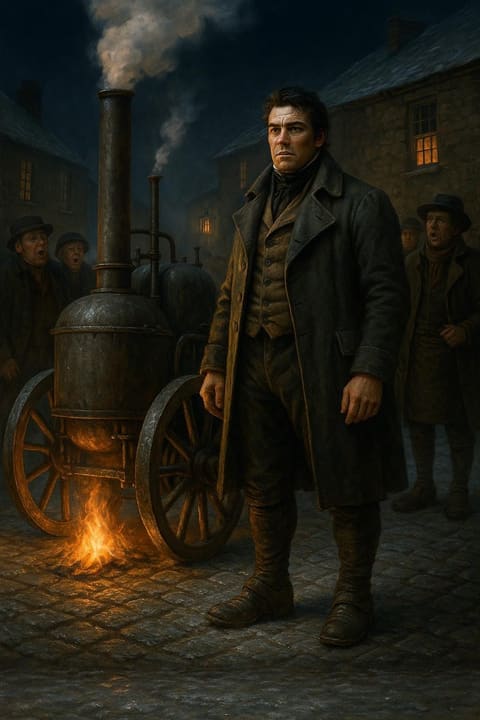
He was a mill owner at twenty. Visionary and shrewd, Robert Owen was unlike any other industrialist of his era.
The Silent Looms of New Lanark
In the crisp autumn of 1800, a strange quiet fell over the bustling New Lanark mills in Scotland. It was an eerie suspension of rhythmic clatter that signified the lifeblood of the Industrial Revolution. A cotton famine had seized England, leaving mill owners in despair. But for Robert Owen, the ceasing of his looms heralded a different kind of challenge. All around Britain, other mill owners, faced with the same predicament, ceased payments to their workers. Owen defied this standard practice, echoing with the audacity only the truly committed can muster, "Their wages are just as important as the thread they spin."
Imagine the sight: over 500 workers, men and women accustomed to the daily toil, now found themselves wandering amidst the silent machinery. They should have been anxious, worried about the days ahead. And yet, each week delivered them their full wages, as if the crisis had skipped New Lanark altogether.
A Philosophy in Action
Robert Owen believed deeply in the human cost of industrial upheaval. It was not merely an economic transaction but a moral one. In an era where workers were nothing more than cogs in the grand industrial machine, Owen envisioned something radically different. New Lanark was to be more than a mill; it was a community with expectations of fairness and the radical notion of respect for each individual's contribution.
Read next: The Day a Weaver's Son Lit Britain's First Public Railway
When the cotton famine strangled production, Owen saw an opportunity to hold fast to his principles. Cutting wages would have been easier. Profitable, even. But he saw the wages as an inviolable pact, not contingent on the operation of machines but on the dignity of human effort and survival. For four long months, the mills remained stoic and silent, but Owen's faith in the community never wavered. The word spread beyond New Lanark — a fabled saga, whispered in mill towns and worker houses throughout Britain.
The Impossible Sacrifice
How did he afford it? It was the question that puzzled Owen's contemporaries. To outside observers, his actions seemed a dire financial misstep. Yet, Owen's philosophy was deeply entwined with a shrewd understanding of business, one that saw beyond immediate gains. It was founded on the idea that happy, healthy workers were not just a moral goal but a profitable one in the long term.
Read next: The Day a Mill Owner Walked Into Court and Freed His Rivals' Children
Every penny spent on these idle wages was a testament to Owen's complex strategy, one that recognized the potential of what modern eyes might call social capital. He managed his mill as more than a money-making enterprise; it was a social experiment in a time where man's worth was regularly measured only in productivity. This mill, under Owen's administration, was forging not just textiles but new norms of industrial relations.
The Ripple in the Industrial Realm
Robert Owen's New Lanark became a benchmark of a different kind of industrialism — one where the welfare of workers was integral to the prosperity of enterprise. His actions challenged the perceptions of working conditions, subsequently inspiring modern labor movements and policy changes. What he did during the cotton famine did not just safeguard the livelihoods of his workers during those daunting months, but it also lit the spark of something greater.
The impacts of those choices resonated beyond the peril of the 1800 famine, echoing through the chambers of labor history as a daring stand for industrial humanity. It tells us much about the potential of leadership tuned to ethical imperatives rather than pressure from prevailing profit-metrics. In a world still grappling with maintaining corporate responsibility and human welfare, Owen's stand in that autumn of 1800 provides a haunting reminder that the right path is rarely the easy one but sometimes the necessary one. It's a legacy etched less in the fiber of textiles and more in the strength of human values.