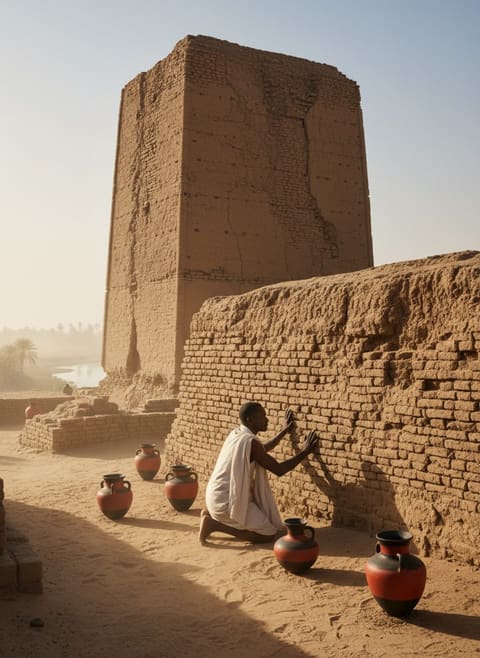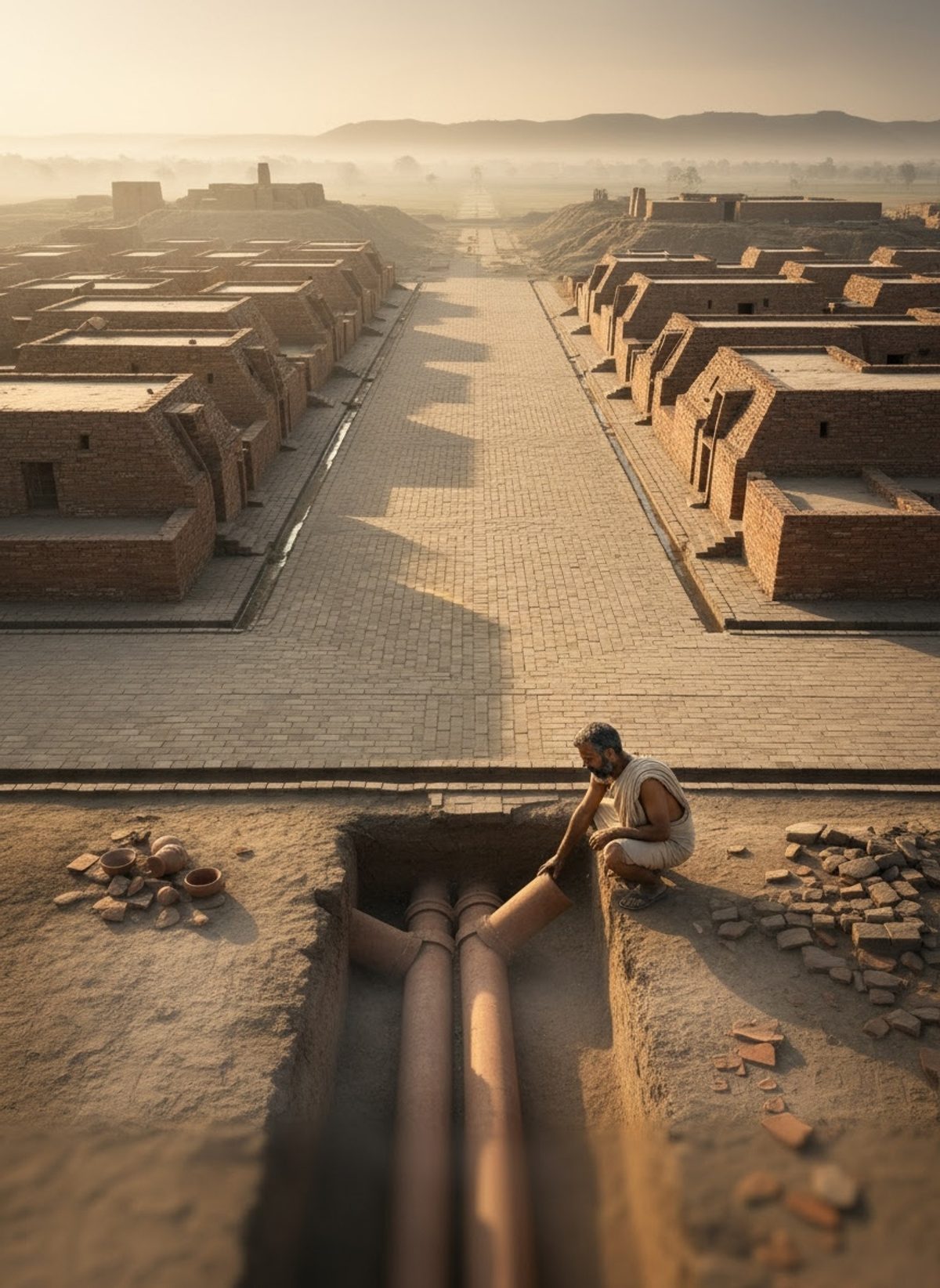
The clang of metal echoed through the narrow streets as a craftsman tidied his tools, packing them away for the day. Not far off, the rush of water carried the day’s debris through the brick-lined drains that snaked beneath the feet of the people of Mohenjo-daro.
This ancient city, set on the plains of the Indus, boasted amenities that wouldn’t be seen in the Western world for millennia. Here, in a city thriving around 2500 BCE, flush toilets, running water, and an intricate sewer system were not just engineering marvels but an expected part of daily life.
The Hidden Genius Beneath the Streets
Walking through the bustling streets of Mohenjo-daro, one might notice an odd absence of grandiose palaces or majestic tombs that typically marked other ancient cities. Instead, the true genius of Mohenjo-daro lay out of sight, beneath the street level, in the meticulously crafted sewage and drainage systems.
Each house, regardless of its size or the wealth of its inhabitants, was connected to a network of brick-lined drains that whisked waste away. This egalitarian approach to civic planning hinted at a society that prized practicality and health over ostentation.
Read next: Rapa Nui Carvers Walked 900 Statues Across the Island
The city planners of Mohenjo-daro were masterful in their understanding of hydraulics, evident not only in the extensive sewer system but also in the presence of public baths and individual household bathrooms equipped with their own flushing mechanisms. Unlike the clustered muddle of many ancient settlements, Mohenjo-daro was laid out in a grid pattern.
Its wide, straight streets hinted at centralized planning and advanced civil engineering, managing to channel stormwater away from residential areas. This kind of urban sophistication wouldn’t be rivaled until the Roman Empire, some 3,000 years later.
A Pioneering Past Forgotten
Mohenjo-daro, part of the broader Indus Valley Civilisation, was a bustling urban hub, contemporaneous with the civilisations of Egypt and Mesopotamia. While the region extended from modern-day Pakistan all the way to the tip of the Gujarat peninsula in India, Mohenjo-daro remained a jewel of urban development. Despite its vibrant existence around 2500 BCE, the city, along with its sister cities, fell into obscurity by roughly 1700 BCE, leaving behind little more than the echoes of its former glory.
Rediscovered in the 1920s by archaeologist R. D. Banerji, Mohenjo-daro’s ruins spoke of a mysterious and once-thriving civilisation that disappeared seemingly overnight. Excavations led by Kashinath Dikshit and later, John Marshall, revealed infrastructure that bewildered and impressed the modern world. How, in an age where most of humanity lived in primitive settlements, did these people achieve such advanced urban planning? It was a question that captivated generations of archaeologists and historians.
The Mystery of Mohenjo-daro's Vanishing
Despite the extraordinary engineering feats achieved by the inhabitants of Mohenjo-daro, the reasons for their decline remain shrouded in mystery. By 1700 BCE, this city and others like it were abandoned. Theories abound: climate change leading to the drying up of the Sarasvati River, shifts in the courses of the Indus River causing flooding, or even invasions by nomadic tribes.
Read next: Ashoka's Pillars: One Emperor Carved His Laws Into Stone
Yet, no definitive evidence has been uncovered to explain why one of the world’s earliest urban societies collapsed. No grand narratives of war have been unearthed, nor have any decayed remnants of tyrannical leaders come to light. Mohenjo-daro left behind few clues to its demise, presenting a tantalizing mystery that fuels academic debate to this day.
Legacy in Stone
Walking through the ruins of Mohenjo-daro today is a journey through a not-so-distant past where life was unexpectedly sophisticated and advanced. As a UNESCO World Heritage Site, it serves not only as a reminder of human ingenuity but of the fragility of civilisations. The city’s very name, "Mound of the Dead Men," evokes both the life that once thrived there and its abrupt, enigmatic silence.
In the broader scope of human history, Mohenjo-daro’s story is an evocative tale that breaks the linear narrative of technological evolution. It challenges us to rethink how we measure advancement, urging us to look beyond the grand edifices of the known empires to appreciate the quiet brilliance of its ancient engineers.
Mohenjo-daro stands not only as a testament to early human ingenuity but as a poignant reminder of the impermanence of human achievement, offering timeless lessons on sustainability and urban planning that resonate even today.