Most visitors to Palenque marvel at the grandeur of the Maya ruins. Yet beneath these ancient stones rests a king whose legacy is carved as deeply as the temple that covers his tomb.
The Ascension of a Maya King
By the time K'inich Janaab' Pakal ascended the throne in 615 AD, Palenque was a city eagerly seeking redemption. Just a few years earlier, it had suffered crippling defeats at the hands of Calakmul, a powerful neighboring city-state.
Emerging from this turmoil, young Pakal, only twelve years old, took on the mantle of ajaw, or ruler. Little did his subjects know, Pakal would reign for 68 years, transforming Palenque into a glorious city more rich in art and architecture than ever before.
Pakal was more than a symbol of hope for a battered city; he was a visionary architect. Under his rule, Palenque experienced a renaissance that left an indelible mark on Maya culture. He commissioned the most elaborate structures and infused them with elaborate carvings depicting the city's storied past. These efforts included his eventual resting place, the Temple of the Inscriptions.
Read next: Rapa Nui Carvers Walked 900 Statues Across the Island
This iconic pyramid is a masterpiece of Maya engineering. It houses one of the longest hieroglyphic inscriptions known, chronicling the history and lineage of the royal family. Yet, Pakal's foresight is truly reflected in the hidden, grand tomb that lay beneath.
Journey to the Underworld: Excavating the Temple of the Inscriptions
Centuries after Pakal's death in 683 AD, the jungle swallowed Palenque, hiding its secrets beneath thick layers of green. In the mid-20th century, the site began to reveal itself again. In 1949, Mexican archaeologist Alberto Ruz Lhuillier embarked on the journey of a lifetime. Although many before him hypothesized about a tomb beneath the Temple of the Inscriptions, none had yet unraveled its mysteries.
It took Ruz three painstaking years to unlock this ancient crypt. He discovered a hidden staircase descending into a labyrinthine chamber, each step taking him deeper into history. In 1952, Ruz finally reached the bottom. What he found was a sight that not only changed Palenque's narrative but also reshaped our understanding of the Maya world.
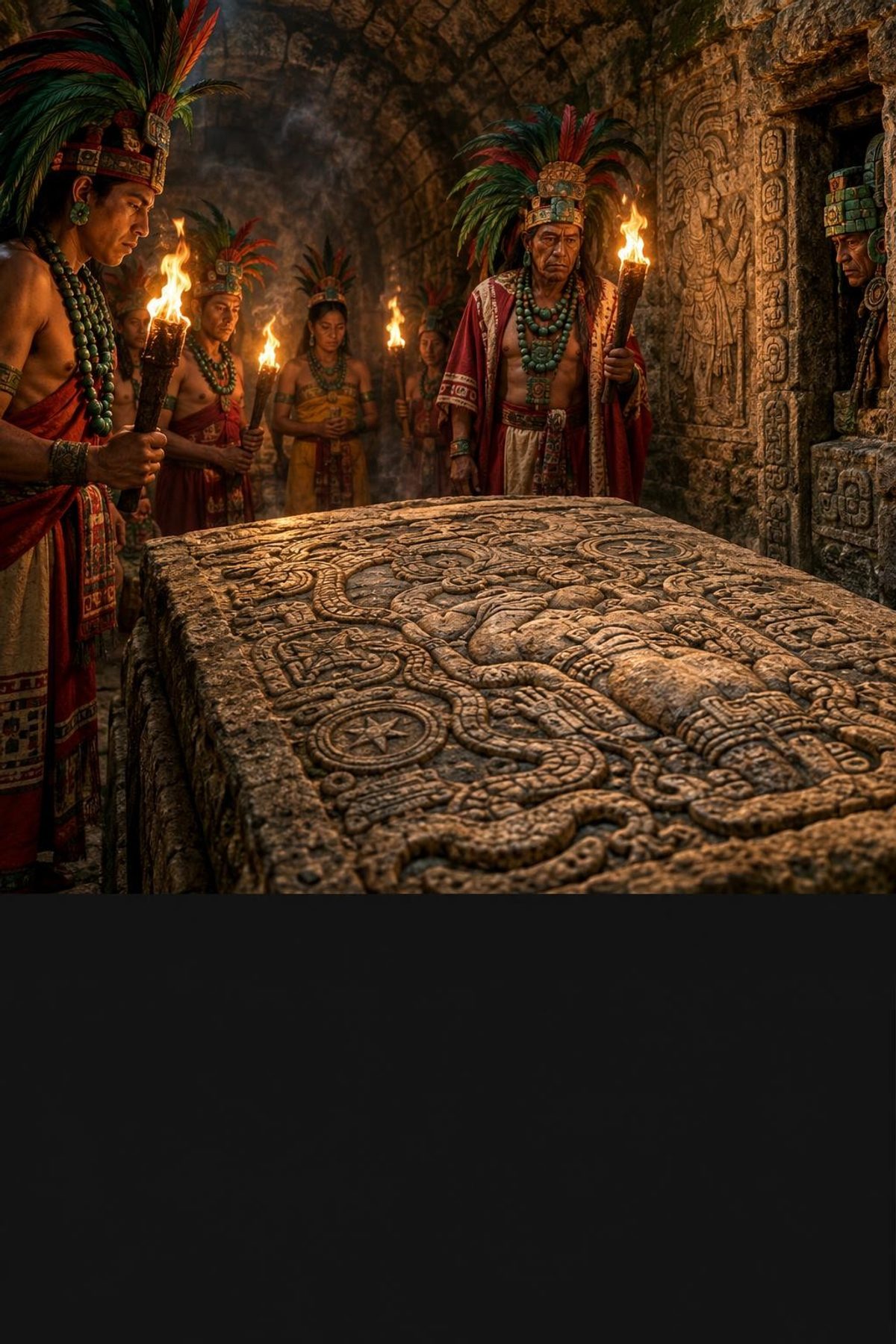
Ruz uncovered a majestic sarcophagus, its limestone lid adorned with vivid reliefs depicting Pakal's own cosmic journey. Weighing five tons, this lid sealed the king within a chamber subtly decorated with vibrant botanicals and celestial symbols—a resting place fit for a king who had journeyed to the afterlife.
Under the Lid: King Pakal's Eternal Journey
Pakal's sarcophagus tells a story that emerges from its detailed carvings—a testament to the Maya's rich mythological world. At its center lies Pakal himself, depicted as a youthful Maize God, a symbol of death and rebirth central to Maya mythology. He is cradled by the branches of the World Tree, the axis of the universe connecting the realms of the gods to the human world and the underworld beneath.
Above him, a celestial bird perches on the World Tree's branches, symbolizing the heavens and the king's divine essence. The carvings present Pakal's death not as an end but as a transition—a pathway extending to the cosmic realms.
This theme of transcendence wasn't limited to the tomb's visual impact. The Maya conceptualized their kings as intermediaries between the mortal and celestial realms, tasked with maintaining cosmic order. Pakal's tomb artistically encapsulated this belief, sealing his legacy not only in stone but in the annals of Maya celestial ideology.
The Rediscovery and Impact on Modern Archaeology
The uncovering of Pakal's tomb was a watershed moment in Maya archaeology. At the time, it was the most intact and richly adorned burial discovered in the Americas. Its significance lies not only in its opulence but also in its ability to reshape perceptions of Maya civilization's complexity and artistic prowess.
Read next: Ashoka's Pillars: One Emperor Carved His Laws Into Stone
While Pakal's burial offered unparalleled insights into Maya rituals, it also expanded the scope of understanding of their dynastic histories. The Temple of the Inscriptions provided a treasure trove of historical detail through its lengthy hieroglyphic panels regarding Pakal’s ancestors and his reign.
The discoveries at Palenque set a new standard for archaeological investigations, leading to further breakthroughs such as the reconstruction of Maya dynasties across the region. The work of luminaries like Linda Schele and Peter Mathews, along with others during what has been termed the "Maya Renaissance" in epigraphy, built upon Ruz’s initial findings. These discoveries continue to illuminate the sophistication of Maya historiography and cosmology.
The Continuing Mystery of Palenque
Even now, less than ten percent of Palenque has been explored. The jungle still conceals vast portions of this ancient city, a haunting reminder of what remains undiscovered. Like a book with unread chapters, Palenque beckons to archaeologists and adventurers alike, promising narratives yet untold.
Tales like Pakal's offer a window not only into the grandeur of a forgotten civilization but also into the universal human themes of legacy, aspiration, and the pursuit of immortality. As we piece together these ancient stories, we are reminded of the threads that connect past to present, deepening our understanding of ourselves and the world our ancestors shaped.
In the depths of an ancient tomb beneath the towering structure of the Temple of the Inscriptions, the echo of Palenque's past continues to resonate—waiting, listening, and shaping the future revelations of history itself.