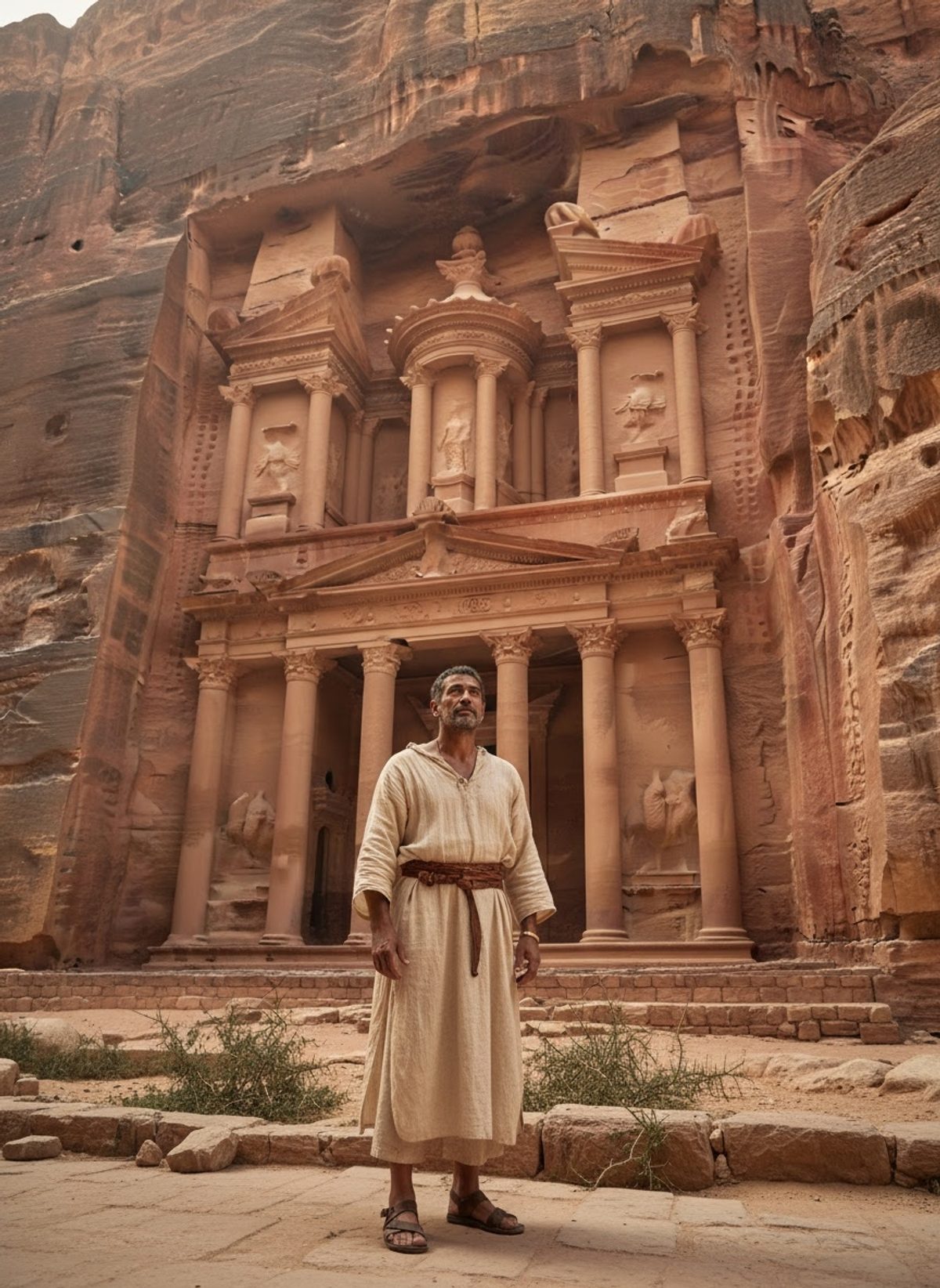
The chill of dawn lingered over the rocky expanse as a dim light crept into the canyon, unveiling the majestic visage of Al-Khazneh, its rose-red splendor quietly enveloped by the towering stone walls of Petra.
A man in worn desert garb paused by the mighty facade, dropping his wares on the sandstone pathway. The sandstone cliffs whispered the tales of an ancient people who had sculpted an entire city from the living rock, transforming their harsh desert habitat into a fortress of incredible beauty and strategic might.
The Carved Kingdom
Deep within the craggy landscapes of southern Jordan, the Nabataeans—a tribe of resourceful desert traders—began their settlement of Petra in the 4th century BC, carving their homes, temples, and tombs directly from the vibrant sandstone cliffs.
Unlike the builders of great cities who relied on assembling bricks and stones, the Nabataeans embarked on an architectural feat unique in design and execution. They honed the art of sculpting rock to create not only a city but an unassailable bastion, integrated seamlessly into its natural surroundings.
Read next: Palenque: The Maya King Buried Inside a Pyramid in 683 AD
The heart of Petra, known as Raqēmō in the Nabataean tongue, became the capital of their kingdom by the second century BC. Petra's prominence arose from its advantageous position along vital trade routes, which linked the Arabian interior with markets as far-reaching as Egypt, Greece, and Rome. This bustling socioeconomic hub facilitated an influx of luxury goods—silks from China, spices from India, and incense from Arabia—funneling them through Petra and enriching its people.
Water in a Parched Land
Ingenious water management was the lifeblood of Petra, enabling the Nabataeans to thrive in an arid environment where others might falter. They constructed an extensive network of channels, pipelines, and cisterns, capturing the scarce and seasonal rainfall and channeling it through hidden conduits carved into the cliffs.
This meticulous hydrological system not only sustained Petra’s agriculture—with fields of barley, dates, and olives—but ensured the city could withstand long sieges, as no external force could hope to starve this well-supplied desert oasis.
Among the engineering marvels were the numerous rock-cut reservoirs, some tucked away high in the mountains, preserving enough water to support the estimated population of 20,000 inhabitants during Petra’s apogee in the 1st century AD. These innovations were not merely practical but also deeply intertwined with the Nabataeans' spiritual worldview—a testament to their symbiotic relationship with the land they revered and sculpted into art.
The Enigma of Al-Khazneh
Dominating the entrance of Petra is Al-Khazneh, a breathtaking monument considered to have been constructed as the mausoleum of Nabataean King Aretas IV during the height of Petra’s prosperity in the 1st century AD. Its facade, a blend of Hellenistic and Near Eastern architectural styles, offers a glimpse into the cultural confluence that defined Nabataean society—an amalgam of traditions absorbed through their extensive trade connections.
The hauntingly precise carvings of Al-Khazneh, shrouded in myth and legend, speak volumes of the Nabataeans' artistic and technical prowess. Standing before it, one must wonder how the Nabataeans achieved such precision without the modern tools and technologies that seem indispensable today. Every inch of the facade tells tales of grandeur and mystery, none more so than that of its name, the "Treasury", which stems from a local legend of hidden wealth secreted away by ancient bandits.
Read next: Teotihuacan: A City of 125,000 Built Itself With No King
The Echoes of a Lost City
The saga of Petra took a somber turn following its annexation by the Romans in 106 AD, who rechristened it Arabia Petraea. Although it retained some of its commercial significance, the rise of maritime trade routes eventually supplanted overland trade, diminishing Petra’s strategic value. Additionally, the devastating earthquake of 363 AD shattered several of Petra’s architectural masterpieces, hastening its decline.
By the onset of the Islamic era, Petra had largely succumbed to obscurity, its presence whispered only through local Bedouins. It waited, shrouded in silence and desert winds, until Swiss explorer Johann Ludwig Burckhardt rediscovered it in 1812. Today, Petra emerges anew each dawn, refracting the sun’s light in brilliant hues, as tourists, scholars, and wanderers stand where once the Nabataeans wove their eternal legacy.
The triumph and tragedy of Petra is more than an archaeological wonder; it is a profound reminder of human ingenuity and adaptation. The stories carved in stone and the echoes of Nabataean dreams remind us of civilizations that flourished under the most daunting of conditions and the lessons their experiences impart on our own.
In Petra, we see not just a city of stone, but a testament to the enduring spirit of a people who coaxed life and grandeur from one of the most unforgiving landscapes on Earth.