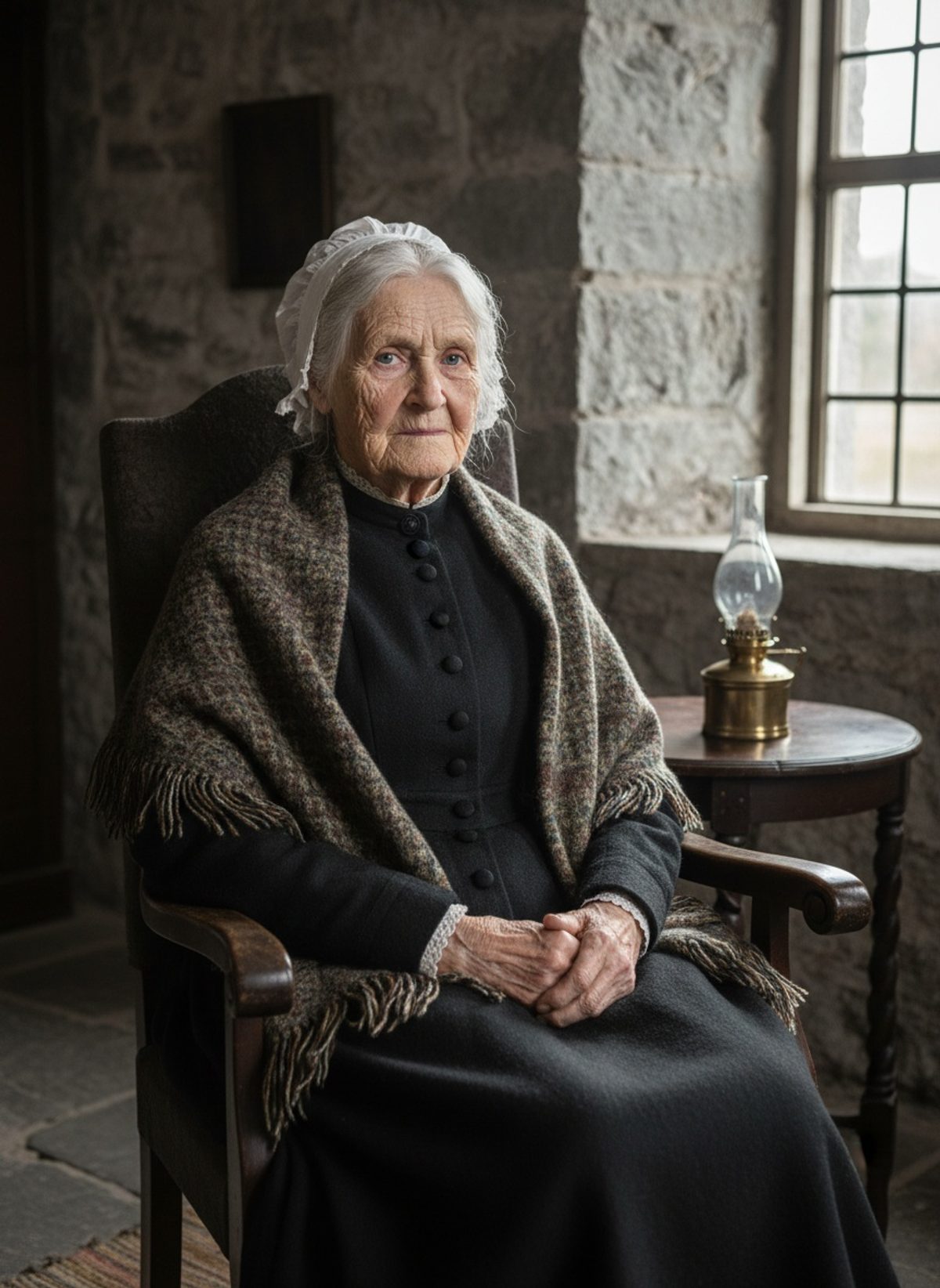
She was born when Napoleon had yet to command the European stage, a mistress of change before the word was even fully understood. Margaret Ann Neve lived until 1903, witnessing the advent of automobiles alongside the longevity of her memories. These 110 years contained the collapses and creations of entire worlds.
Margaret Ann Neve's story begins on the serene island of Guernsey on 18 May 1792, amidst an era rich with turmoil and transformation. Just a stone's throw away from the mainland, the waves around her home carried echoes of revolutions. Her father, John Harvey, carved out his existence commanding Guernsey’s militia, playing in the delicate orchestration of merchant shipping and privateering. Young Margaret—the eldest of eight siblings—would witness seismic international changes not from afar, but right at her doorstep. While the world grappled with the ripples of the French Revolution, she felt its earliest reverberations in the very fabric of her daily life.
Guernsey may have been her geographical anchor, but Margaret Ann's education propelled her outwards, to the bustling plains of bustling Bristol, where she cultivated a thirst for the written word. Her education was, by any means of the early 19th century, extraordinary. In Brussels, she absorbed languages like a sponge—French, Italian, German, Spanish—and dared to explore the Greek scriptures, a testament to her insatiable curiosity. This linguistic dexterity would soon come to define her as she navigated the circles of European enlightenment, her erudite engagement earning her the moniker "la spirituelle" from none other than Charles François Dumouriez, a towering figure of the French Revolutionary Wars.
In 1815, she trod upon the soil of Waterloo, not just as a witness, but as a testament to history's evolving theatre. The battlefield, still haunted by recent memories, lay quiet under the weight of its ghosts. With the wisdom of a time-traveling seer, she gathered pieces of the past, souvenirs that immortalized the contrasts of human ambition and folly. That journey with her headmistress marked the birth of a lifelong dedication to preserving the relics of past narratives.
Read next: Einstein Cooked His Egg in the Soup. On Purpose.
In practical matters, Margaret’s life was anchored by love. Her marriage to John Neve on 18 January 1823 was not merely a social contract but a union enriched by shared exploration. They found joy even in a honeymoon trip back to Waterloo, reliving the echoes of history together. Their life in England lasted for 25 years until John's death in 1849 prompted her return to Guernsey, a widow, but not alone.
As Britain expanded through the victorian era, dragging its global influence in its whirlwind, Margaret lived in "La Chaumière," a poetic shelter named for its thatched bonnet. Her sister Elizabeth became her companion in unrecorded voyages, their last international venture reaching up to Kraków, Poland—then under the firm clasp of Austria-Hungary—when Margaret was eighty, persistent in her quest for a world unfurling like a roadmap before her. She was unencumbered by age or expectation, her adventures timed with the railroads' rise and the decline of once mighty empires.
The late 19th century drew its final breaths with Margaret's life racing into its twilight chapters. By her 107th birthday in 1899, the boroughs of Saint Peter Port rang with accolades—a worthy celebration for a woman who traversed the vastness of modern inception. More than 250 officers, jurats, and community leaders thronged Rouge Huis to celebrate a life that had quietly paralleled expansive industrial and social metamorphoses. Her existence alone, tracing the arc from gas lamps to electric lighting, showcased a resilience bound within fragile human frames.
Read next: He Served the Khan's Court. He Freed a Thousand Slaves.
When technology leapt forward to encapsulate the power of steam and the innovation of Edison, Margaret remained. Perhaps it was the education that spurred her boundless agelessness or those countless hours under the weight of antiquarian tomes. Likely, it was a conviction in life's undying curiosity playing through every introduction and invention she witnessed.
Margaret Ann Neve's past was scribed on the unyielding brittleness of time; she foresaw moments of societal upheaval and catharsis the way others read a palm. When she dies in 1903, automobiles have firmly arrived, harbingers of 20th-century speed, and 45 American states marked a landscape she once might have only dreamed hearing about from trans-Atlantic whispers.
While Margaret never bore children, her legacy was sculpted by human endeavor. It might seem strange to connect an island-born woman who strode the worldly roads of Napoleon’s downfall to the automobiles driven in her last years, yet every story that slips quietly into the recesses of history often does so with unmatched significance. These epochs of her life, among the crescendos and decrescendos, echo a profound reminder: that it is sometimes those gentle lives, observing silently on the sidelines, that bear witness to history’s grandest narratives. Margaret Ann Neve, with her unassuming quietude, captured the intricacies of changing eras, reflecting in a gaze both the past's wisdom and the future’s relentlessly advancing horizon.