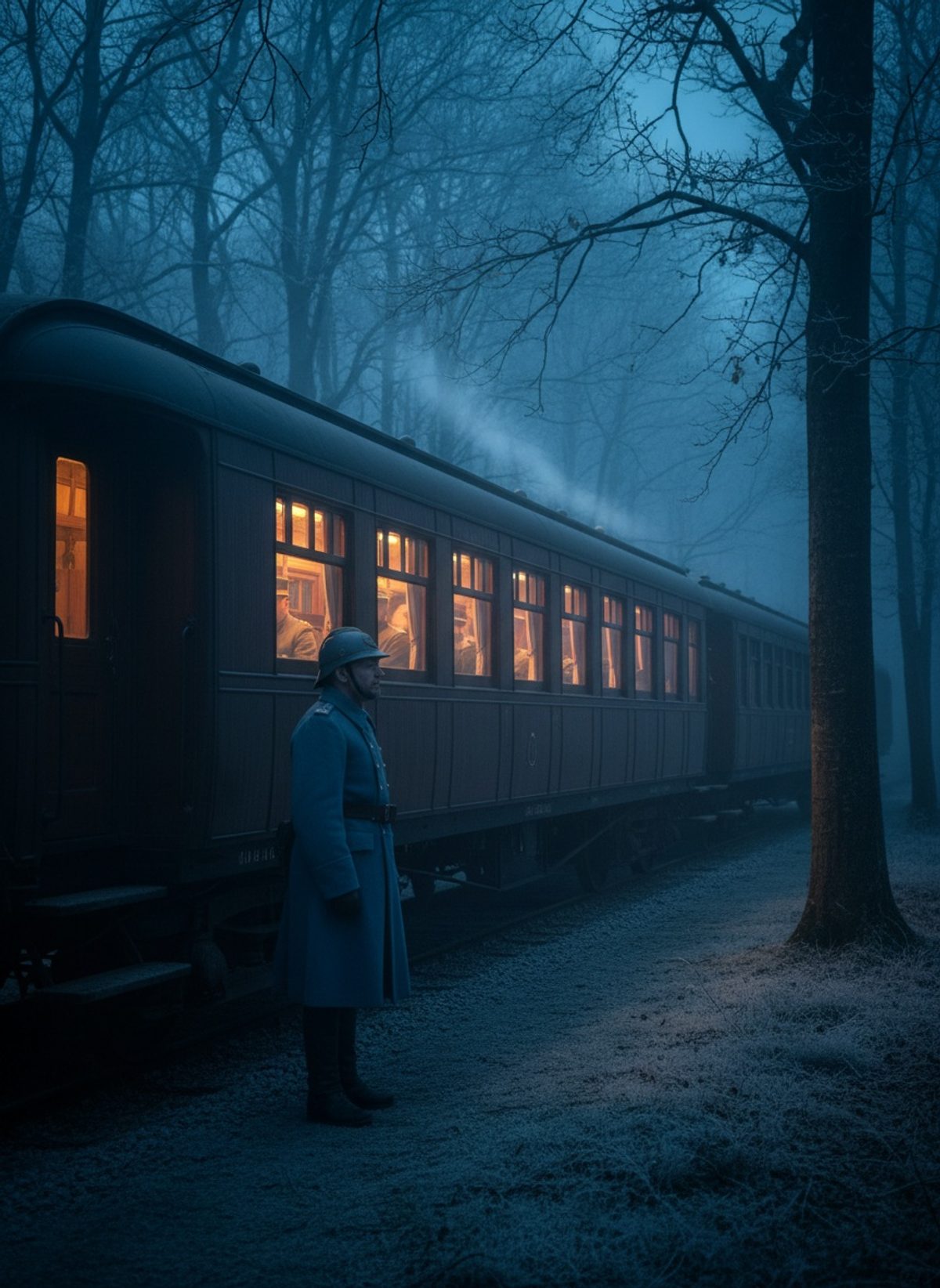
November 11, 1918. A cold mist clung to the Forest of Compiègne.
The Quiet Before the Ceasefire
Beneath the shadowy canopy of towering trees, a distinctive train carriage stood silently in a railway siding. This was not just any railway coach, but dining car No. 2419D, a piece of rolling stock that was about to play a pivotal role in history. Originally built in the spring of 1914 by the Compagnie Internationale des Wagons-Lits, the company famed for the luxurious Orient Express, it was yet another symbol of grand European travel quickly repurposed by the exigencies of war. By November 1918, it had transformed from opulence to the nerve center of military strategy, serving as the mobile headquarters for Marshal Ferdinand Foch, the Supreme Allied Commander. In this carriage, at the pre-dawn hour of 5 a.m., the silence was broken by the signing of a document that would end four brutal years of the First World War.
The terms were laid out meticulously, yet the emotional weight of the moment was palpable. The German delegation, led by Matthias Erzberger, entered the wagon with a heavy burden. Despite the chilly November air, there was a distinct warmth within the wagon, a stark contrast to the cold realities of the battlefield. For Erzberger and his fellow delegates, there was little choice. Millions had perished, economies were shattered, and empires teetered on the brink of collapse. With somber determination, they acquiesced to the Allied terms.
By 11 a.m., as agreed, the guns fell silent across the Western Front. The Great War, which had drawn in nations from every corner of the globe, finally reached its conclusion. But as soldiers emerged from their trenches blinking at the dawn of peace, the 2419D dining car remained a silent witness to the unfolding peace in the idyllic yet unassuming forest of Compiègne.
Read next: Betty Ong Radioed American Airlines for 23 Minutes From Flight 11
A Carriage of Historical Consequence
After the ink dried on the armistice agreement, the Compiègne Wagon transformed once more. The symbolic significance of the carriage was not lost on anyone, especially the French. In 1919, the venerable dining car briefly returned to its civilian role, feeding travelers, only to find a more permanent resting place in the Army Museum in Paris. There, it was prominently displayed in one of Europe's most storied military collections, a testament to the dramatic events it had played host to.
By 1927, the Compiègne Wagon had found a new home at the Glade of the Armistice, back where its place in history was forged. The timing was fitting, accompanied by a painstaking restoration that returned the carriage to its former glory. The serene Glade of the Armistice quickly became a pilgrimage site, not only a reminder of war and peace but an evocative space brimming with stories of ambition, strategy, and human cost. Visitors would stand in awe, peering through the glass at the very table where peace was brokered.
An Echo of Defeat
The Compiègne Wagon's story, however, did not end in the interlude between wars. In the summer of 1940, following the lightning invasion and subsequent defeat of France, Adolf Hitler orchestrated a scene steeped in orchestrated symbolism. The Führer, desiring a visual representation of Germany’s triumph over its long-time foe, ordered the same train carriage moved back to the forest of Compiègne. Once again, it stood in the familiar clearing.
Here, on June 22, 1940, France was forced to sign another armistice, but this time the roles were reversed. Hitler's intention was clear—to reverse the humiliation Germany felt in 1918 and to do so on the identical stage. As the German leaders reveled in their victory, the forest bore witness to the bitter symmetry, turning the carriage into a lasting emblem of Europe’s turbulent inter-war history.
Read next: Reckless: The Mare Who Hauled 9,000 Pounds Under Fire at Outpost Vegas
The Germans then transported the carriage to Germany as a trophy of war. Like many war spoils, its fate was sealed amid the chaos of World War II’s final days. It was reportedly destroyed by the SS in 1945, its demise overshadowed by the colossal collapse of the Nazi regime. Although its physical form was lost, the symbolic import of Dining Car 2419D lingered in collective memory.
A New Chapter at The Glade of Armistice
The conclusion of World War II brought new challenges in remembrance and memory, particularly for a Europe grappling with both recovery and atonement. In 1950, the original Compiègne Wagon was replaced in the peaceful glade by an identical carriage donated by the Compagnie Internationale des Wagons-Lits. Meticulously restored, this new carriage now stands where the original once did, allowing generations that followed to engage with the site's historical weight.
As we revisit the story of the Compiègne Wagon, we find ourselves pulled into the narratives of the past, the diverse emotions tied to a simple rail car that hosted milestone moments of European history. Where men once sat negotiating terms of either capitulation or ceasefire, we now see echoes of unity and discord, of power and its fallibility. The famous dining car today remains on display at the Glade of Armistice museum, a solemn fixture amid ferns and old wood, asking us to ponder who we have been and who we might become.
Through the wagon's preserved existence, history invites us to look beneath the veneer of a dining car’s polished wood to reflect on the symbolic interplay between peace and power—a reflection essential to understanding the complex legacies of the wars they never taught you about in schoolrooms.