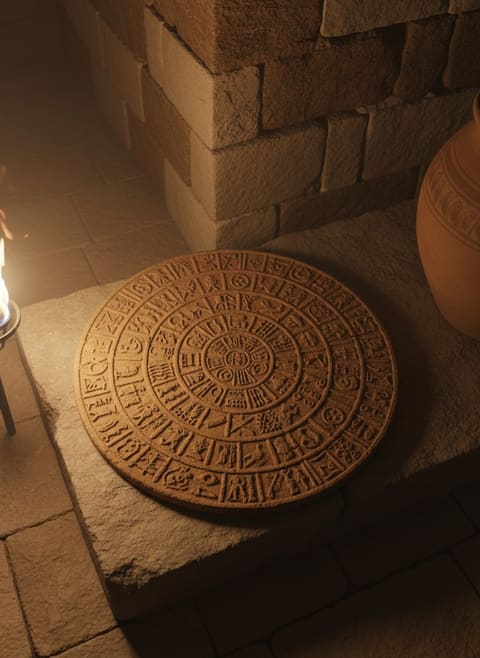
It was just a jumble of encrusted bronze, misshapen and indistinct. But hidden beneath that corroded exterior lay a sophisticated mechanism centuries ahead of its time. The Antikythera Mechanism, discovered off the coast of a Greek island, remains a marvel of ancient engineering that challenges what we thought we knew about the capabilities of ancient civilizations.
The Shipwreck That Changed History
In the spring of 1900, Captain Dimitrios Kontos and his band of sponge divers from the island of Symi made an unexpected discovery. During a precarious underwater expedition near the island of Antikythera, they stumbled upon the remnants of a Roman cargo ship, resting on the seabed 45 meters below the surface. Among the treasures recovered—bronze and marble statues, delicate glassware, and intricate jewelry—the divers dredged up an unassuming chunk of corroded metal. Little did they know, this fragment would rewrite the narrative of technological innovation in the ancient world.
The ancient wreck eventually proved to date back to around 70–60 BCE, but the corroded bronze lump, which at first may have seemed trivial among the other artifacts, held the key to insights buried deeper in history than anyone could have imagined. The tale of the Antikythera Mechanism begins thousands of years ago, crafted by a hand now lost to time, yet whose precision and ingenuity defy our conventional understanding of ancient Greek technology.
The Enigma Begins to Unravel
The odd mechanical object retrieved from the depths remained largely ignored until a year later, in 1902, when Greek politician Spyridon Stais noticed a gear embedded within the metal during his visit to the National Archaeological Museum in Athens. His observation sparked the curiosity of his cousin Valerios Stais, the museum's director, who initiated the first systematic study of the fragments. What they revealed seemed profoundly out of place in the narrative of history: a device constructed with intricately interlocking gears designed to predict astronomical phenomena and track time in ways unseen again until a millennium later.
Read next: The Sanxingdui Masks: Bronze Faces From a Civilisation With No Name
The mechanism’s shattered form was pieced together fragment by fragment, each discovery deepening the mystery. Of the 82 separate fragments conserved, four contained evident gear trains. One gear, a massive 13 cm in diameter, tooth by tooth told a story of scientific genius. But who crafted such an object and how deeply did their understanding of the cosmos go? These questions loomed unanswered for decades as speculation and wonder intermingled in scholarly circles.
Revealing the Secrets of the Stars
It wasn't until 2005 that a team led by Mike Edmunds from Cardiff University began utilizing modern technology—computer X-ray tomography and high-resolution scanning—to delve into the statue-encasing layers of the Antikythera Mechanism. What they extrapolated from the faint inscriptions and unseen components within was astonishing. The device was not merely a calendar or timepiece. It functioned as an astronomical computer capable of predicting eclipses, following the intricate pathways of the Moon, and even accounting for its variable speed—a feat based upon the work of Hipparchus of Rhodes.
As more inscriptions were deciphered over the years, revealing calculations tied to the synodic cycles of Venus and Saturn, the mechanism emerged as a comprehensive model of the heavens as seen from Earth. It had the capability, many believe, to project the positions of the five known classical planets—an understanding intimately linked with the work of Greek scholars of the time. Impressive in itself, it challenges the notion that such understanding and techniques were lost until the mechanical clocks and computers of medieval Europe.
Read next: The Voynich Manuscript: 600 Years and No One Can Read It
Beyond the Realm of the Ordinary
The machine, housed in a modest 34 cm × 18 cm × 9 cm wooden-framed case, speaks volumes of the Hellenistic world's ambition and astronomic curiosity. How this knowledge was applied remains speculative—could it have been an instructional tool, a valuable aid to navigation, or even a demonstration of the Ancient Greeks’ grand exploration into celestial realms? While some experts propose the initial calibration of the mechanism could date to as early as 204 BC, its exact creation remains the subject of academic debate.
The skill entrenched in this analog computer implies a community of scholars whose work reached the apex of intellectual inquiry long before the famed icons of the Renaissance began their quest for understanding. With each tooth of its delicate gears and every inscription in its weathered bronze, the Antikythera Mechanism not only demonstrates a mastery over mechanics but reveals a society deeply engaged in universal exploration.
A Testament to the Enduring Human Spirit
As you stand before the fragmented remnants of the Antikythera Mechanism today, housed safely within the National Archaeological Museum of Athens, consider what it represents beyond its mechanical splendor. This device invites us to revise our perceptions of history, to recognize the lost achievements of ancient civilizations, and to acknowledge that human ingenuity and the pursuit of knowledge are as old as humanity itself. The Antikythera Mechanism asserts that history holds more mysteries than we may ever know, each discovery inviting us to bridge the past with the ever-evolving quest for understanding that defines the human experience.