July 18, 1986. The bronze glinted in the early morning sun, casting long shadows across the dusty Sichuan soil. Construction workers outside Chengdu, intent on breaking the ground for a new project, stumbled upon something that would irrevocably alter the understanding of ancient Chinese history. When they unearthed two pits brimming with giant masks and a multitude of otherworldly artifacts, little did they know they had uncovered the remnants of a civilization that defied easy classification, one that had gone unrecorded by history.
The Sanxingdui site, nestled near the city of Guanghan in Sichuan Province, soon bustled with archaeologists eager to investigate the enigmatic setup. Radiocarbon dating indicated the artifacts hailed from the 12th to 11th centuries BCE, placing them squarely within China's Bronze Age. Yet these objects did not bear any hallmarks of the contemporaneous Shang dynasty, well-documented in ancient texts. Instead, the bronze faces with their protruding eyes and elongated ears held a different story within their silent forms, telling tales of a civilization with distinct traditions and unrivaled artistic ambition.
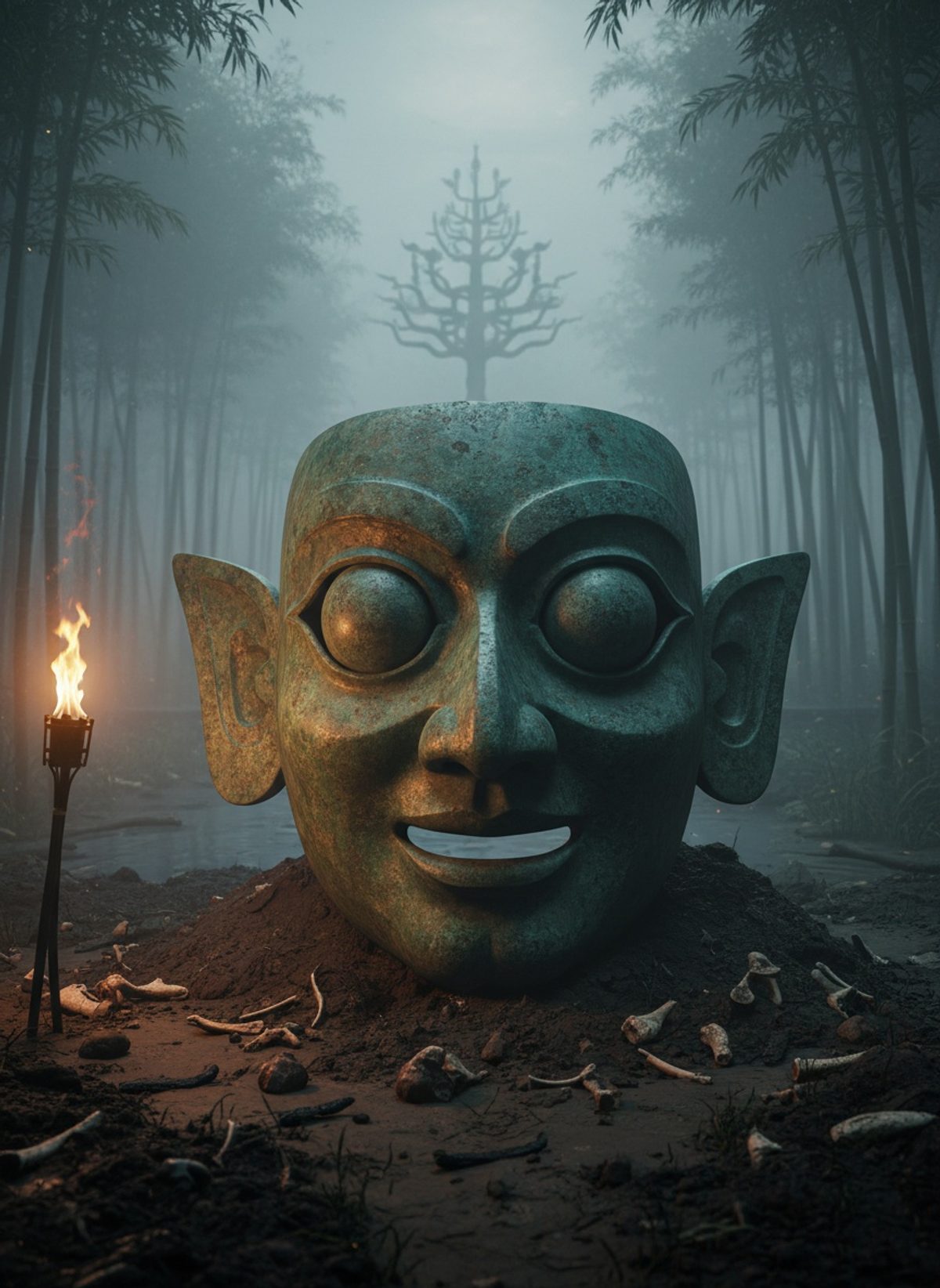
The Sanxingdui archaeological site yielded over 10,000 artifacts, each object a testament to the skill and creativity of its makers. But none were quite as arresting as the masks with enormous, protruding eyes that seemed to stare across millennia with an otherworldly gaze. These were no ordinary masks; they ranged from human-sized to larger-than-life and bore the visage of what could be gods or spirits in ceremonial attire. The purpose of these masks remains a subject of debate. Some scholars posit they could represent deities or ceremonial figures, potentially reflecting the society's spiritual beliefs or theater traditions.
The land where these objects were found betrays little of the grandeur hidden beneath; yet, it once embraced the archaeological remnants of a walled city. Referred to on the banks of the Yazi River, the city was surrounded by impressive fortifications encompassing over 3.6 square kilometers (1.4 square miles). The walls, along with a network of canals for irrigation, navigation, and defense, reveal a sophisticated urban planning unmatched by many contemporaneous civilizations. Its impressive infrastructure might have supported what some theorize was a thriving cultural hub.
Read next: The Nazca Mummy With the Elongated Skull No One Can Explain
Excavated in layers beneath centuries-old sediment, the Sanxingdui artifacts also included altars and life-sized bronze sculptures, some featuring elegantly designed trees that reached human height. There were also figures cast in bronze with elongated limbs—likely used in worship or ritualistic practices. These monumental objects defy easy categorization, a profound indicator of the skill and resources that Sanxingdui commanded.
Despite its magnificence, there is scant mention of Sanxingdui in ancient Chinese texts. Archaeologists have associated this site with the ancient kingdom of Shu—though its capital later moved from Sanxingdui to Jinsha, approximately 40 kilometers away. The Chronicles of Huayang, a set of regional historical texts compiled during the Jin Dynasty, recount tales of Shu's legendary rulers, including one named Cancong. Intriguingly, Cancong was described as having protruding eyes, sparking curiosity among scholars who wonder if the masks depict this early ruler or if they serve a more symbolic role related to the kingdom's mythology or cosmology.
The lack of written records or inscriptions challenges historians to piece together the puzzle of Sanxingdui's governance structures or societal norms. The precious materials and artisanal proficiency evident in the crafted works imply a highly organized civilization, yet without written language or records, the social structure and daily lives of these people remain speculative.
Beyond the realms of archaeology, the Sanxingdui site invites unique interdisciplinary perspectives. For instance, some anthropologists speculate that the culture exhibited possible trade or cultural exchanges with neighboring regions, highlighted by the presence of seashells and jade found within the pits, which were not locally available. This presents a tantalizing narrative of a civilization engaged in broader, dynamic interactions with the ancient world long before the concept of the Silk Road came into existence.
Read next: The Tomb of Antinous: The Grave No One Has Ever Found
The mystery of why Sanxingdui seemingly vanished as abruptly as it emerged gives rise to further intrigue. Some researchers hypothesize that seismic activity could have caused catastrophic flooding that eventually displaced the civilization or forced a relocation to the nearby Jinsha site. Yet, these are just theories, leaving room for continued debate and exploration.
To this day, the artifacts from Sanxingdui—now housed in the Sanxingdui Museum—stand as beacons of a world almost lost to history, thrust into prominence in a serendipitous moment. Their existence challenges not only the historical narrative dominantly attributed to the Shang dynasty during the Bronze Age but also prompts questions about the multifaceted nature of human civilizations, the stories of which are only partially told through what remains unearthed.
Here lies the enduring power of the Sanxingdui story: these alluring and mysterious figures articulate a hidden chapter of human creativity and spirituality. The masks, statues, and relics from Sanxingdui whisper of a culture's vivid imagination and profound artistry, stretching our understanding of ancient China beyond the well-traveled paths of written history. In their silent, enduring presence, they remind us of the elusiveness of history and the enduring impact of human ingenuity across centuries.