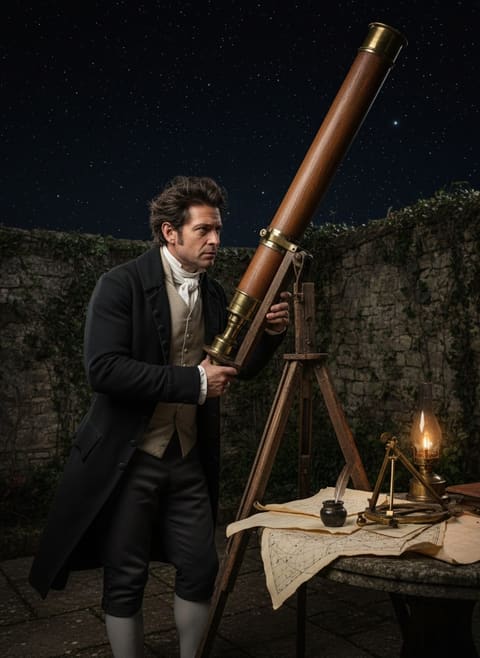
The morning mist clung to the rolling hills of Somerset like a soft, grey shawl, the air thick with the damp chill of an English autumn. Along the banks of the newly constructed canal, the clinking of metal against stone broke the quiet serenity as workers began the day’s labor of sculpting earth and rock. Somewhere amidst the bustle, a man paused to wipe his brow, his gaze lingering over the exposed strata of soil and rock. There, etched into the layers of the earth, were the secrets of time itself – and William Smith, a man with neither university education nor scholarly acclaim, was on the brink of revealing them to the world.
Roots in the Earth
Born the son of a potter in the rural village of Churchill, Somerset, William Smith was a man bound to the soil from the start. His early years were spent in the fields and hills of the English countryside, where the rhythms of nature and the land carved themselves into his consciousness. While others saw just stones and clay, Smith saw stories. Each rock, each fossil, whispered of ancient seas and bygone eras, hidden chronologies waiting to be uncovered and shared.
In 1799, as a canal surveyor, Smith’s work took him alongside England’s burgeoning network of waterways – arteries of commerce that sliced through the terrains of Somerset and beyond. It was here, amidst the mud and toil, that he began to notice a recurring pattern. Fossils, distinctive in form and impeccable in their placement, appeared predictably within the sedimentary layers. These fossils were more than mere curiosities; they were markers, signposts written in stone that suggested a universal order beneath the chaotic surfaces of the earth.
The Geologic Puzzle
Fascinated by these findings, Smith’s keen observations led him to formulate a revolutionary concept: strata, layers of sedimentary rock, could be identified and correlated by the fossils they contained. These fossils, he believed, were not randomly scattered throughout the rocks but appeared in the same order wherever they were found. This stratigraphic principle hinted at a groundbreaking concept of geologic time – that the earth’s history could be read back through its layers like the pages of an ancient tome.
Read next: The Day a Joiner's Son Gave the World a New Kind of Light
Smith dedicated himself to mapping these layers, creating a comprehensive visual guide that would decode the language of the rocks. His journey took him across Britain, traversing hills, moors, and valleys, enduring the challenges of weather and terrain, all while meticulously charting the regions he explored. With stick in hand and a leather satchel filled with specimens, Smith was both explorer and artist, capturing the earth's story with the precision of a surveyor's eye and the imagination of a poet’s soul.
An Extraordinary Map
By 1815, after years of painstaking labor, Smith unveiled what would become his magnum opus: the first geological map of an entire nation. It was a colossal undertaking, a document that laid bare the sublime complexity of Britain’s subsurface tapestries. Hunks of limestone, coal seams, and clay beds unfolded in vivid colors across a sprawling canvas, each hue signifying a distinct geological formation. This was not merely a map; it was a symphony of stone and fossil, an atlas to the past that offered scientists and scholars a radical new way to explore the very foundation of their island home.
Read next: The Day a Blacksmith's Son Mapped the Blood Inside Us
The significance of Smith’s work reached far beyond Britain's borders. By demonstrating that the earth’s strata could be scientifically categorized and understood, he provided the crucial underpinnings for the nascent science of geology. The very way humanity engaged with the planet began to shift. Rocks were no longer passive elements but active narrators in the epic saga of earth’s evolution. Institutions that once turned a blind eye to the unlettered surveyor now found themselves compelled to acknowledge the profound importance of his work.
A Legacy Layered in Time
Though initially uncredited and uncelebrated during the latter part of his life, Smith’s contribution to geology eventually received the recognition it deserved. His geological map, once a groundbreaking curiosity, evolved into a cornerstone for scientific inquiry into the history of the earth. Today, we understand the depths of time not just through abstract numbers and concepts but through the tangible layers and patterns that William Smith first invited us to read.
His story stands as a testament to the power of passion and perseverance, a reminder that great insights often emerge from the unlikeliest of places. As our modern world uncovers new mysteries buried deep within the earth, the lesson of the canal surveyor from Somerset remains ever relevant: sometimes, to unlock the secrets of the future, we need only rediscover the past written in the rocks beneath our feet.