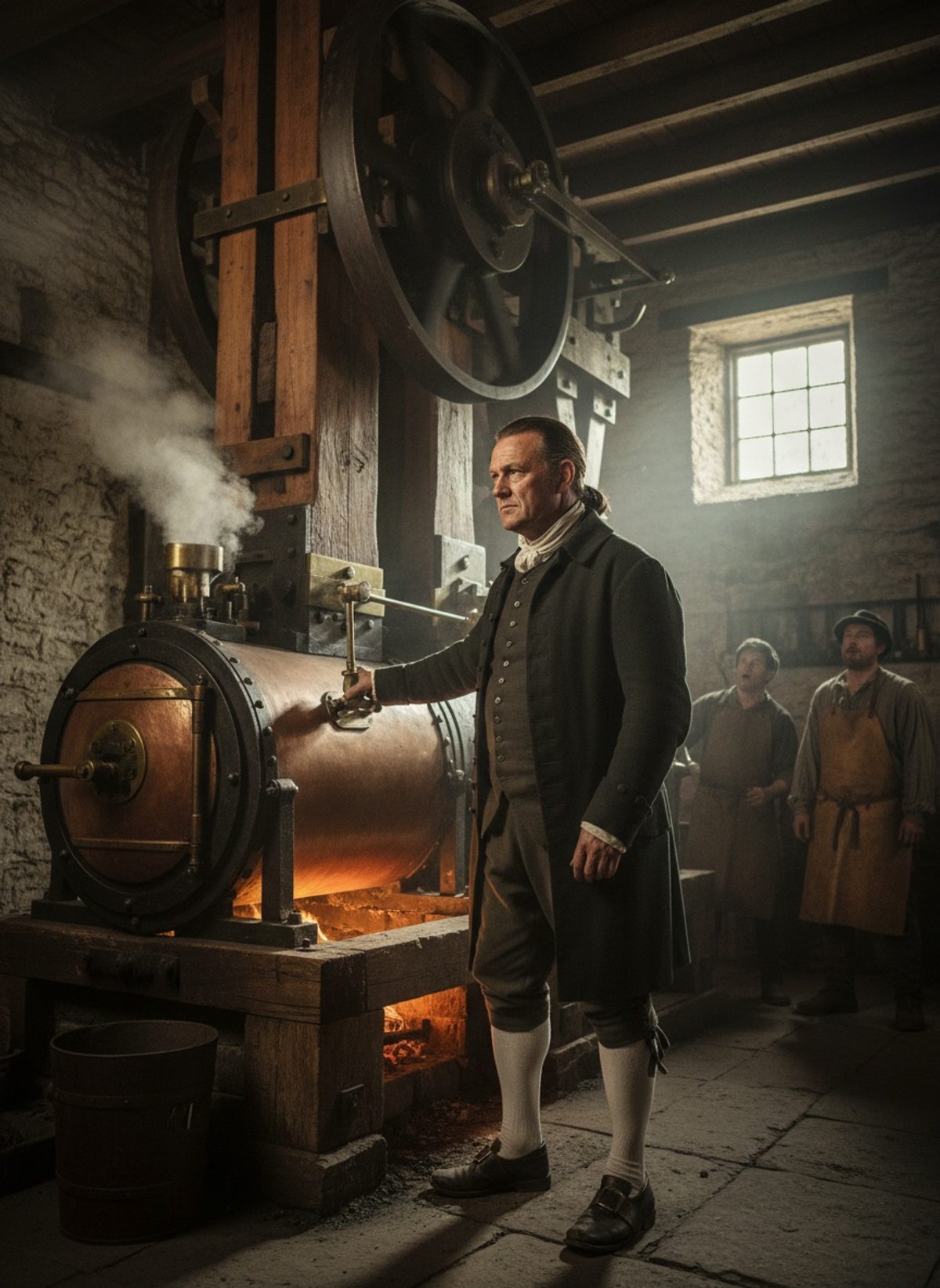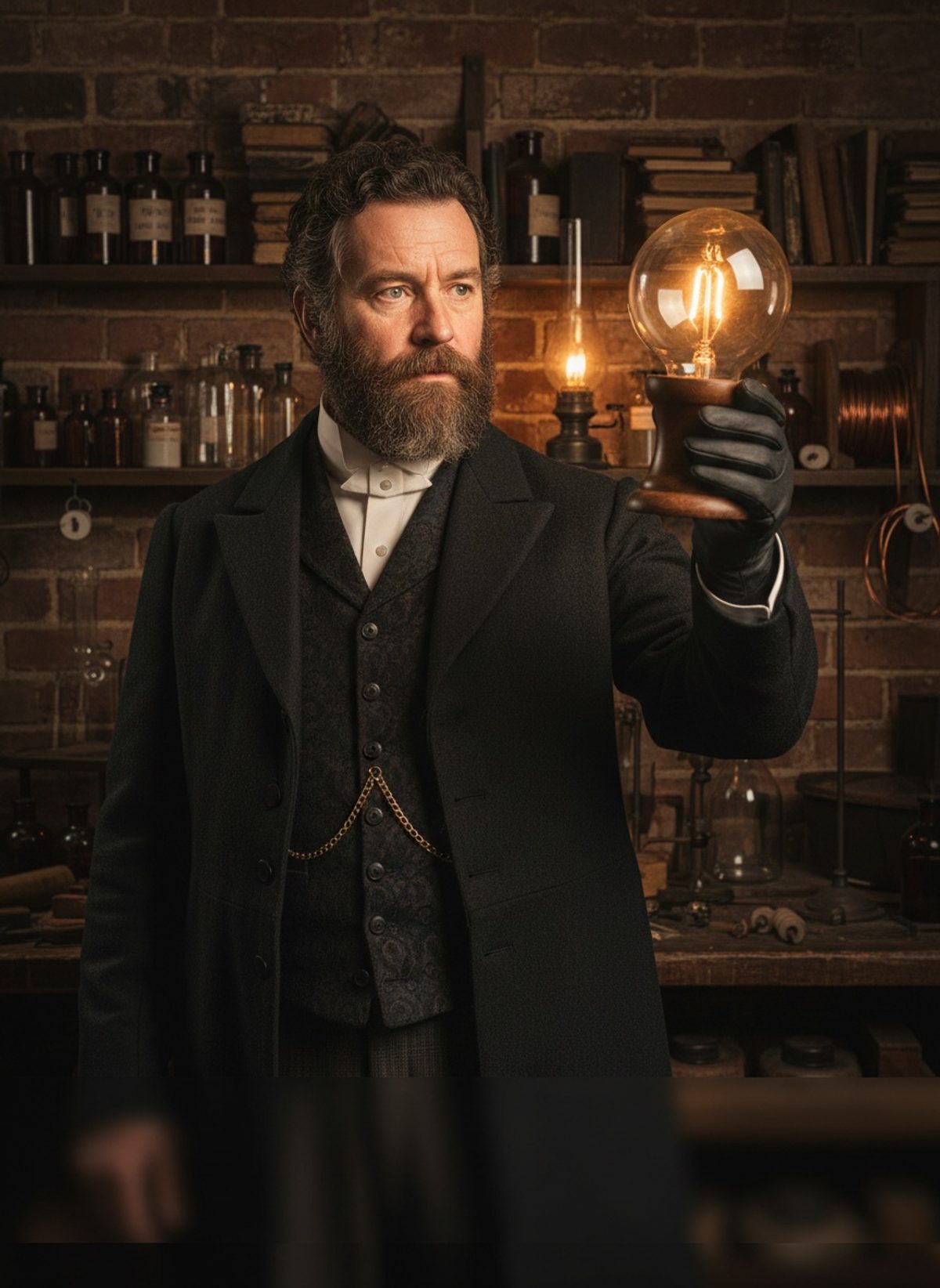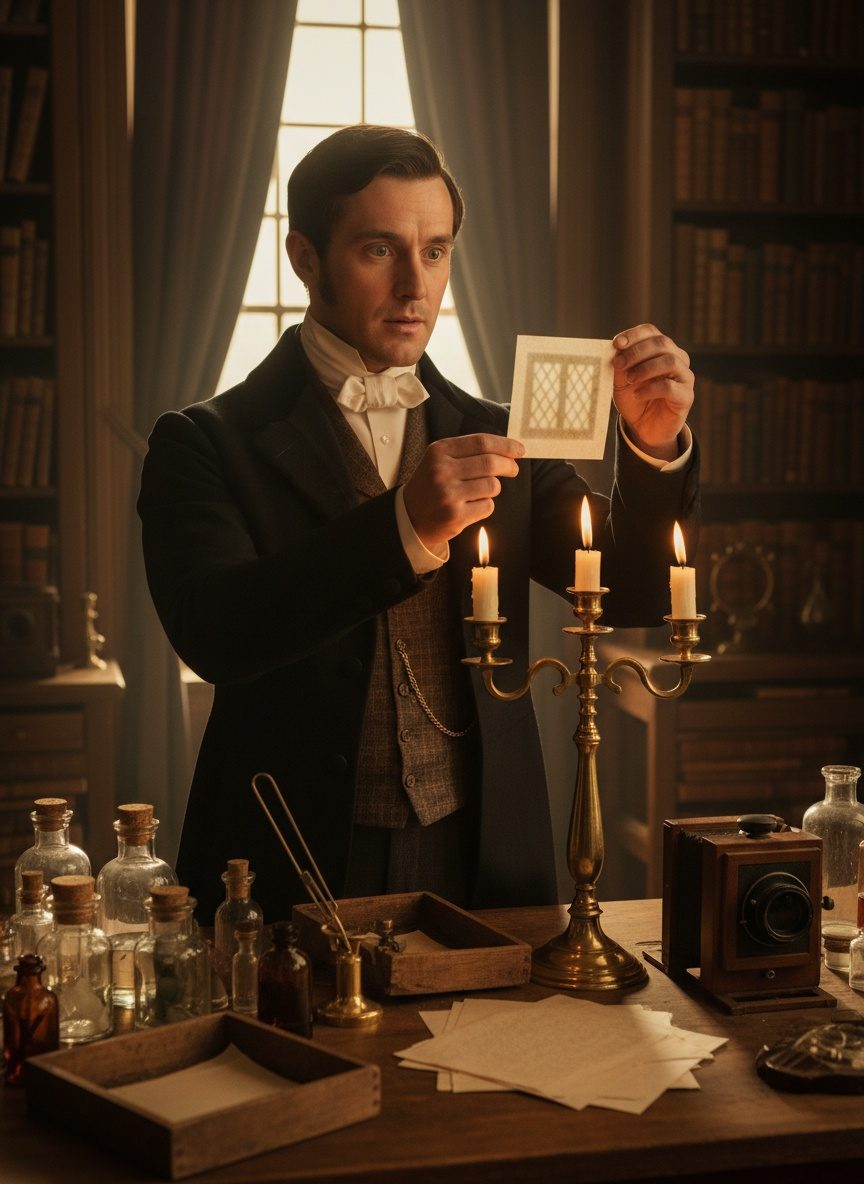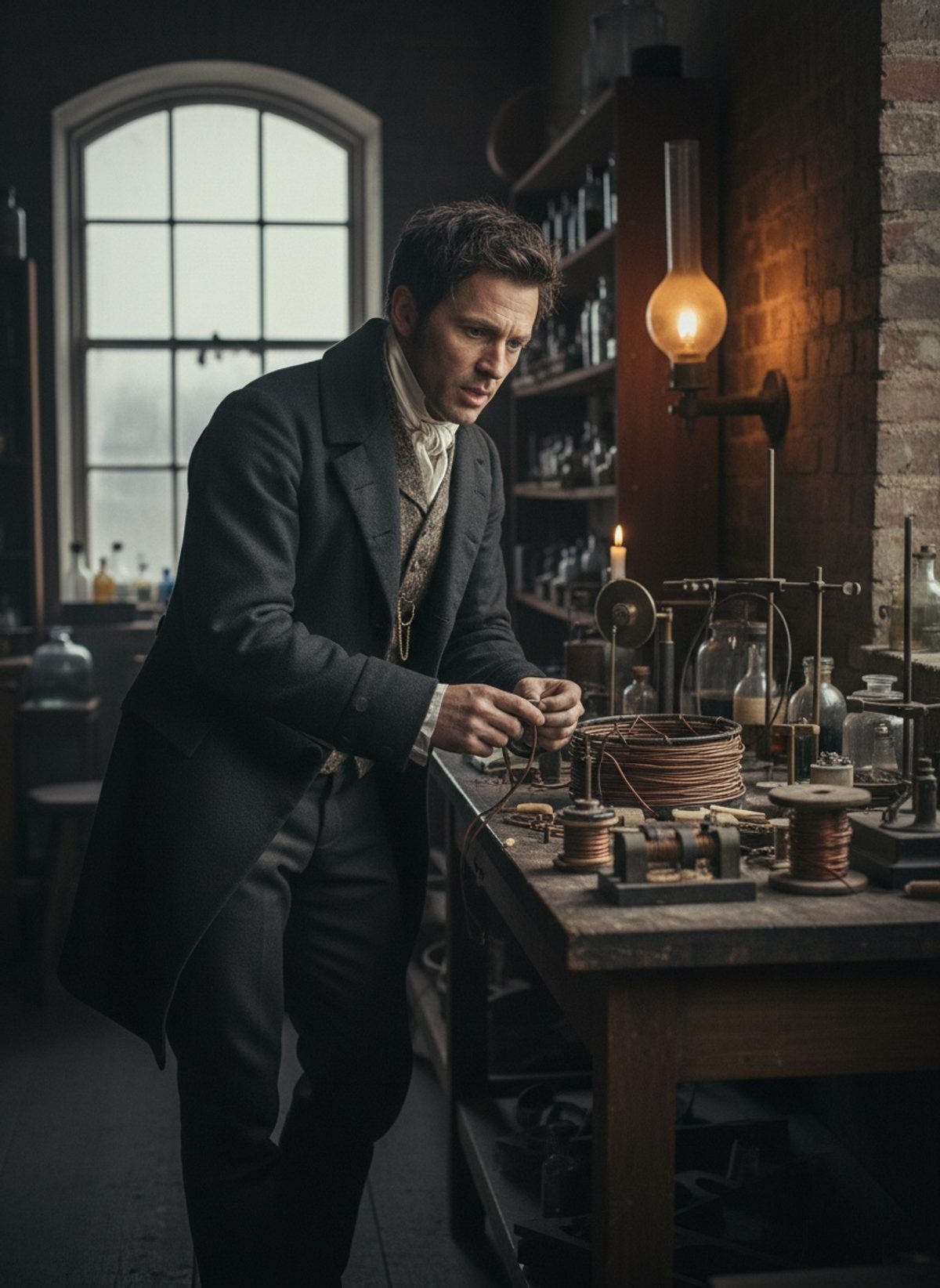
The magnet hung ominously, its shadow dancing on the wall as the flickering flame of a single candle cast the workshop into magic. Michael Faraday's fingers trembled slightly in anticipation as he wrapped the coil of copper wire around the iron ring. Distant sounds of London’s busy streets filtered through the window, but inside this modest room, a different kind of energy was building.
Once a humble blacksmith's son, Faraday now stood on the precipice of rewriting the very laws that governed darkness and light. Without the benefit of formal education, his journey from the narrow alleyways of Newington Butts to the inner sanctum of the Royal Institution was itself a miracle of curiosity and resolve. Raised in a family where bread was scarce and books scarcer, young Faraday had found his escape in the dusty pages of whatever volumes passed through his hands as a bookbinder's apprentice. Voltaire and Newton whispered secrets to him from their spine-bound confines, urging the youth to seek a universe beyond ink and leather.
With each rotation of copper, Faraday’s thoughts raced back to his early days at the appalling employer who bound him to the trade. At fourteen, his contract was meant to forge a future in bookbinding. Instead, it stitched together a fabric of self-education that would redefine power itself. Pages turned in the evening glow of candlelight; science absorbed into his very marrow. His passion wasn’t just for knowledge, but for the kind that lit the dark corners of human existence. His evenings were infused with letters and experiments. By the time his apprenticeship ended, Michael Faraday was no ordinary tradesman. He had, quite literally, bound himself to a destiny far beyond the reach of most men born to similar circumstances.
Now, with his coil in place, he struck flint and steel, igniting a kindling even more profound. Here was a contraption made with an iron ring, simple in design yet world-altering in potential. The science of magnetism and electricity was hardly new, Newton’s work had touched on it, but like a cipher awaiting a worthy key, it had remained stubbornly dormant. Faraday's genius was in seeing the threads of simplicity others tangled into knots. These elements, reeking of industry and innovation, would soon rip through the shrouds of gas-lamps and candle wicks that cloaked human progress.
Read next: The Day a Gardener's Son Gave the World Its First Weather Forecast
Faraday's humble background could have constrained him, bottling up his intellect within societal strata unwilling to recognize brilliance without privilege. But providence intervened in the form of Sir Humphry Davy, a chemist of great repute who noticed the boy’s latent talent. It was Davy who invited him into the hallowed halls of the Royal Institution, a cathedral of contemporary science. This was a laboratory unmatched, an arena where the mysterious forces of the natural world danced in harmonious chaos, challenging those brave enough to understand them. Faraday was such a man, his heart and mind attuned not just to science, but to its potential applications for everyday life.
Outside, the cacophony of life in early 19th-century London served as a stark contrast to the quietude within. Factories roared and carriages clattered, never sparing a thought for the solemn man at work amid the sizzle of an open flame and the careful adjustments of copper wire. In these electrifying surroundings, Faraday’s unassuming breakthrough laid foundations that modern civilization would one day rest upon. He was developing the principle of electromagnetic rotation, which in time would give rise to electric motors everywhere—from the tools powering industry to the unseen forces behind silent vehicles riding our city roads.
The wire seemed to jump to life at last, sending a current he could feel through his very fingertips. This sensation wasn’t just electricity coursing through an antiquated tool; it was the pulse of innovation itself. Years later, cities across the globe would bathe in electric light, owe their elevator lifts, and silent streetcars would glide, initially all born from that spark—the day a blacksmith's son rewired the entire world.
By forty, Faraday had banished the shadows for countless people. Gas-lit lamps would flicker down to smoke and ash, thrown aside for the white, hot blaze of electric illumination—a dawn ushered in by the son of a man who molded iron for a living. From humble flares to radiant brilliance, Faraday’s work demonstrated that intellect respects no boundaries of class or circumstance.
The audacity of giving form to invisible forces and making them do mankind’s bidding was and remains unmatched in its impact. No man had begun poorer nor climbed higher in the annals of personal achievement. Where Faraday led, others like Edison and Tesla sprinted towards a world electrified. Yet, despite his enormous contributions, Faraday himself took no practical part in the commercialization of his discoveries. His joys were simple and nested in the delight of exploration for its own sake, never clinging to the material fruits of his labor.
As the century waned, Michael Faraday’s legacy cast its glow far beyond the darkened lanes of Newington Butts, transcending his departure in 1867. Today, we encounter his legacy every time we switch on a light or breathe life into a silent realm of electronics through a mere button. When we peek into the brilliant unknowns coaxed into submission by sciences, it is through a gateway he helped construct. In the end, the son of a simple blacksmith handed the world the reins of electricity—a force that continues to march us into the future at the speed of light.