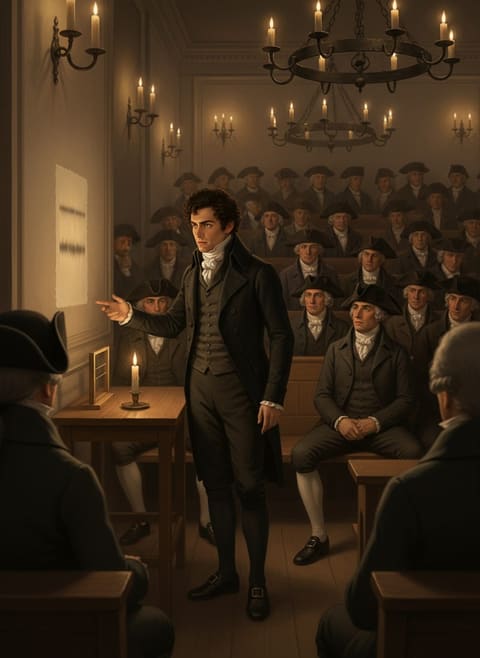
He was the son of a blacksmith and a bookbinder's apprentice. Michael Faraday had never set foot in a schoolroom.
The Workbench Alchemist
In the heart of London in the early 19th century, the city was a smog-filled epicenter of industrial ambition. Hidden away in the hum of its bustling streets was a young apprentice named Michael Faraday. In the quiet corners of a dusty bookshop, day after day, Faraday stitched together the pages of volumes he could never afford, weaving his own education from the words he read. With each binding, he absorbed the beating heart of the Enlightenment, an era of discovery where electricity was still an untamed force, more akin to magic than science.
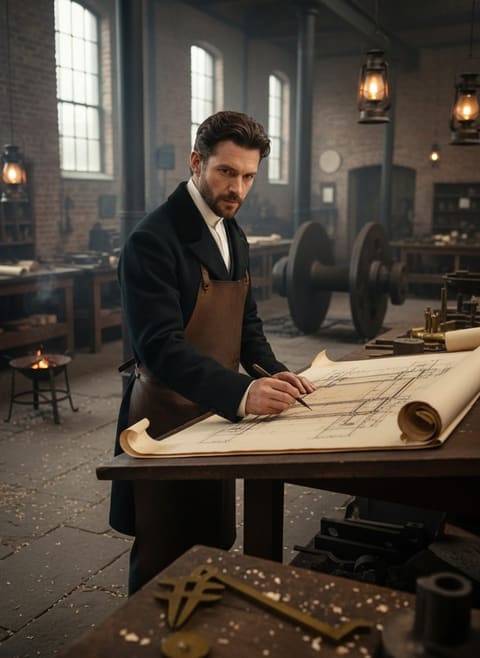
Faraday's rise from obscurity embodied a dramatic departure from the norms of his time. Lacking formal education or social status, he employed a workbench as his university, and coils of wire and rudimentary magnets as his textbooks. His relentless drive to understand the secrets of the universe pushed him into unexplored territories, where curiosity led the way into a realm where intuition reigned supreme. This internal surge of inquiry reached its apex one fateful afternoon in 1831, a day that would silently shake the very foundations of modern society.
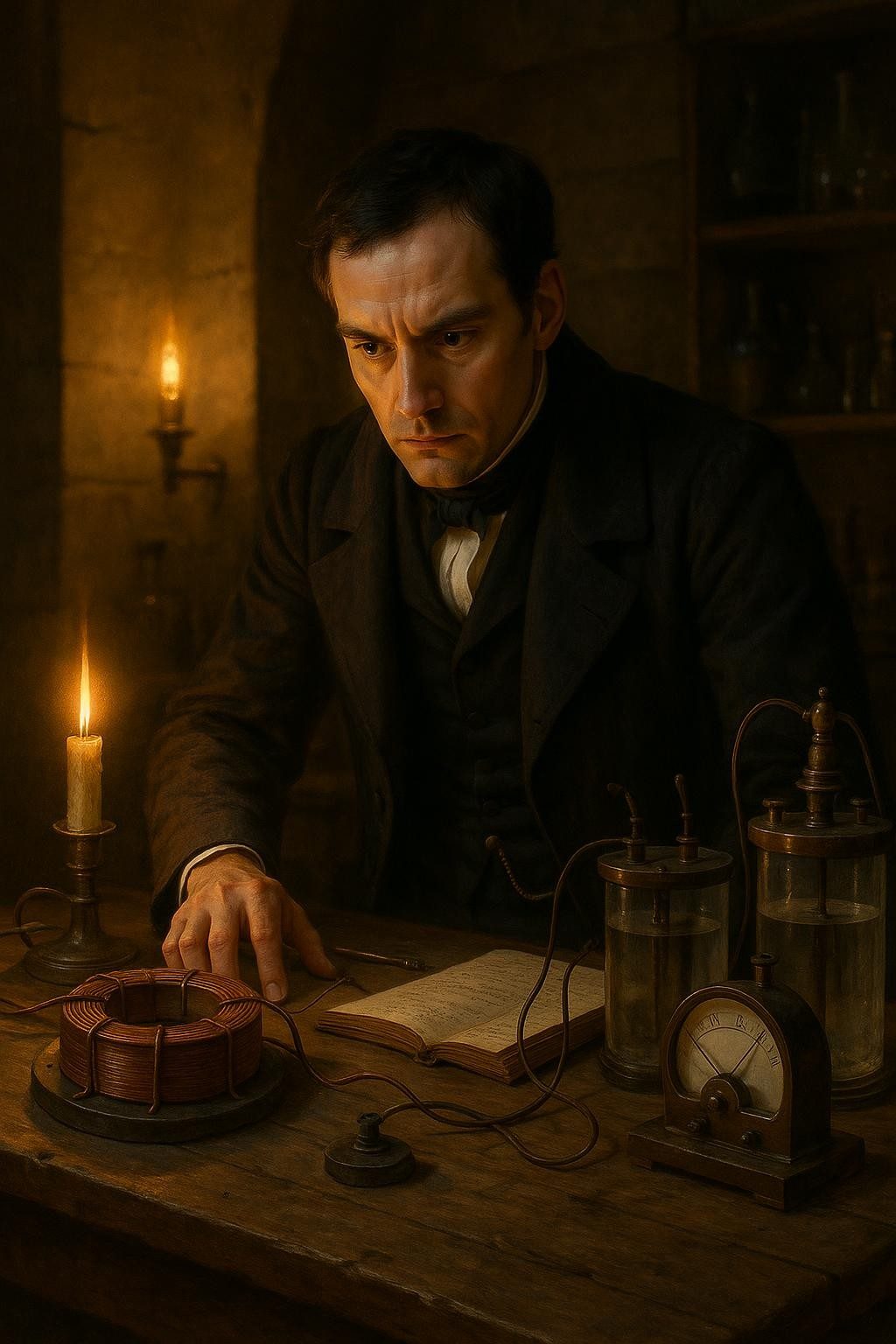
In his basement laboratory at the Royal Institution, Faraday's simple set of tools belied the revolutionary experiment at hand. He wrapped wire into coils and, with a steadfast hand, waved a magnet through them. What followed was not an explosive revelation but a gentle birth of understanding, as tiny sparks of electricity danced to life. The world didn't come to a halt to watch, nor did the newspapers herald this modest breakthrough. Yet, in the whisper of those coils, Faraday unlocked the latent power of generation, setting the stage for a world that would soon be electrified.
Read next: The Day a Weaver's Son Mapped the Invisible World
Magnetism and the March of Progress
Consider the impact of this revelation in the context of a society driven by gears and steam. Before Faraday's discovery, electricity was a curious phenomenon, painfully misunderstood and rife with limitations. The magnet and coil, however, were more than elegant apparatus in his hands; they were harbingers of a new era. Here was a means to harness nature’s immutable energies, a silent contract between magnetism and electricity that could power light, industry, and communication.
In those first delicate demonstrations, Faraday not only exhibited the raw principles of electromagnetism but imparted to the world a revolutionary vision. Moving a piece of metal through a coil could induce a current, and that current could conceivably be used to power the future. While other intellectual giants of the era contributed to the burgeoning field of electrical sciences, none matched Faraday's intuitive grasp of nature's invisible threads. His work expanded beyond the laboratory, influencing theoreticians and inventors who would further mine these insights for practical applications.
As the Victorian Age marched forward, the uses of electricity evolved from laboratory curiosities into transformative technologies. The understanding that electrons could be moved through wires to do work became a cornerstone of the world’s electric framework. Vast networks of power generation came to life, fossil fuels burned to move magnets within enormous coils, sending currents to softly glow within newly invented lightbulbs. Railroads and factories transformed with electric motors, the tendrils of Faraday’s discovery touching every aspect of life.
Read next: The Day a Clockmaker's Son Rewired How We See the Stars
A Legacy Encoded in Every Circuit
Despite his groundbreaking contribution, Faraday remained humble, his name whispered in academic circles rather than shouted from history’s rooftops. Yet, his legacy is encoded in the very fabric of our modern world. Every buzzing power plant, every light flickering to life, every hum of an electric motor is a quiet tribute to his moment of inspiration in 1831. Through his experiments, Faraday established a legacy of possibility, proving that curiosity could reshape the known universe even without the pedigree of prestige or the lure of wealth.
Modern readers may consider the story of Faraday a bygone chapter in a dusty textbook—yet it is anything but. His tale offers a vision of a world malleable by discovery, a world where learning is not confined to institutions or entitlements. His insights resonate today in a time of exponential technological growth, where echoes of his pioneering work continue to shape the fields of physics and engineering. From the movements of a magnet through a wire to the cityscapes outlined in neon—Faraday's day in 1831 profoundly changed the trajectory of human progress.
Reflect on a moment: that a man without traditional education, armed with boundless curiosity and a practical spirit, could tune into the unseen symphony of science and alter the world forever. It’s this enduring belief in the power of ideas over circumstance that makes Michael Faraday’s story not just a chapter left out of the textbooks but an indelible lesson for generations across the globe, inviting each of us to see the unseen and imagine the possible.