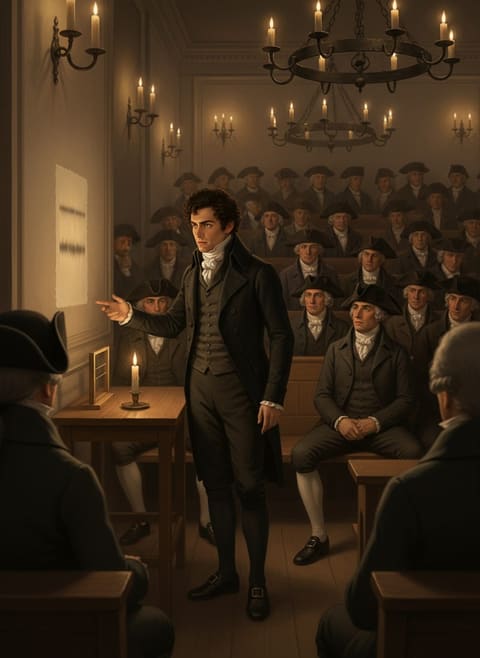
He was twenty-three years old. He had never published anything when he fundamentally changed our understanding of the universe.
In the mid-17th century, England found itself besieged by the bubonic plague, a grim visitor from the pages of medieval history, now returned to stalk the streets. By the summer of 1666, this deadly specter caused the University of Cambridge to shut its doors, scattering its scholars to the countryside in a desperate bid to outrun infection. Among those exiled was a young student, Isaac Newton, who found himself back at his mother's home in Woolsthorpe, Lincolnshire. What might have been a simple case of being in the wrong place at the wrong time turned into one of Earth's most fortuitous coincidences. Alone in his rural retreat, Newton embarked on a period of contemplation and experimentation that would crack the opacity of the heavens and lay bare their secrets.
Though Cambridge had sent him to pastoral seclusion, Newton's mind straddled isolated Woolsthorpe and the broader cosmos. Whether standing amidst the lowing cattle or staring at the bucolic horizon, his thoughts raced faster than any falling apple. Legend has it that an apple dropping from a tree stirred Newton's musings—a fine tale that history often retells with dramatic embellishments. But perhaps more important than the myth is the notion it represents: the force that pulled the apple to the earth might also reach up to grasp the moon and bind it to its orbit. This conceptual leap was nothing less than the birth of the theory of gravitation, a force both subtle and universal, ephemeral yet inexorable.
The boundaries between earth and sky blurred as Newton began to quantify the very fabric of nature itself. Detailing his apple-inspired revelations later in life, he would eventually describe the mathematics governing gravity in his landmark work, "Philosophiæ Naturalis Principia Mathematica." However, at just 23 and confined to a countryside abode, Newton lacked both the renown and resources for publication. Yet necessity is the mother of invention, and with limited guidance, he plumbed the depths of mathematics to construct new methods for calculus—a powerful tool to decipher change and motion. It was as if universes unfolded from the desk in his childhood home.
Read next: The Day a Weaver's Son Mapped the Invisible World
Newton had equipped humanity with the mathematics to chart the galaxies and plot the planets. Known for his private and reclusive nature, his sparsely sown correspondence suddenly filled with inquiries to friends, mentoring one moment and challenging the next. His contributions during this fertile year of isolation shattered the prevailing Aristotelian dogmas that had held sway for centuries. For two millennia, the ancients hypothesized stars and planets as divine realities, beyond human comprehension. But with his revelations, Newton played the great liberator, inviting mortals to be more than mere spectators in the cosmic theater. Man could join the director's ranks of a majestic performance.
He invented more than ideas: Newton's experiments in optics broke down light into its constituent spectrum using homemade prisms. When others saw white, Newton envisioned a rainbow. While the colors danced across walls, his mind dissected their essence, blending mastery of scientific rigor with creative foresight. In time, he championed the concept that light could be composed of particles, not just waves—a notion that would not see vindication until well after his lifetime, yet remained foundational to modern quantum physics. Even as nature spread its vibrant palette, Newton wielded the power to capture it as a catalog of natural law.
Read next: The Day a Clockmaker's Son Rewired How We See the Stars
For onlookers, his Linconshire sojourn might have appeared as nothing more than an idle interlude, a brief pause until the scholars returned to their cloisters. But for those attuned to the whispers of destiny, Newton's solace in Woolsthorpe was the hushed revolution of discovery, unfurling piece by piece. His mind sparkled with color-spun ideas, energetically forecasting storms of an intellectual movement that would later carry humanity along a tide that has yet to crest. Borrowing from what he described as standing on the shoulders of giants, the oft-quoted phrase echoes that Newton himself had become that very giant, raising new generations of minds to unprecedented heights.
Here lies the crux: when history seems poised to forget this chapter of happenstance and forced solitude, it turns not on Newton alone but on the broader human tale—the power of a single mind, undistracted and unhindered by the constraints of society's routine, to change the very laws by which that society lives. Newton, the young scholar temporarily severed from academia's halls, became the lynchpin of human understanding, doing so in a time when fear cast its pall over the world. The disparity between the humble origin of his insights and their monumental scale is one all can appreciate, a reminder that brilliance often lurks unpolished far from the clamor of the lauded lecture halls.
In the grand lexicon of human achievement, Newton's discoveries serve not just as a record of individual genius but as a testament to the power of passion meeting circumstance. After his so-called "annus mirabilis," the year of wonders, upon returning to academia, he might have found the gates of Cambridge as ordinary as before. Yet, mortals have since peered upward, empowered by Newton's elegant equations and celestial comprehensions. While moments of grand revelation may come all too infrequently, Newton’s solitary triumph at Woolsthorpe beckons us to remember that sometimes the universe, with its vastness and intricacies, fits into a single quiet place waiting for a new story to be told.