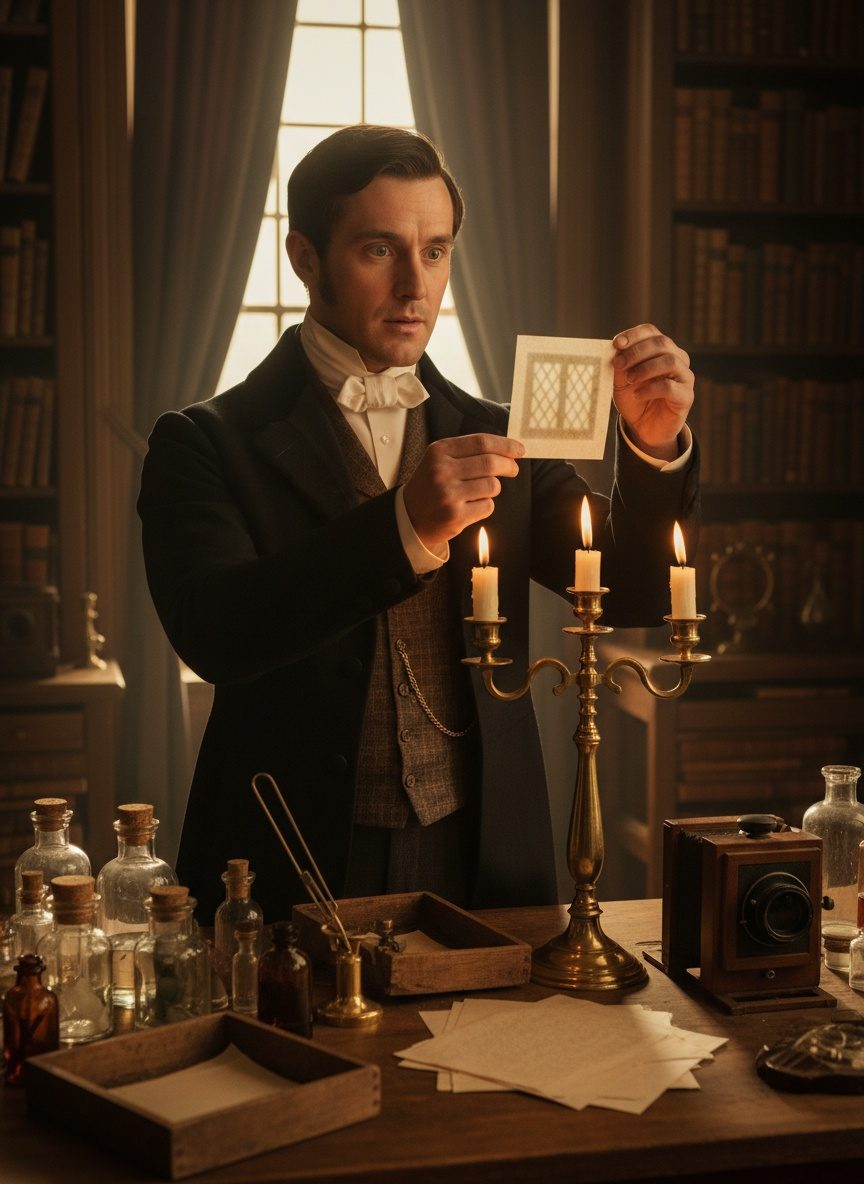
April 15, 1798. The air was thick with the scent of blooming lilacs.
In a candlelit room at Cambridge, a figure was poised with an air of palpable determination. His fingers danced methodically over a large wooden board filled with engraved dots and lines. This was no ordinary performance; it was the pursuit of celestial understanding by a man who had never seen the stars. Nicholas Saunderson, despite the darkness that had enveloped his vision since infancy, was illuminating the universe with his uncanny ability to chart the heavens through touch alone. He was a blind mathematician whose influence would ripple through the corridors of academia, capturing minds and hearts alike with his extraordinary story.
Charting the Invisible
Nicholas Saunderson was born in 1682, in a small village called Thurlstone, in Yorkshire. What might sound like the beginning of an ordinary life took a dramatic turn when a smallpox infection claimed his sight when he was just a year old. Yet, Saunderson defied conventional wisdom and redefined expectations. Raised in a time when the blind were often seen as burdens, he displayed an insatiable curiosity that transcended his lack of sight. His father, a humble exciseman, supported Nicholas’s thirst for knowledge, equipping him with a wealth of classical and modern texts, which Nicholas devoured audibly with help from friends and family who would read aloud to him.
Through sheer will and an extraordinary memory, Saunderson taught himself Latin, Greek, and mathematics. His ambition was set upon the stars, and soon his reputation as a mathematical prodigy began to surface. Not an easy feat for someone who had never beheld the planets or calculated an equation upon paper. Instead, Nicholas relied on a braille-like system he devised, using boards with raised dots, which enabled him to perform complex calculations. His proficiency captured the attention of prominent figures in the academic world, eventually steering him to Cambridge, a bastion of scientific brilliance during the Georgian era.
Read next: The Day a Deaf Man Gave the World Its First Electric Motor
In 1711, through exceptional skill and perhaps dogged perseverance, Saunderson achieved the coveted position of Lucasian Professor of Mathematics at Cambridge, a prestige once held by none other than Isaac Newton. Here, he developed a series of lectures on Newton’s optics. The irony was profound—not only had Saunderson never seen light, but he was also translating the visual wonders of the universe into a language he could interpret and teach. His approach, described by his contemporaries as methodical and deeply intuitive, relied heavily on his acute sense of touch and spatial awareness, laying profound mathematical landscapes from sheer memory and logical deduction.
The Resonance of Knowledge
During Saunderson's tenure at Cambridge, he became renowned for his ability to impart knowledge to students who rushed to his lectures. His grasp of mathematical principles, such as calculus and algebra, was near legendary. To his pupils, he was a sage, a man who needed no visual aid to guide them through the complexities of mathematical equations, and his lectures were eagerly attended by students thirsting for the same understanding that came so naturally to him.
Without access to traditional texts, Saunderson leaned heavily on innovative teaching methods. He crafted models which allowed students to feel his thought process—his fingers were their guides through the complicated terrain of theorems and proofs. His logical worksheets did not rely on sight but on a perceptible rhythm, showing the deeply interconnectedness of mathematics with the physical world that was palpably constructed through tactile stimulation. Fellow professors marveled at his prowess; they too recounted his brilliantly articulate speeches that brought the poetic dance of numbers to life.
Saunderson's gifts extended beyond mere academic teachings. He had a sharp wit and was fond of philosophical debates, which he engaged in with vigor. He became an indispensable figure at Cambridge, not only for his intellect but also for his unique perspective that challenged others to think beyond conventional means. His story gained renown, serving as inspiration that echoed across the halls of academia—unyielding proof that determination and ingenuity transcended even the starkest obstacles of human condition.
A Legacy in the Stars
In the heart of Cambridge, Saunderson pushed boundaries one could hardly understand, let alone explain. Despite his reliance on touch, he laid down a legacy not through the things he had seen, but through the truths he had revealed to the world that had once deemed him an anomaly. His journey is a remarkable narrative of overcoming life's greatest hurdles, rendering them minuscule against the backdrop of human capacity for knowledge and understanding.
By the time of his passing in 1739, Nicholas Saunderson had etched his name among the greats of mathematical history. He mapped a scholarly path not on clear sight, but on clarity of mind, a gift he shared and manifested through every lecture and interaction. The stars, which he had described so meticulously without the gift of sight, bore testament to a vision unparalleled through mere optics: a projection of intellect, creativity, and relentless pursuit that taught generations to operate beyond the confines of physical limitation.
The story of Nicholas Saunderson reminds us that the landscape of knowledge is bound not by what we see but by how we choose to explore it. His life challenges us to redefine our perceptions of disability and ability, showing us that true understanding lies in the connections we make—and those we have yet to forge—between the worlds within and around us.