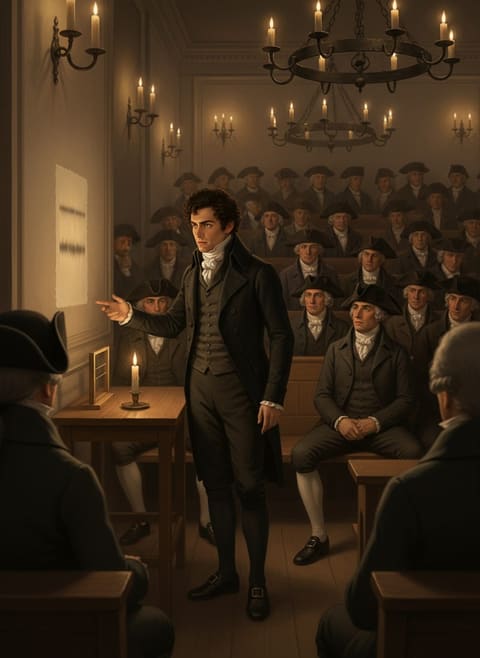
William Herschel was just another musician. That might have been all he ever was if it weren't for his fascination with the stars.
A Musician with an Eye for the Cosmos
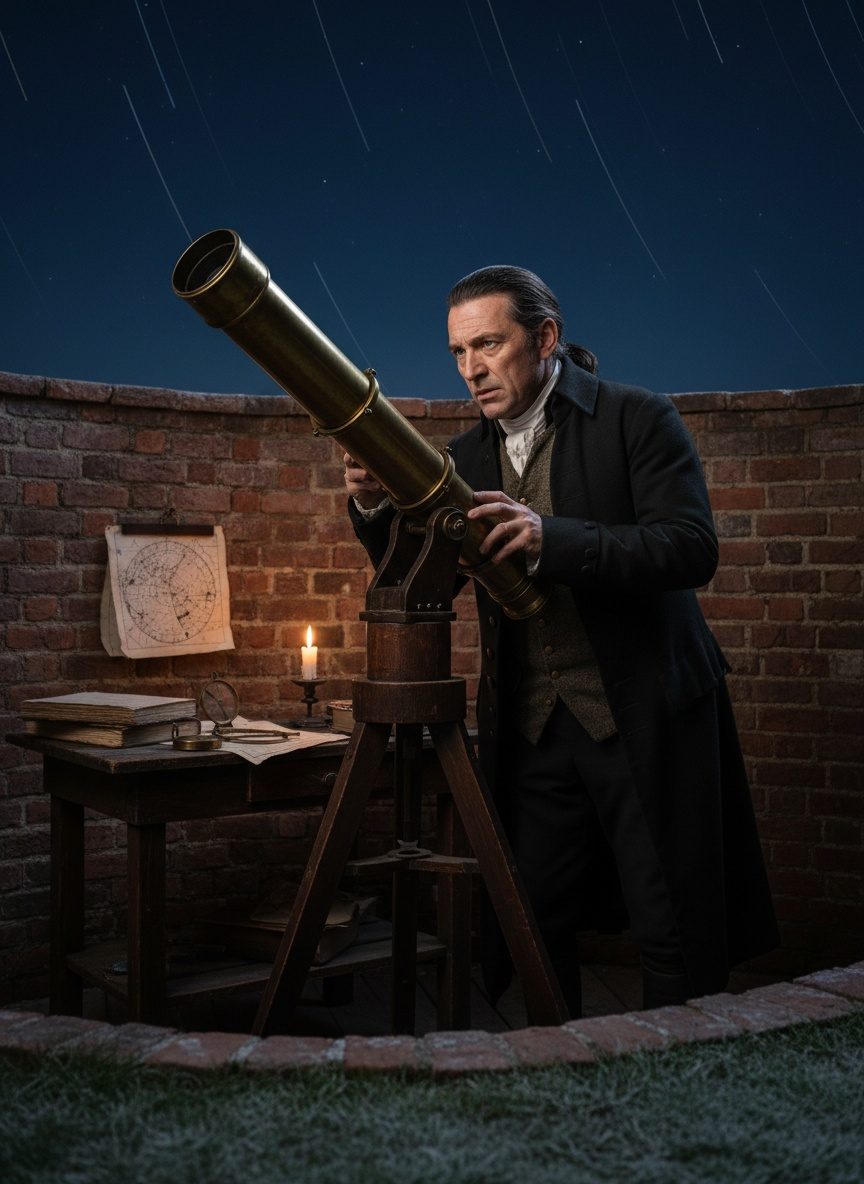
In the refined city of Bath, amidst grand crescendos and exquisite symphonies, a man named William Herschel found himself captivated—not by the melodies resonating in concert halls, but by something unseen with the naked eye. With no formal training in astronomy and armed with nothing more than curiosity and a homemade telescope, Herschel would wander into the fields of Somerset after a day orchestrating chords, eager to pierce the night's veil. Who would imagine that it was here, amidst the pastoral tranquility juxtaposed against celestial wonders, that a musician would stumble upon a monumental cosmic discovery?
Herschel's hands, deft in striking the ivory keys of his organ, were equally skilled in grinding lenses for the telescopes he meticulously crafted. Unbeknownst to him, these evenings spent gazing heavenward were setting the stage for an event that would rock the very foundations of the known universe.
A Night in March That Changed the Sky
It was the night of March 13th, 1781, when Herschel directed his telescope toward the starry expanse with an aim to survey the distant binary stars. But what unravelled before him was unlike anything he'd documented before—a dim, yet unmistakably mobile point of light. Raising a brow, Herschel methodically noted each detail, his musician's precision translating into an astronomer's meticulous observations. This wasn’t just an ordinary star; it seemed to wander amongst them.
Read next: The Day a Weaver's Son Mapped the Invisible World
What Herschel had stumbled upon was no less than an uncharted planet, hitherto unknown in recorded history. It was a revelation of immense consequence, involving a celestial body that extended the bounds of human understanding beyond the Saturnine ring.
Challenging the Heavens without a Degree
It's often said that innovation needs no permission from convention. Herschel firmly embodied this. In a time when academic lineage often dictated one's scientific worth, Herschel—a Hanoverian immigrant dabbling in the lucrative occupation of court musician—defied the thresholds of class and scholarly tradition. This man, having not a single scientific accolade to his name, contended with the theoretical predictions of Isaac Newton himself and triumphed by adding what is now known as Uranus to our solar system.
An intriguing tidbit about Herschel's discovery is how it stood as a testament not just to passion over pedigree, but to the power of sheer observation. His instruments, crafted through experimentation rather than institutional prowess, outperformed the established tools of the official observatories of the era. Herschel’s findings challenged the notion that knowledge was solely in the domain of the learned elite.
A Planet for the King
A man of music and the stars, Herschel knew the significance of patronage. His discovery was initially dubbed “Georgium Sidus” in honor of King George III, a nod not just to monarchal favor but a savvy gambit for securing financial support to fund further astronomical pursuits. Though royal interest was piqued, the scientific community resonated more with its classic name "Uranus," a tribute that aligned with the Greco-Roman tradition of celestial naming.
Read next: The Day a Clockmaker's Son Rewired How We See the Stars
The discovery of Uranus would ripple through European astronomy like a ground-shaking crescendo. It challenged existing paradigms and invigorated a new era of celestial cartography. While Herschel may have hoped to solidify his position in the celestial community of his time, what he achieved was far beyond securing financial backing; he had enshrined his place in history as the man who defied the stars—not by rewriting them, but by extending their melody.
The Celestial Symphony We Almost Missed
There is something profoundly human in Herschel’s story: the pursuit of a passion against tangible odds, the power of curious observation, and the willingness to question the universe itself without fear of what it might reveal back. One could argue, it echoes a timeless query: how many symphonies of discovery lie unnoticed, waiting for someone with the audacity to look beyond the obvious? William Herschel’s journey from the concert hall to the stars is a testament to the boundless reach of human curiosity.
Each evening under the skies of Bath, Herschel demonstrated that the cosmos could indeed harmonize with the human spirit. And while Uranus might be only a fleck in the infinitude of the cosmos, its discovery underscored a profound truth: sometimes the blindest of us all are those who can see but choose not to look. William Herschel opened the heavens not just with his eyes, but with his indefatigable spirit, reminding us that the universe's score is sung in more than one voice.