Henry Fawcett was blind. But he saw a future that no sighted politician dared envision.
In the fields of Victorian England, where expansive estates met the industrious heartbeat of the age, a single shot rang out in 1858, altering the trajectory of Henry Fawcett’s life forever. At the tender age of twenty-five, Fawcett was involved in a shooting accident, leaving him blind and plunging him into a darkness most could not fathom navigating. Society, with its limited scope, quietly consigned him to obscurity, a fate accepted for the visually impaired of the era. Yet, Fawcett defied this narrative, stepping not into the shadows but into the halls of influence.
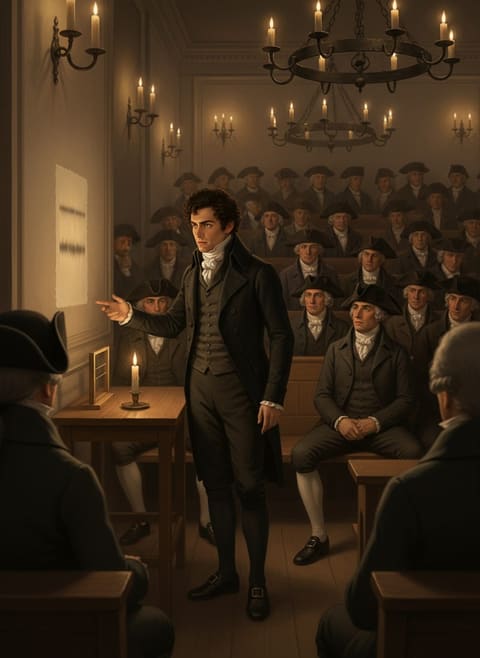
It was in Birmingham, 1868, among the perpetual whispers of innovation and revolution, that Fawcett embarked on a journey seldom traveled by those who had lost their sight. He wielded the tools of intellect and determination, reshaping not only his destiny but that of countless other blind individuals across Britain. His ascent to Postmaster General was nothing short of extraordinary, for it carried the weight of a personal mission: to illuminate the paths of those navigating the world through touch, sound, and imagination.
Fawcett's tenure as Postmaster General was marked by an upheaval of ordinary expectations. Where others might have bent beneath the pressure of public office, he thrived, transforming challenges into opportunities. His experience in overcoming his own disability informed his groundbreaking policies, particularly the one that would grant blind people free postage. At first glance, this might appear a minor detail in the vast Victorian bureaucracy, yet for those it touched, it was a lifeline to knowledge and connectivity. Imagine the wonder and anticipation as books written in embossed type began to reach hands that had never held them before, bringing tales and ideas to life through fingers tracing each curve and angle.
Read next: The Day a Weaver's Son Mapped the Invisible World
The mail became an avenue of enlightenment, and one can picture scenes of newfound readers tapping out excited rhythms on tables, discovering worlds they had only glimpsed in their dreams. Fawcett's policy ignited a quiet revolution; knowledge that had been the privilege of sighted individuals now coursed freely through the fingers of the blind. This newfound accessibility empowered many and broke barriers, signifying hope and changing perceptions of what was attainable for those with disabilities.
His influence was not limited to legislative triumphs. Fawcett was deeply human in his approach, a Parliamentary force who never disconnected from the people he served. This meant that his innovations were not simply enacted from afar but were the result of listening, understanding, and acting on the voices from within the blind community. Such empathy was a rarity in the calculated corridors of Victorian power, an era where efficiency often eclipsed human need.
Read next: The Day a Clockmaker's Son Rewired How We See the Stars
Fawcett's vision reshaped societal narratives, transforming disability from a mark of limitation into a backdrop for possibility. His life and efforts were not merely accidents of history but deliberate actions, paving a way for future advancements in accessibility. Today, we celebrate Braille and modern technology aiding the visually impaired, yet these innovations owe much to a groundwork laid by people like Fawcett. His story infuses the historical tapestry with threads of resilience and advocacy.
In an age propelled by sight, Henry Fawcett’s blindness enabled him to see and perceive reality differently. His personal challenges honed a remarkable political acumen, which harmonized with the zealous progressive currents of the Victorian age, illustrating that adversity does not predetermine an end but signals a transformation in perspective. Fawcett harnessed his blindness not as a deficiency but as an alternative viewpoint, kindling progress for others who shared his darkness.
The tale of Henry Fawcett casts a long shadow of inspiration, forcing us to reassess boundaries we subconsciously craft. Today, in environments rich with literature and technology built on the principles of inclusivity, his legacy underscores an essential truth: innovation flourishes not from conventional sight but from insights born of necessity and empathy. Fawcett's life compellingly demonstrates that vision is not confined solely to what is visible to the eye; true sight involves the courage to perceive what lies beyond, fundamentally altering the landscape of what's possible.