November 20, 1782. Frost clung to windowpanes in York, hardening with each whisper of the night wind.
The Mute Gaze of the Night Sky
On this cold evening, a young man sat by the window, seemingly lost in the cosmos. John Goodricke, though deaf and unable to speak, had the voice of his thoughts articulated through the vastness of the night sky. No university lectures had occupied his days, no scholarly debates had shaped his evenings. Instead, it was here, in the quiet solitude of a medieval city, that Goodricke unraveled one of the mysteries of the universe.
Born in 1764, John Goodricke was rendered deaf by a childhood illness before his time for eloquence arrived. In an era when such afflictions pushed one to society's periphery, Goodricke's family instead recognized his keen intellect. He attended the Warrington Academy, an institution noted for its progressive education, where his fascination with science took root.
Yet, it was in York, by his window, where Goodricke commenced his nightly vigils, recording the ceaseless dance of the stars. He came to know them as intimates, noticing their regular twinkles and constant sparkle, but it was one particular star that captivated him—Algol, the "Demon Star" in the constellation Perseus. Unlike others, Algol dimmed in predictable cycles, like the flicker of a distant lighthouse.
Read next: The Day a Weaver's Son Mapped the Invisible World
Decoding the Language of the Stars
John Goodricke's meticulous nature set him apart as he patiently charted the erratic pulse of Algol over many nights. Pen in hand, candle flickering beside him, he filled page after page of a notebook with numbers and notes, seeking to solve the riddle Algol presented. The constant struggle with cold and damp, so typical of English winters, was alleviated by the strength of his resolve and perhaps even the warmth of discovery that seemed to glow just beyond the reach of his calculations.
By systematically observing Algol's behavior, Goodricke was able to determine the star dimmed every 2.867 days, a precise calculation that was astonishing for its time. The young astronomer's insight struck a chord in the scientific community. Variable stars, those that changed in brightness, were scarcely understood—a mystery of the universe where light did not adhere to constancy. Through his observations, Goodricke suggested that Algol was being eclipsed by a darker star, a conclusion reached decades ahead of its time.
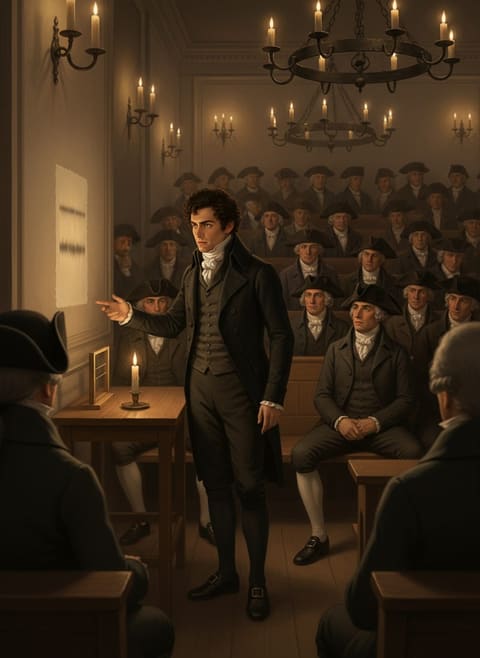
The Royal Society, recognizing the significance of his work, awarded Goodricke the Copley Medal, the prestigious accolade that celebrated the valor of intellectual discovery. For a young man of twenty-one, silent before the great and learned men of London, this was an extraordinary recognition.
Brief and Brilliant: The Luminosity of a Life
Goodricke's life was destined to be as fleeting as the cycle of the stars he loved. On the cusp of adulthood, his health, tested by many a freezing night by the window, began to wither. In the year he received the Copley Medal, he succumbed to pneumonia, a life too short but infinitely vibrant in the legacy it shone upon the night sky.
Read next: The Day a Clockmaker's Son Rewired How We See the Stars
The astronomy Goodricke conceived was only beginning to find its horizons. His work with Algol, and indeed other variable stars like Delta Cephei, laid a groundwork upon which future astronomers would build. The concept of stellar cycles would later become a vital tool in measuring cosmic distances. Comparisons of Cepheid variables would eventually help Edwin Hubble in identifying galaxies beyond our own, vastly expanding our comprehension of the universe.
John Goodricke's story resonates with an almost poetic irony; a man who heard nothing and spoke even less contributed more to the language of the cosmos than many well-versed in human tongue. His is a story that speaks to the power of observation and the unyielding pursuit of knowledge in the face of intangible odds.
The Celestial Whisperer
In contemplating John Goodricke's contributions, one cannot help but marvel at the vision he possessed despite his auditory silence. It compels us to acknowledge a myriad of truths woven into the fabric of innovation—a seamless blend of patience, dedication, and the ability to see what lies hidden beyond the obvious horizon.
The stars he studied still shimmer above us, reminders etched against an eternal tapestry. Each night as the sky darkens, they wait once again for a young observer, warmed by candlelight and curiosity, to listen closely to the ever-whispering universe. In that quiet, in the presence of stars, Goodricke's legacy gently declares to the ages: there is harmony in silence, and brilliance where patience resides.