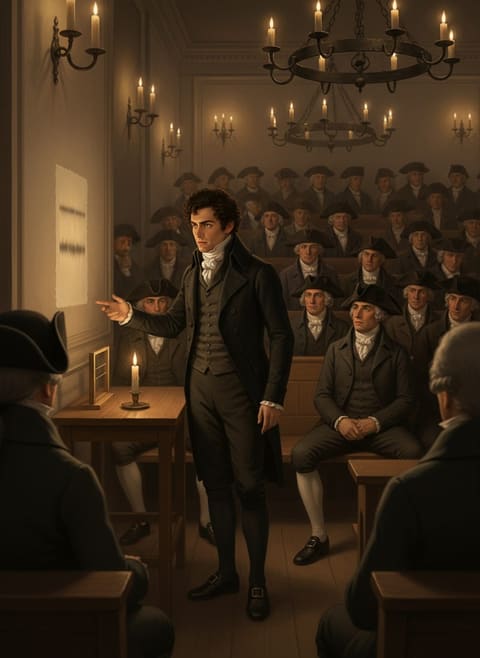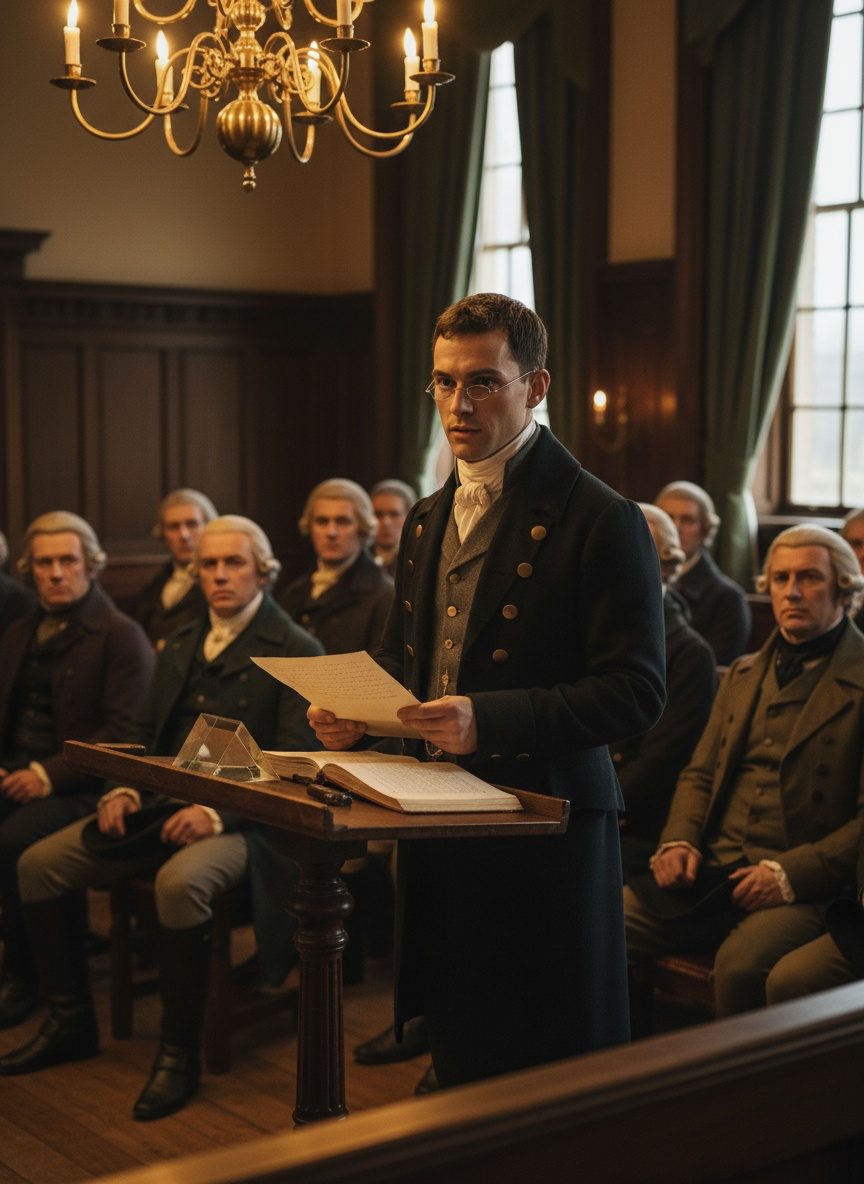
1794. The candle-lit room was a hive of anticipation.
A Curious Phenomenon
It was a November evening when the small assembly of Britain's finest thinkers gathered at the Manchester Literary and Philosophical Society to witness a presentation that promised to challenge their perceptions — quite literally. In the flickering glow, murmurs of excitement mingled with the scratching of quills against paper as John Dalton prepared to address the room. Though he himself could not discern it, Dalton was about to unfurl the mystery of color and light in a way never before attempted.
Standing at the podium, Dalton was a figure of serene unease. His demeanor was typical of the Quaker modesty he embodied, but the ideas he was about to introduce were anything but timid. Dalton, a man who famously professed to never having seen red or green as others did, was about to lay the groundwork for a science yet unnamed. Despite his visual limitations, or perhaps because of them, he had devoted himself to the study of colors, driven by an inability to accept their invisibility to him was without explanation.
The Experiment That Changed Everything
Dalton’s unwavering curiosity had a simple genesis — his own peculiar way of seeing the world. He recounted how he and his brother, both unable to distinguish certain colors, perceived the world differently than most. His world was painted in shades of blue, yellow, and brown, lacking the vibrant reds and greens others took for granted. Through meticulous observation, he had come to suspect the peculiarity lay not in the eye’s surfaces, but within its crystalline lens. He postulated that this lens might possess a distinct hue that limited its perception of color.
Read next: The Day a Weaver's Son Mapped the Invisible World
For a man unable to see the crimson of a rose or the lush green of spring foliage, Dalton's findings were remarkable. He wove his theories together with threads pulled from rigorous experimentation and a passion for truth. By boiling down the complexities of his condition and examining the scattered evidence through his lens of logic, Dalton offered an explanation that resonated far beyond his personal experience.
Reactions and Reverberations
As Dalton presented his findings that November night, the room was silent but for the rhythmic scribbling of notes. His peers were captivated. This remarkable idea — that color perception could differ so drastically between individuals — was as disorienting as it was enlightening. Dalton was essentially introducing a new way to consider the human sensory experience, suggesting an incredible diversity hitherto unnoticed.
While some skeptics dismissed Dalton's claims as speculative, others saw potential. His pioneering work attracted interest across Europe, sparking debates that would only gain momentum as the decades rolled on. Though his hypothesis regarding the colored lens was not entirely accurate, his work spurred subsequent discoveries that eventually unraveled the complex interactions between light, color, and the human eye. Dalton had lit a fire in the academic world, one that would burn long into the future.
Read next: The Day a Clockmaker's Son Rewired How We See the Stars
A Prelude to Modern Vision Studies
John Dalton’s 1794 thesis was the first documented expression of what is now referred to as color blindness, or more scientifically, Daltonism. His observations formed the bedrock of continued research, enabling future scientists to slowly peel back the layers of refraction and reflection, and explore the unique ways in which eyes perceive the twirling hues of the spectrum.
As the years passed, the understanding of color vision and its abnormalities matured. In the 20th century, discoveries about the photoreceptor cells in the retina provided a deeper insight into how Dalton might have seen the world. Yet it was Dalton's early courage to explore what was then unknown and undefinable — his resolute belief that personal limitation could spawn universal understanding — that propelled these advances.
Beyond Visible Boundaries
To this day, Dalton's work reminds us that science is not just about seeing with the eyes, but with the mind, heart, and spirit. From the shadows of that November evening, he dared to question why the world looked different to him — and in doing so, helped the world see differently. If nothing else, Dalton’s legacy lies in the fact that he used scientific inquiry not as a mirror of flaws, but as a beacon to illuminate unseen realities. He taught us to listen to the evidence of our senses, even when they defy common notions, for therein might lie answers to questions we’ve yet to imagine.