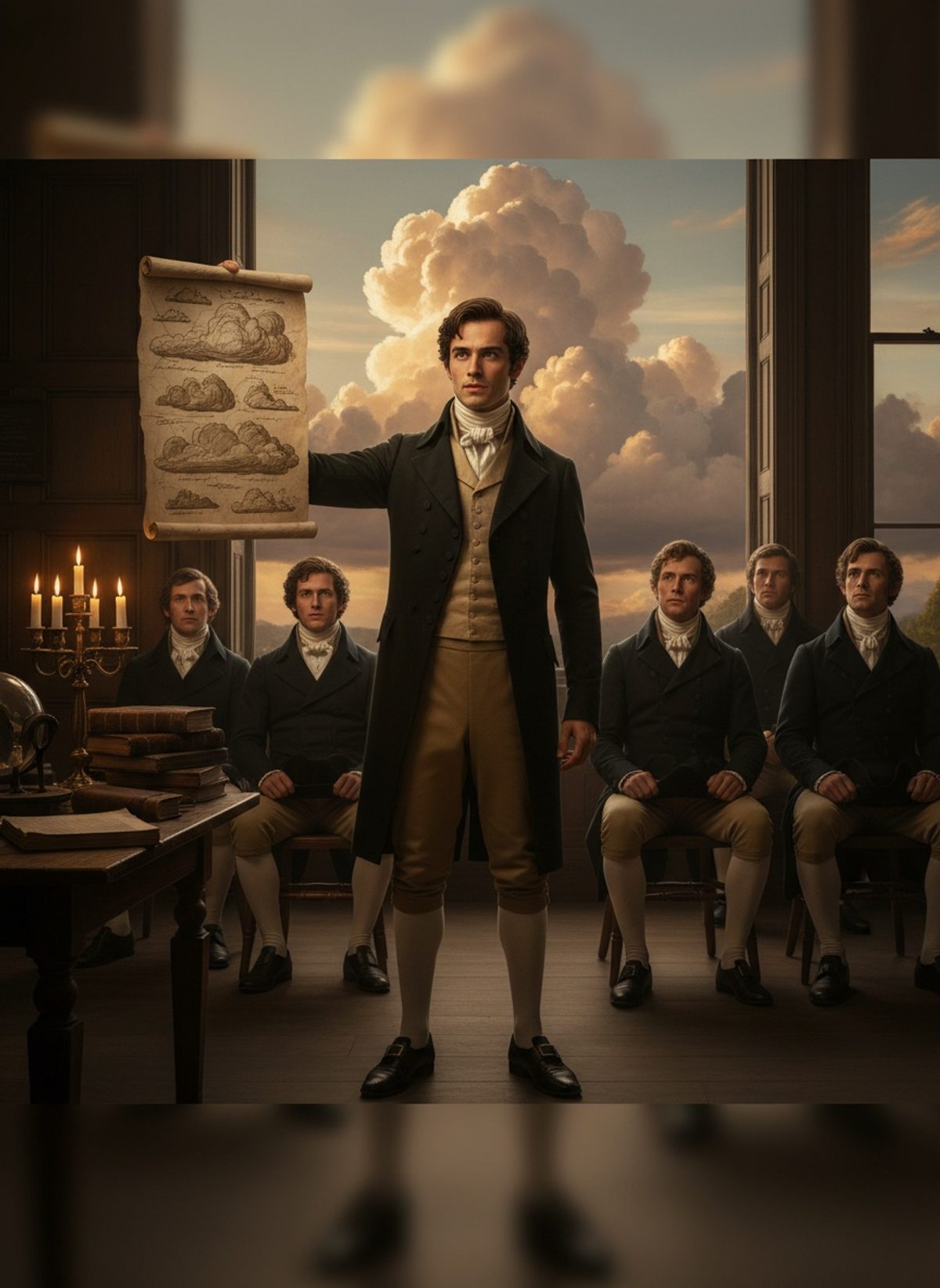
The dim glow of candlelight flickered against the glass windows of an ordinary London meeting hall, casting long shadows over the captivated audience within. It was a chilly evening in 1803, and a drizzling rain patted softly against the panes, as if the heavens themselves were eager to witness the momentous occasion unfolding inside. A quiet rustle of anticipation filled the room, growing heavier with every word spoken by a young chemist poised to transform the very language of the skies. His name was Luke Howard, and though a mere practitioner of chemistry, he would extend his reach far beyond terrestrial confines into the ethereal realm above. Nothing in the scientific annals had quite prepared the gathering for what Howard was about to unveil: a comprehensive system of naming clouds, forever altering mankind's relationship with the heavens.
The Skyline Language: Genesis of Cloud Classification
For centuries, clouds had drifted unnamed, silent in their nebulous glory above Earth’s bustling societies. Farmers gazed skyward for signs of rain, sailors squinted into the horizon seeking fair weather, yet the enigmatic formations held their secrets close. The nomenclature of clouds simply did not exist. Enter Luke Howard, a Quaker chemist with a fervent passion for the natural world and a keen mind for systematic classification. Born in London on November 28, 1772, Howard grew up during a time when scientific exploration was blossoming. His meticulous nature found an outlet in meteorology, where he could apply the rigor of chemistry to the ever-shifting celestial tapestry.
On that historic evening in December 1803, Howard stood before the esteemed members of the Askesian Society—a gathering of amateur scientists in London. As he unveiled his taxonomy, he brought structure to chaos with poetic precision. Howard introduced a lexicon that included terms like cumulus, the Latin for "heap" or "pile," apt for the billowing, cotton-like clouds synonymous with fair weather; stratus, meaning "layer," for the uniform gray blankets draping the sky; and cirrus, Latin for "curl of hair," evoking the wispy, high-altitude clouds resembling fine locks.
The conceptual leap Howard took was not merely a cerebral endeavor—it was a bold declaration of humanity’s potential to interpret and name the natural world. His systematic approach provided a universal language that transcended borders, allowing people across different lands to communicate with clarity and consistency about atmospheric phenomena. It marked a turning point where science began to frame nature in a lexicon that was just as practical as it was beautiful, embedding an aesthetic appreciation within a rational order.
Read next: The Day a Weaver's Son Mapped the Invisible World
A Chemist Among Clouds: An Unlikely Meteorological Pioneer
Howard’s journey to becoming the "Father of Meteorology" was as intriguing as his contributions were groundbreaking. Trained as an apothecary, Howard was self-taught in meteorology, driven by curiosity rather than formal education. He meticulously observed the skies, harnessing both his scientific acumen and creative insight. His 1803 publication, On the Modification of Clouds, outlined his classification system and gained the respect of esteemed contemporaries such as Goethe, who penned poems inspired by Howard's work. Such recognition was testament not only to the scientific merit of his findings but to the artistic allure they carried.
Quaker beliefs had instilled in Howard a profound respect for orderliness and simplicity—qualities that would shape his scientific ethos. While cloud classification at first glance might seem far removed from chemical compounds and pharmaceutical formulations, Howard's analytical skills were inherently allied with nature’s own rhythms and patterns. Unlike modern meteorologists equipped with satellites and radar, Howard relied solely on his keen observations and methodical note-taking. It was this discipline that enabled him to distill the complexities of atmospheric phenomena into elegant scientific truths, accessible to scholars and laymen alike.
The very act of naming clouds was an exercise in humility and boldness. Howard acknowledged the limitation of human understanding against the expanse of the natural world, even as he sought to chart its terrains with precision. The structure he devised was elegant in its simplicity, applying Latin roots to forge an intuitive undertaking. It captured the ineffable beauty above and accorded it a place within the human lexicon, laying the foundation for all future atmospheric science.
Read next: The Day a Clockmaker's Son Rewired How We See the Stars
The Wind’s Whispers: Legacy of a Linguistic Revolution
Two centuries have passed since Howard’s linguistic revolution, yet his cloud nomenclature remains a cornerstone of meteorology, grounding forecasts and atmospheric studies in a nuanced understanding of the sky. His legacy has woven itself into the weather reports we rely on daily, from joyous announcements of clear skies to cautious warnings of impending storms. Howard’s classifications have become the weather’s voice, articulating not just the scientific but the inherent poetry of our environment.
The decoding of clouds has done more than satisfy scientific curiosity; it has enriched our cultural landscapes, influencing art, literature, and the quotidian contemplations of the observant individual. Howard’s system endures because it is not static; it has grown and adapted, yet its essence remains true to the original observations laid out in that London hall long ago. It bridges the rational and the romantic, framing the ephemeral skies within a historical continuum.
Why, then, should we remember Luke Howard and his classification of clouds? As we gaze upward, the act of naming these floating shapes empowers us with both understanding and wonder. It urges us to look beyond what is seen, to translate natural phenomena into a shared language that connects us. Now, as when it all began, Howard’s clouds whisper to us—encouraging contemplation and reflection upon our place beneath celestial voyages. His work reminds us that even the simplest act of naming can unveil layers of meaning, influencing how we relate to our world.