He was blind by the age of six. Yet, John Metcalf could see possibilities others could not.
The Blind Navigator of the Pennines
In the heart of the Georgian era, amidst England's rapidly expanding roads and burgeoning connections, John Metcalf of Knaresborough emerged as an unlikely hero. Born with sight, his world turned dark when scarlet fever claimed his vision at six years old—a sentence that seemed destined to confine him to a life of limitations. Yet Metcalf defied the circumstances, living not in shadows of what he couldn't do, but in the light of his boundless capability. Before he was renowned as a pioneering road builder, Metcalf had already navigated life with an uncanny perception, one cultivated by necessity and mastered by pure audacity.
Long before he stepped into his role as a surveyor, Metcalf honed his spatial awareness by playing outdoor games and later by leading stagecoaches across tricky Yorkshire terrain. He could distinguish footsteps and read emotions through tone of voice, developing an acute sensitivity to the world around him. But what truly set Metcalf apart was his remarkable confidence, which told him that the very roads he had once traveled by ear and touch could be mapped and mastered by someone like him, no matter how improbable it seemed.
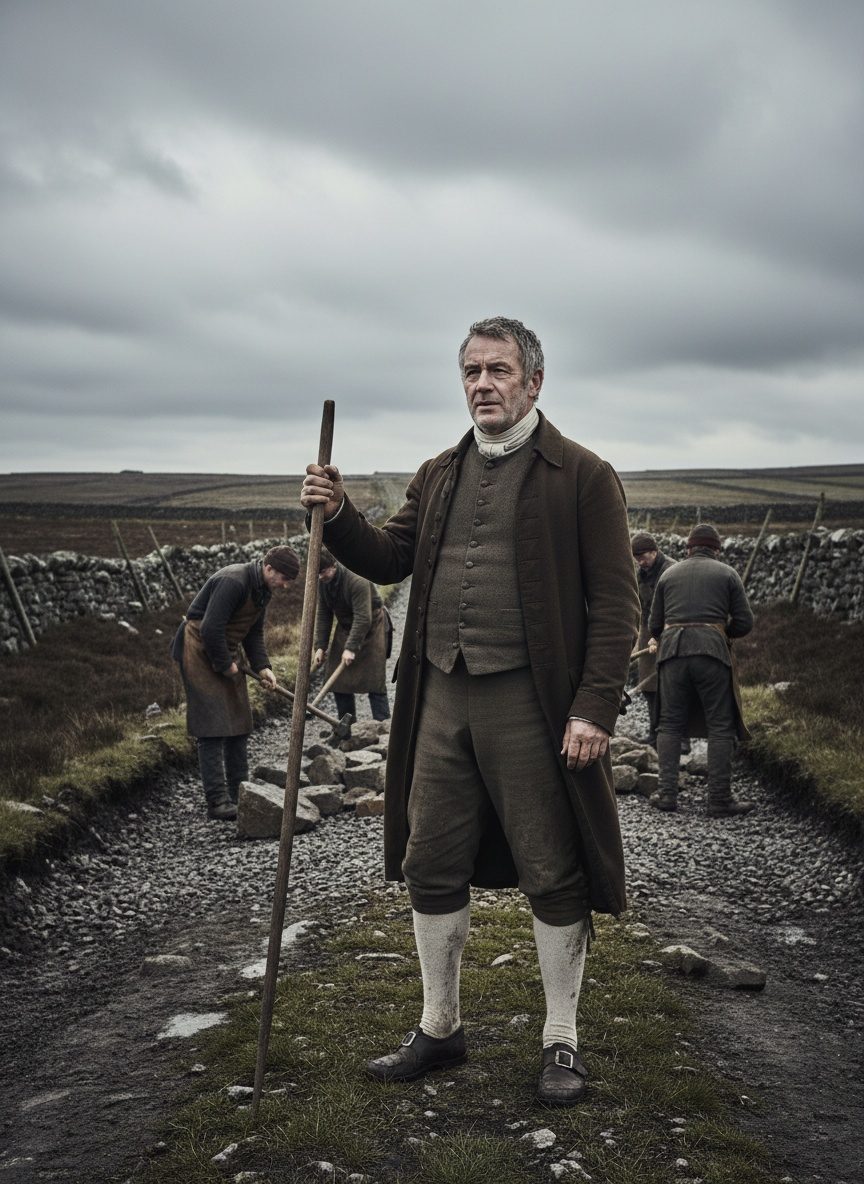
It was this daring that led him to the Pennines, a land riddled with impossible promises for those attempting to coax paths from its rugged landscape. While sighted engineers faltered at the notion of tempering such terrain, Metcalf embraced the challenge, not with sight, but with hands, feet, and mind as his guides. Armed with a long staff, he felt for the solid ground beneath the moorland bogs, calculating gradients and intuiting the land's natural contours. It was said that his roads bore an eerie precision and elegance, crafted with an artistry born from necessity, encouraged by internal sight.
Read next: The Day a Cornish Surgeon Walked Into a Condemned Cell
Leading Men and Forging Paths
Metcalf possessed more than mere skill; he wielded an influence that inspired trust among the men he led. Known as "Blind Jack of Knaresborough," Metcalf attracted a camaraderie with the navvies, those laborers who looked beyond his blindness and saw only the strength of his resolve. To them, Metcalf was not simply a project manager but a fellow tradesman of the earth—one who wrestled the land alongside them, shoulder to shoulder in their shared endeavor.
The Pennine roads were built with sweat and sheer determination, cutting through vast expanses of unforgiving moorland and intractable bogs. But where others might have seen a blind man leading navvies, Metcalf saw teamwork and potential. He developed ingenious methods for surveying his routes, often sending his men ahead to drive stakes into the ground at regular intervals. By walking the staked lines, Metcalf could sense any rises or falls in the terrain and adjust the path accordingly. It was laborious, yes, but incredibly effective.
His roads were said to be among the finest in England, a testament to his perseverance and subtle understanding of natural landscapes. In a period often plagued by hastily devised and poorly executed infrastructure projects, Metcalf's legacy stood as proof that dedication and innovation could overcome what seemed impossible. His ability to see what others could not extended beyond the geographical, transforming the local economy and improving connectivity within the region.
Read next: The Day a Vicar's Son Walked Into a Debtor's Cell and Freed Them All
The Legacy Within and Beyond Borders
Across 180 miles of England's northern reaches, Metcalf's roads became more than mere pathways; they were lifelines that connected communities, opened markets, and facilitated the exchange of culture and commerce. From the bustling town of Knaresborough to the remote moors, Metcalf's work proved vital to the nation's progress during a time of rapid change and industrialization.
Yet the true essence of Metcalf's contribution lies in his challenge to the limitations imposed by circumstance. Where others measured boundaries in disability, he saw opportunities for empowerment and achievement. His work does not merely illustrate an engineering feat but underscores a broader human truth: that vision, in its most profound form, is not bound by the eyes but is born of determination and an unwavering belief in the possible.
In a world that too often defines capability in narrow terms, John Metcalf's life story offers a reminder of the hidden potential within us all. His roads were not just forged through landscape but through the barriers of perception, inspiring future generations to question perceived limits. In every contour laid down more than two centuries ago, Metcalf left an indelible mark that continues to guide and challenge us today. Readers might ponder this as they travel without thinking—the stories behind the roads they traverse and the extraordinary people, often left out of the textbooks, who made those journeys possible.