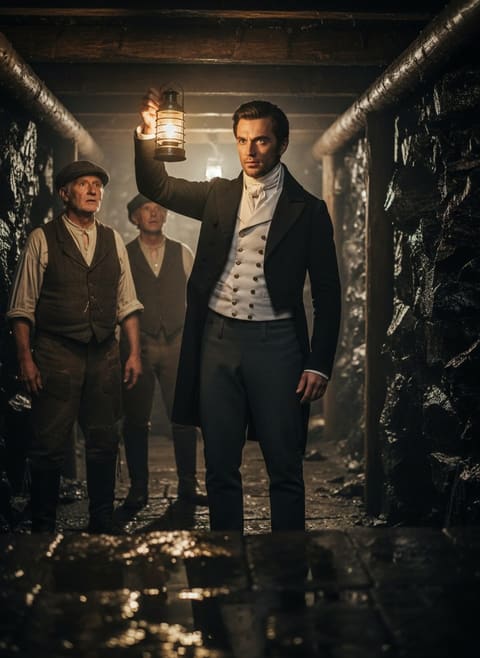
He had almost no formal education. Yet Michael Faraday became one of the greatest scientific minds of the 19th century.
Faraday's unlikely journey began in the midst of London’s bustling streets, where he was born in 1791 into the world as a blacksmith's son. His early life could have easily predetermined his future to continue in the family trade, yet it was an altogether different path marked by curiosity and opportunity that sparked his intelligence. At the age of thirteen, after receiving only the most rudimentary schooling, Faraday was sent to apprentice at a local bookbinding shop. This new trade seemed unassuming enough, but it laid the foundation for one of history’s most extraordinary self-educational exploits.
In the musty shadows of Riebau's bookbinding shop, Faraday found a treasure trove of information. He voraciously devoured the contents of the books he was meant to bind, turning every spare moment into an opportunity for self-taught discovery. Here, hidden amongst the pages of academic and philosophical tomes, Faraday discovered not just knowledge, but a passion for chemistry and the natural sciences.
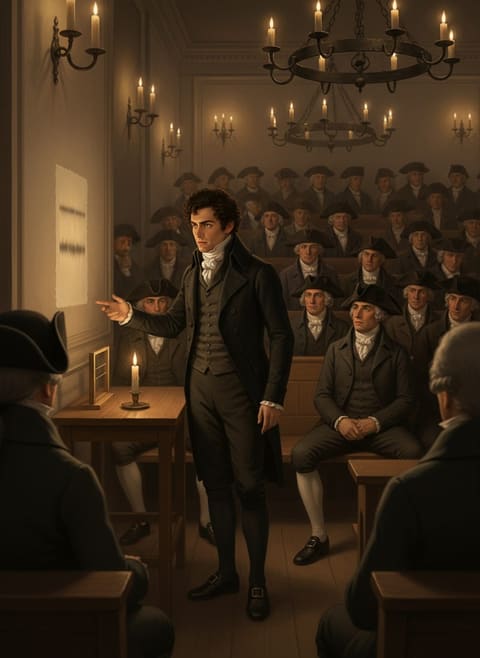
By the age of twenty-one, brimming with newfound insight and a hunger for more, Faraday seized a rare opportunity to attend lectures by the esteemed chemist Humphry Davy. It was the year 1812 when he sat enthralled in the hall of the Royal Institution, meticulously taking notes that would later become his ticket into a life of scientific endeavor. Davy, influenced by Faraday's dedication and determination, offered him a position as a laboratory assistant—a role that would change Faraday's life forever.
Read next: The Day a Weaver's Son Mapped the Invisible World
The journey was not without its hurdles. The scientific community at the time was an elite circle, guarded by class and pedigree. Faraday, a young man without a university education or notable lineage, was determined to prove his worth. He navigated this complex labyrinth with humility and an unyielding dedication, eventually finding his place in the world of scientific innovation. Over time, he mastered the art of experiment and observation, absorbing all he could from Davy and the wealth of knowledge he had access to at the Royal Institution.
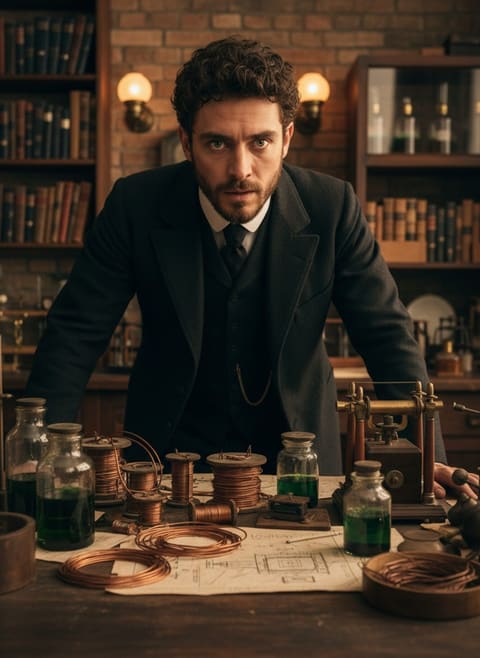
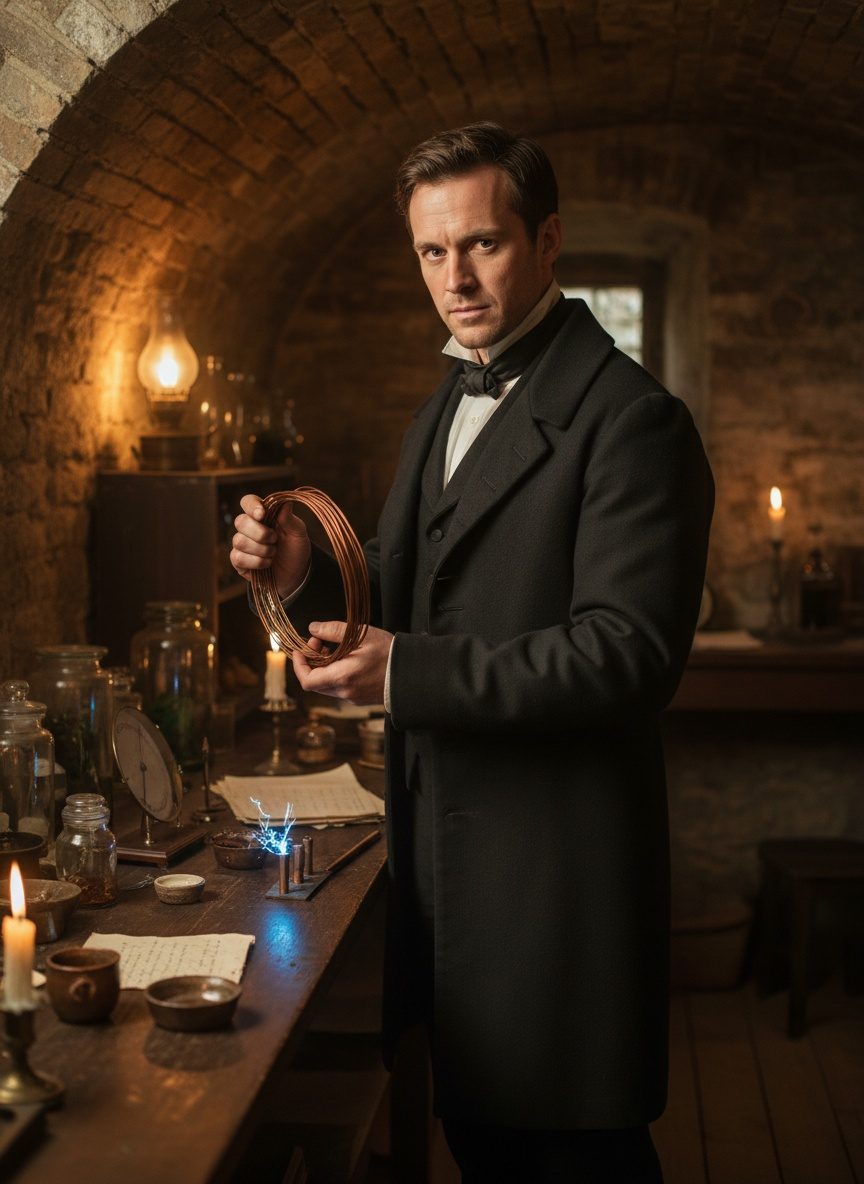
It was in the basement laboratory of this hallowed establishment that Faraday embarked on a series of groundbreaking experiments concerning electromagnetism. It was within these walls, amid the clink of glassware and the hissing of Bunsen burners, where he would make his most enduring contribution. The experiment was deceptively simple—a metal wire, a magnet, and an electric current—but its implications were profound.
Faraday discovered that when he moved a conductor through a magnetic field, it generated an electrical current—a phenomenon now known as electromagnetic induction. This principle was no mere curiosity; it would serve as the cornerstone for the development of electric generators and transformers, eventually leading to the expansion of electricity's role throughout the world.
With this revelation, Faraday effectively switched on the engines of the modern world. His work provided the theoretical foundation for harnessing and generating electricity, transforming it from an experiment in a lab to an essential utility powering cities across the globe. Despite the fact that he could scarcely have imagined the full scope of its impact during his own lifetime, Faraday's discovery set the stage for the electrification that would illuminate entire nations, catalyzing the move from gaslight to electric bulb and beyond.
Read next: The Day a Clockmaker's Son Rewired How We See the Stars
Faraday, ever modest and unassuming, continued his scientific endeavors, contributing indispensable insights across various fields of physics and chemistry. Not one to rest on his laurels, he pursued research in electromagnetism, electrochemistry, optics, and even diamagnetism, earning him the reverence of peers and accolades from institutions far more prestigious than any he could have dreamed of attending as a young boy.
In an era defined by rapid technological advancement and industrial prowess, Michael Faraday stood as a beacon of intellectual perseverance, a testament to the boundless potential of human curiosity and ingenuity. His humble beginnings and lack of formal training underscore a resounding truth about the democratizing power of knowledge: that with enough passion and perseverance, the barriers separating ordinary life from extraordinary achievement can be all but dissolved.
Today, as our world thrums to the tune of high-voltage power grids, producing energies far beyond what could have been envisioned in the rainy streets of Victorian London, Michael Faraday's legacy endures. It reminds us that the future is not illuminated merely by the chandeliers of the elite, but by the grit and imagination of those who, with little more than a passion for understanding, dare to illuminate the shadows of the unknown, giving us the power—quite literally—to see the world in a new light.