October 18, 1761. The wind bit sharply against the sails of HMS Deptford.
The Problem of the Unmeasurable Sea
For centuries, the great oceans of the world held a deadly mystery — one that no university-trained scholar or seasoned sailor had managed to solve. To navigate with any accuracy, to know precisely where one was on the vast expanse of water, required knowledge of both latitude and longitude. While latitude could be discerned through the position of the sun at noon, longitude remained, for much of history, an abyss of uncertainty.
The consequences were dire. Shipwrecks were common, and countless sailors met their fates dashed upon unseen rocks or lost in the boundless blue. What sailors needed was a reliable way to measure time accurately at sea because, quite simply, the Earth’s rotation could be likened to the world's truest clock. If one could determine the time at a known location while also knowing the local time, longitude could be calculated, transforming navigation into something approached with mathematical precision.
However, the sea, relentless and unforgiving, seemed determined to thwart such endeavors. Pendulum clocks swung wildly with the motion of a ship, and temperature changes affected clock mechanisms too greatly for accuracy. Some of Britain's finest theoretical minds called it impossible. And yet, it was to a self-taught clockmaker from Yorkshire that hope came to rest.
Read next: The Day a Weaver's Son Mapped the Invisible World
The Clockmaker's Unwavering Dedication
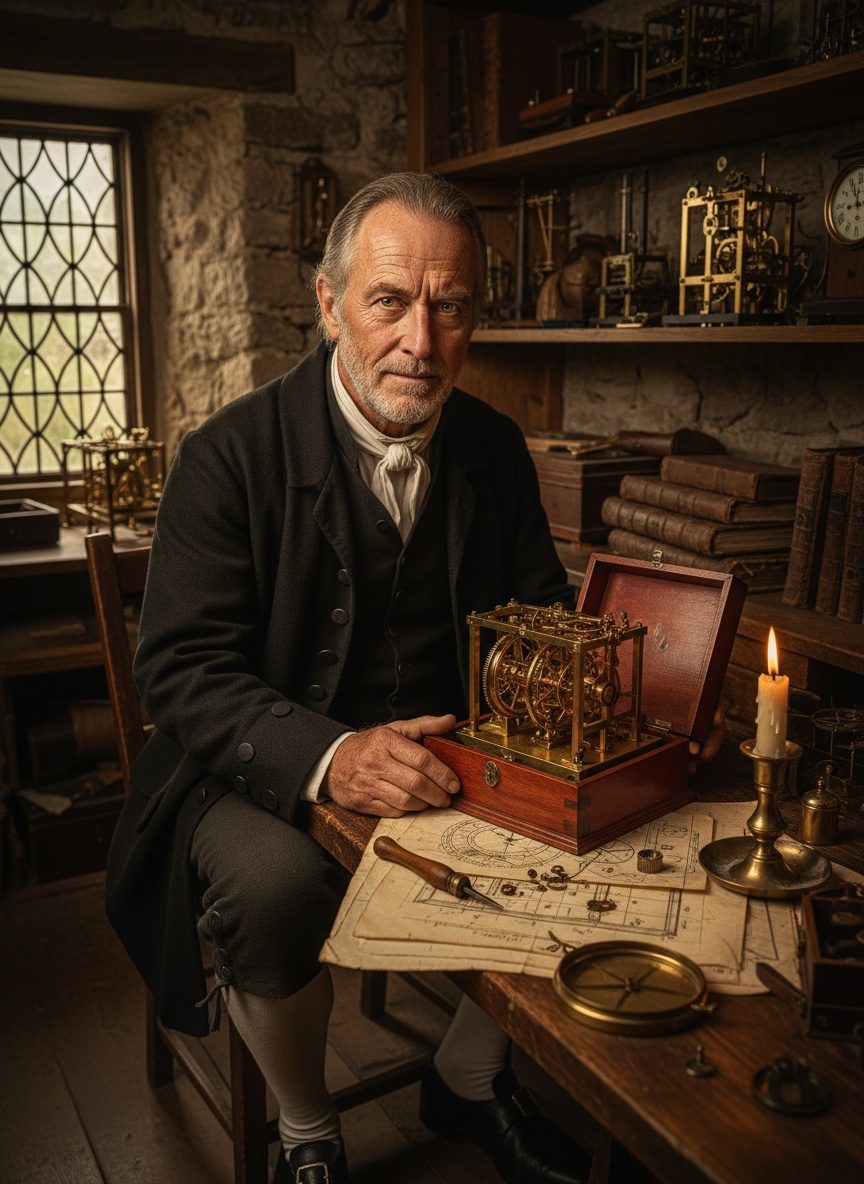
In the quiet corners of England, far from the haughty halls of the Royal Society, John Harrison embarked on a path that would redefine maritime navigation. Born the son of a carpenter in a humble village, Harrison’s curiosity led him down the path of clock making. His early constructions, built with the precision of a carpenter’s hand, began to whisper of the secrets of time.
By 1761, Harrison had been consumed by this singular challenge for four decades. Along the way, he encountered skepticism that would have made lesser men surrender. Guided by nothing more than practical engineering and unshakeable resolve, Harrison crafted an object like no other: the marine chronometer, a marvel of intricate gears and springs that was impervious to the ocean's wrath. While other timepieces faltered in the face of rolling seas, Harrison’s creation, fondly dubbed H4, promised to keep impeccable time.
It was characteristic of Harrison to test his work uncompromisingly. Not only did his chronometer have to withstand the relentless battering of waves and the corrosive sea air, it also defied natural expansion from heat and contraction from cold. The challenge was immense, but Harrison’s craftsmanship was destined to turn probability into possibility.
The 1761 Voyage: A Test of Time
With Harrison's son, William, in possession of the precious H4, the HMS Deptford embarked on its journey to Jamaica—a voyage that would decide the fate of John Harrison’s lifelong endeavor. The chronometer, unlike the splash of the ocean waves or the unpredictable squalls, ticked away with serene certainty, seemingly untouched by the elements.
As days turned into nights, and weeks into watch rotations, Harrison's clock displayed a steadfast endurance. HMS Deptford might have been a typical frigate of His Majesty's Navy, yet it held within its wooden heart a revolution-in-waiting. There in the creaking hull, amidst the clanking of muskets and the chanting of sailors, the chronometer maintained its accuracy with an error of no more than five seconds by the end of the journey.
Read next: The Day a Clockmaker's Son Rewired How We See the Stars
Such precise timekeeping meant that longitude could be calculated to within about a nautical mile, a revelation that rendered theoretical debates moot. It’s said that on these waves, something beyond a simple mechanical achievement had been accomplished—it was a promise that mankind had finally cracked one of the age-old maritime challenges, one previously believed to be impossible.
Echoes Through Time
The significance of John Harrison's accomplishment extends beyond its immediate implications for navigation. His marine chronometer lent the Age of Exploration and Empire a degree of safety and precision it had never known. The invention helped Britain solidify its control over the sea routes of the world, underpinning the empire’s growth and influencing trade routes for generations.
Yet, at its core, this story is about the quiet power of persistence and ingenuity. Harrison's journey underscores a lesson often left unspoken in textbooks — that sometimes the greatest minds are not those in ivory towers, but the relentless spirits in workshops, marked by grease and dust, who see beyond the impossible.
In our rapidly evolving world, where innovation often meets skepticism, John Harrison’s victory over uncertainty reminds us that the greatest discoveries still lie in the hands of those who dare to say, “What if?” It’s this heartbeat, which Harrison gifted to the world, that continues to echo throughout time, as steady and honorable as each tick of the wondrous H4.