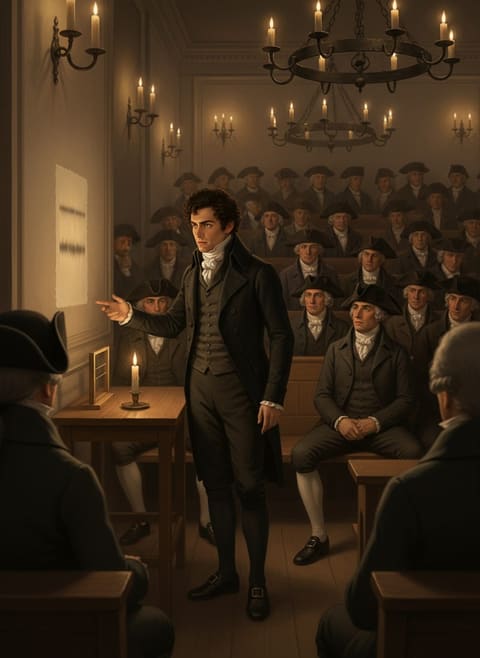
The breeze off the Thames River was sharp with the bite of early morning when John Harrison, a clockmaker hardened by decades of labor, found himself facing the reluctant disinterest of the Royal Astronomical Society. For over forty years, Harrison had dedicated his life to solving one of the deadliest riddles of navigation—how to measure longitude at sea. Yet, here he stood again, with only dismissals and derisive laughter in return for his life’s work. It was a dream plagued by relentless obstacles, but Harrison had one last card to play.
More than idle curiosity drove his ambition. Lives were at stake. Each year, ships vanished, claimed by the oceans because they could not determine their east-west position on the open sea. Latitude was a simple problem, solved by the angle of the sun or northern stars. Longitude, however, required the calculation of time — time that could change everything.
In 1714, a solution had been deemed vital enough to prompt the British Parliament to offer a staggering prize of £20,000 to anyone who could provide a practicable method of discovering longitude. This bounty stirred the minds of inventors, scientists, and rogues alike. People speculated about astronomical tables, or even outlandish mechanical devices. But for Harrison, the answer lay within the beating heart of human innovation — a reliable timepiece.
Harrison was a self-educated son of a carpenter, a simple craftsman from Yorkshire, yet his mind was anything but humble. With precise movements and patience as enduring as the oak woods he once shaped, he dedicated his life to building a marine clock — a chronometer — that would keep time with precision unaffected by the motion of a ship or temperature changes at sea.
Read next: The Day a Weaver's Son Mapped the Invisible World
His first attempts — H1, H2, H3 — were marked by intricate gears and massive, cumbersome frames. They resembled small siege engines more than wristwatches. As a carpenter’s son, Harrison’s hands were deft, but breakthroughs were slow, each tick of progress a battle with materials and ingenuity. Despite his exceptional prototypes, doubt threaded the halls of Britain’s scientific elite. While they marveled at his craftsmanship, they were hesitant to entrust their voyages to such mechanical experiments.
Each iteration inching him closer to the prize, Harrison knew that time was not on his side. Still, he pressed on, refining his designs with the single-minded focus of a craftsman obsessed with precision. By 1761, he presented the H4, a marvel reduced to the size of a large pocket watch — its innovation lay in its ability to maintain precision across severe conditions, and its elegance echoed the ticking pulse of eternity itself.
The test that followed cast Harrison’s hopes adrift once more. When the Admiralty ordered his chronometer to be tested on a voyage to Jamaica, its success was nearly buried beneath bureaucratic hesitance and technicality. Yet Harrison, stubborn and persistent, did not fade into the obscurities of history. In 1773, desperate to see his work recognized, he went to the only power that stood above the establishment that had held him back: the king himself.
Read next: The Day a Clockmaker's Son Rewired How We See the Stars
King George III became a reluctant yet faithful ally. Known as a man of science, he took it upon himself to test Harrison’s chronometer under his own roof at the palace. For months, George III documented the precision of H4, measuring the subtle dance of seconds that could mean life or death to sailors adrift in perilous waters. His conclusion resounded with immutable authority — Harrison’s chronometer worked, a triumph of human craftsmanship over nautical chaos.
With royal advocacy forcing the Admiralty's hand, recognition at last arrived. Harrison, weathered and aged, finally claimed the prize in his twilight years. His journey had traced the delicate balance between resilience and innovation, his victory an indelible swing of justice not only for himself but for the thousands of sailors whose journeys were shortened by the precision of time.
John Harrison’s clock had given the world a tool of unparalleled reliability, the very heartbeat of the sea discipline. This achievement bore a timeless impact. It was a revolution silent in its operation, yet it forever altered mankind's relationship with the oceans, turning the malevolent depths into navigable routes of trade, exploration, and vision. Although Harrison’s name is whispered like ghost voice among broader retellings of maritime history, the essence of his life's work still echoes — not just in the mechanics of navigation, but as a reminder of the relentless human spirit tasked with mastering nature’s vast, mysterious expanses.