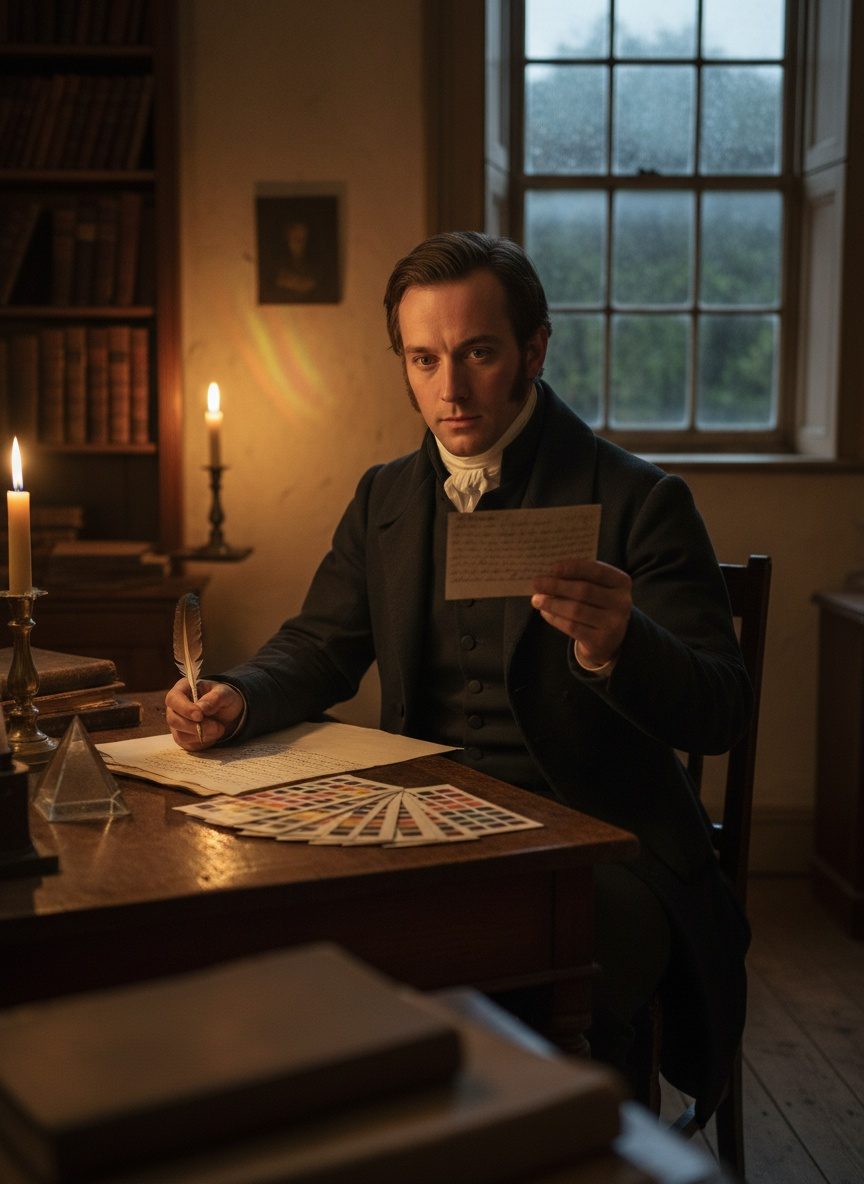
The damp cobbled streets of Manchester in 1794 gleamed under the morning drizzle, transforming the city into a blurred collage of grey hues. The air was thick with the scent of coal smoke and wet earth, as the city slowly awoke to the clamour of industrial progress—a symphony of clanging hammers and creaking wooden wheels. In a modest room situated on a narrow street, a young schoolmaster sat hunched over a desk, papers strewn about like leaves in autumn. His name was John Dalton, and while the world around him was awash with colours he could not fully comprehend, he was on the brink of unravelling a mystery that had long confounded him.
Born into a Quaker family in the serene countryside of Cumberland, Dalton had always been drawn to the natural world, a curiosity that flourished despite his economical hardships. His fascination with the sciences was as relentless as the rain that often drenched the fells of his homeland. Yet, within this scientific passion lay a personal quandary—an inability to perceive colour as others did. He had always struggled to distinguish between shades that seemed vibrantly distinct to those around him. While others marveled at the deep crimson of a sunset or the rosy blush of an English rose, these colours eluded him, blending into the mundane tapestry of his vision.
In 1794, this personal affliction transformed into scholarly pursuit when Dalton began his systematic inquiry into colour perception. The task was Sisyphean; he lacked the sophisticated instruments of future generations, relying heavily on his acute observation and relentless dedication. Through painstaking experiments with coloured liquids, which often resembled nothing more than kitchen concoctions, Dalton documented his observations with meticulous detail. It was amid these trials that he realised his view of the world was not unique in its deficiency—a revelation that prompted him to share his findings with the broader scientific community.
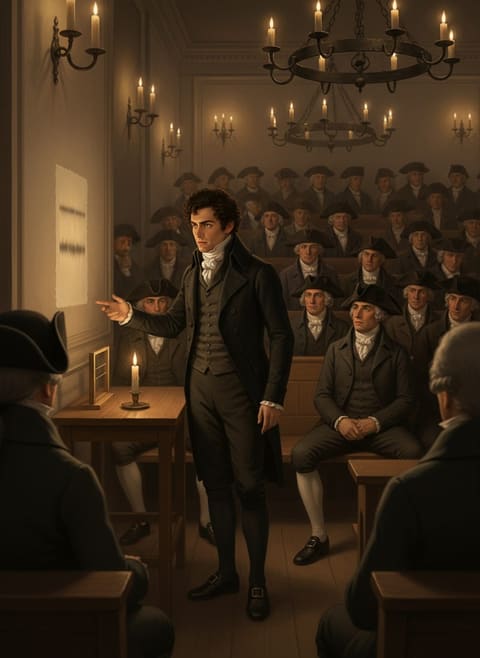
Dalton's groundbreaking paper, presented to the Manchester Literary and Philosophical Society, marked the first scientific exploration of what we now know as colour blindness. He theorised that this visual anomaly might stem from a discoloration of the fluid in the eyeball, an idea that would later be proven incorrect, but the fact remained—he was opening a new frontier in the understanding of human perception. His work provided a scientific explanation to a condition that had, until then, been relegated to personal peculiarity or dismissed as folly.
Read next: The Day a Weaver's Son Mapped the Invisible World
What Dalton achieved went beyond a mere scientific paper—it was a shift in how the world viewed colour, and by extension, those who perceived it differently. He pioneered the notion that vision discrepancies were not merely deficiencies but variations of perception. This challenged the widely accepted norms, broadening the landscape of scientific inquiry into human biology. Dalton gave this phenomenon a name—Daltonism—a testament to his deep-seated involvement in the birth of this field. In doing so, he laid the foundation for future scholars, who would build upon his initial findings with the aid of advancing technology and scientific understanding.
Throughout his life, Dalton's commitment to both teaching and research remained unwavering. He was as much a fixture in the Manchester academia as the workhorse chimneys dotting the skyline, tirelessly advocating for the importance of scientific inquiry. His dedication to exploring the natural world was indiscriminate, with contributions spanning meteorology, atomic theory, and even the development of early weather charts. Yet, it was his work on colour blindness that left an indelible mark on the world, shaping how subsequent generations would understand sensory impairments.
Read next: The Day a Clockmaker's Son Rewired How We See the Stars
As Dalton grew older, his reputation as a man of science solidified, attracting the awe of contemporaries and the respect of later scientific luminaries. He became an emblem of the self-taught polymath whose inquisitive nature and contemplative spirit could transcend the limitations of his time. The seeds of curiosity he had sown in the field of vision science would flourish long after his death, sprouting into a world where diverse forms of sight were not only acknowledged but celebrated.
The story of John Dalton is not simply one of scientific triumph but of human tenacity and the quest for understanding in a time when the world was still being mapped in hues of discovery. His relentless pursuit of answers to a problem as intimate as the colours he could not see is a reminder of the power of personal experience in driving scientific innovation. And today, as we navigate the complexities of perception and reality, Dalton’s legacy endures as a poignant reminder that sometimes, it is the questions born from our limitations that guide us to greater truths.