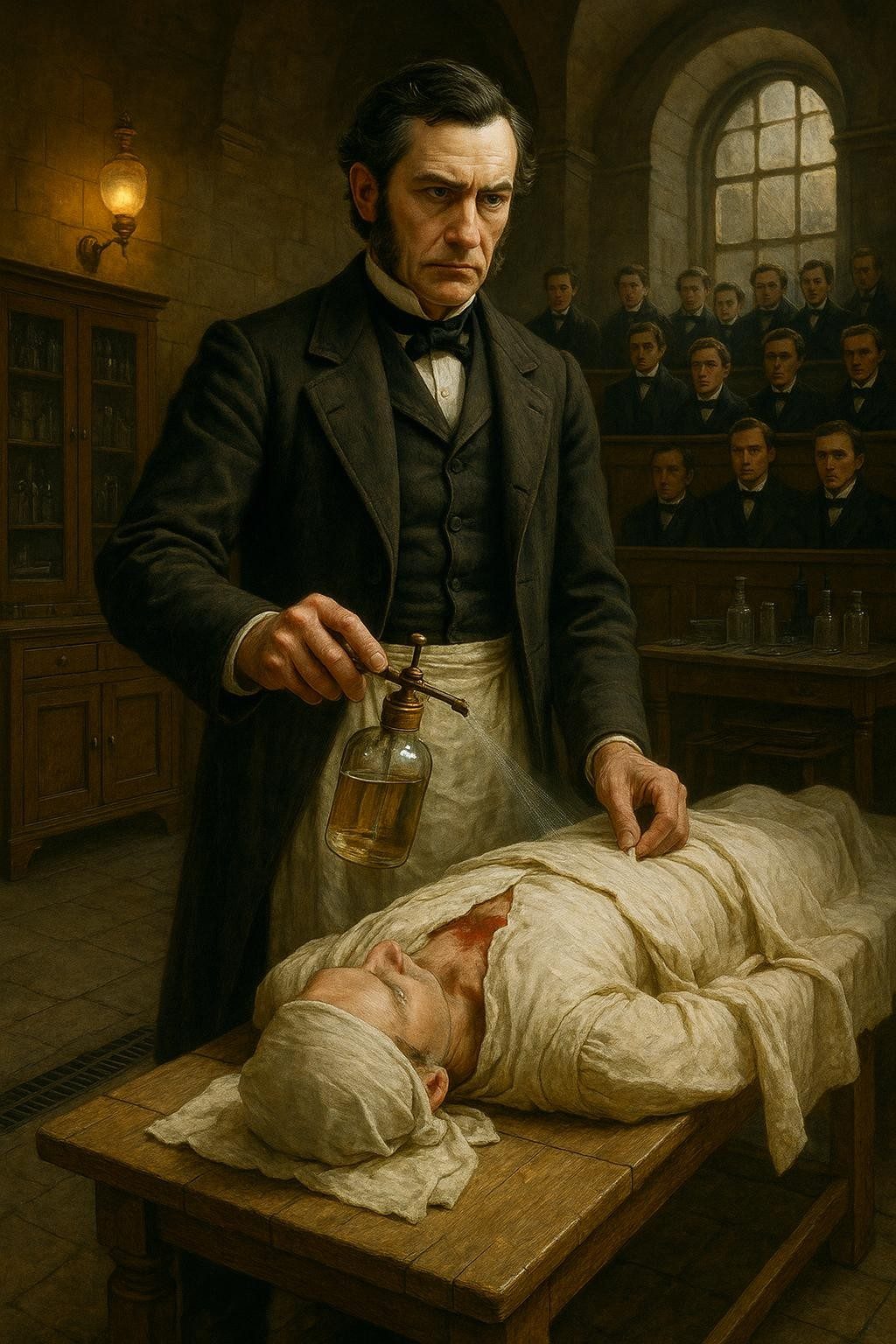
March 16, 1865. A thick fog clung to the streets of Glasgow, swallowing sound and muffling the city’s frenetic heartbeat. Inside the infirmary, silence was impossible.
The Silent Battle of Glasgow
At Glasgow Royal Infirmary, the air carried a sour, metallic aroma — an unholy blend of blood, damp ether, and the unwashed linens that shrouded a legion of injured men. Here, death was a frequent visitor, especially in the post-operative wards where one dreaded word whispered through the corridors with mounting hopelessness: putrefaction. It was a grim fate, the odious decay of the living, inflicted by the unseen hand of infection that cut deeper than any surgeon's scalpel.
Joseph Lister, a quiet surgeon who seemed perpetually lost in introspection, wandered the halls with a gaze that both pierced and pondered. Son of a Cornish miner, Lister was a man carved from the rugged cliffs of Cornwall — his hardiness mirrored the stone, yet his mind was as boundless as the sea. While others accepted the carnage in the wards as a brutal necessity, Lister refused to look away. He watched, he listened, and he dared to question the long-held traditions of medicine that declared cleanliness unnecessary in the wake of surgical practice.
Inspired by Louis Pasteur’s germ theory — itself a contentious whisper in the grand halls of established medicine — Lister concocted an idea as radical as it was simple: an antiseptic solution to wage war against the invisible enemy. His laboratories were makeshift — if not downright primitive by today's standards — but there, amidst stained glass and guttering candlelight, he tested and retested his theories. Few believed him, fewer encouraged him. But in the long dance with death, isolation breeds resolve. Lister resolved to change the fate of surgery not through force, but through quiet persistence. The antiseptic he would ultimately trust was carbolic acid, and with it, Joseph Lister aimed not just to heal, but to revolutionize.
Read next: The Day a Weaver's Son Mapped the Invisible World
The Carbolic Crusade
If invention is the father of necessity, then desperation was the midwife of antiseptic surgery. In an era when the very action of breathing in hospitals could invite infection, Lister’s preliminary experiments were met not with excitement, but derision. Critics in the surgical community scoffed at the notion that invisible particles could morph into deadly entities, dismissing Pasteur’s budding literature as foolishness. However, Lister’s determination was resilient, the fires of his ambition stoked by the cries of the afflicted and dying.
The shadows of doubt extended from Lister’s peers to his operating theaters where he enacted his antiseptic ritual. Shadows lurked behind his instruments of steel, the malodorous threat of gangrene looming in defiance. Here, among bloodied bandages and dim lanterns, Lister applied his solution of carbolic acid upon wounds and instruments alike, his actions meticulous and calm as though he were painting care upon the canvas of life.
Skepticism tarnished the air around him, yet as months passed, a startling change became clear. Fewer wounds festered into their dreadful carrion blossom. Patients, once destined for sepsis among the crowded and futilely ventilated wards, showed unexpected signs of recovery. Lister recorded each triumph with a scientist's precision, cataloging converted frowns of doubt into arched brows of intrigue. News of his success began to echo beyond the walls of the infirmary, stirring curiosity in far corners of the medical world.
Yet triumph was ripe with challenges. Lister's crusade was not merely one against disease but against the weary inertia of men content with known defeats. Improvements were not immediately heralded with trumpets of victory. Traditions, after all, die hard. Lister's painstaking documentation and the undeniable fragrance of success were catalysts for change, igniting the first sparks of what would become a modern revolution in medicine.
Read next: The Day a Clockmaker's Son Rewired How We See the Stars
The Legacy in Every Breath
Through the gloom of habitual suffering, a ray of empirical light shined with increasing intensity. The skepticism that veiled early antiseptic trials gradually unraveled as the data spoke truth: antiseptic techniques reduced mortality. Doctors, like generals receiving new maps in an ancient war against death, began to embrace carbolic acid not as a curiosity but a crucial ally.
Lister’s resolve whittled away the granite foundation of surgical fatalism, ushering an age where antiseptic methods paved the corridors of operating theaters worldwide. His impact transformed the grim realities of Victorian medicine, breaking the fevered cycle of infection that turned noble institutions into charnel houses. The subsequent acceptance and evolution of antiseptic practices crescendoed into modern sterilization techniques, revolutionizing the field and gifting humanity years — if not centuries — of life previously undone by invisible spores and microorganisms.
Though Lister’s humble crusade began in the shadows of doubt, its legacy resides between every inhaled breath, a testament to curiosity over fear, inquiry over silence. His story reminds us that the quiet conviction of an inquisitive mind can change the world, not through thunderous revolution, but through persistent, calm insistence in the rightness of discovery. The Cornish miner’s son from Glasgow didn’t merely heal wounds; he altered the course of history one antiseptic drop at a time. In honoring Joseph Lister, we honor the transformative power of questioning the unseen forces that shape our world and the relentless pursuit of knowledge that defies even death itself.