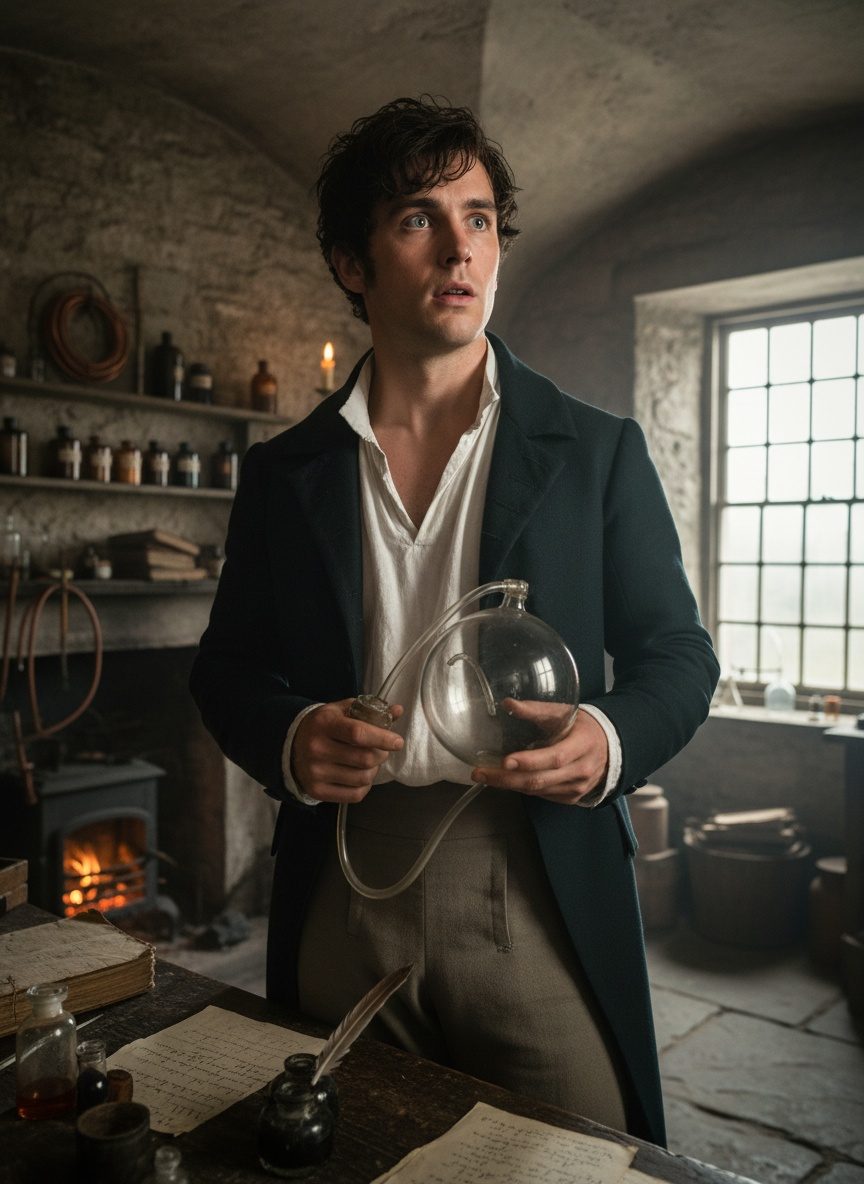
August 1799. The salty air clung to the cliffs of Penzance, where the Atlantic winds blew with unabated power.
The Unlikely Laboratory
In the heart of Cornwall, a small town known more for its rugged seascapes and tales of smuggling than scientific discovery, a young man named Humphry Davy stood at the brink of groundbreaking innovation. The son of a humble woodcarver, Davy was not born into the world of academia or privilege. Yet, his restless mind and insatiable curiosity drove him to unravel the mysteries of nature from the confines of a makeshift laboratory in the basement of the Penzance Dispensary. It was here, amidst the smoky lamplight and the scent of seacoal, that Davy embarked on a journey that would forever change the course of medical science.
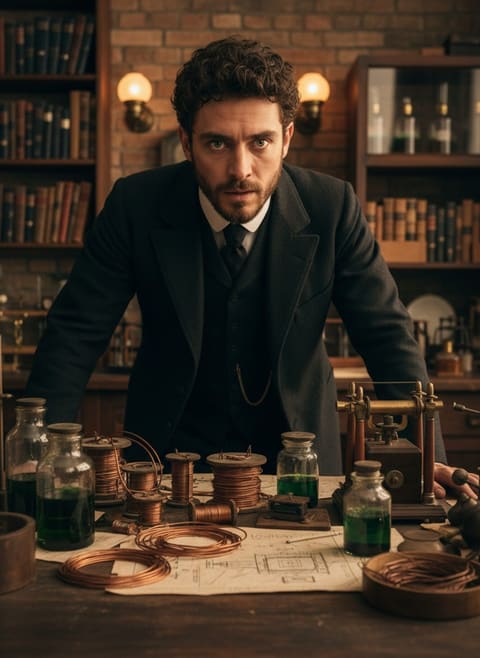
Davy's workshop was a testament to resourcefulness and imagination. Equipped with little more than borrowed scientific instruments and his own ingenuity, he transformed the space into a sanctuary of alchemical exploration. For young Davy, the world was not defined by boundaries of formal education or financial limits, but by the endless possibilities he could imagine. He delved into the bubbling cauldrons of chemistry, producing gases and compounds with an artist’s flair, guided only by his fearless experimentation and keen observational skills.
In this modest setting, Davy was driven by the allure of gases that had barely been understood. Chemistry was still an evolving field, one that promised as much danger as it did discovery. It was his relentless probing into the nature of these gases that led him to inhale the vapors of nitrous oxide—a moment that would soon echo through the hallowed halls of medical history. The gas, which induced a euphoric state followed by fits of laughter, would later earn the moniker "laughing gas." Davy, in his detailed documentation, noted its peculiar ability to erase pain as it enveloped the senses in a blissful haze.
Read next: The Day a Weaver's Son Mapped the Invisible World
A Vision Through Haze
With the candor of a scientist and the soul of a poet, Davy articulated the intoxication he experienced with nitrous oxide—a feeling of floating joyously detached from the corporeal world. This ecstatic detachment, as he meticulously recorded, hinted at potential applications beyond mere amusement. In an era when surgical procedures were excruciating ordeals endured without anesthetic relief, Davy envisioned a future where pain might be vanquished. His prescient insight—that nitrous oxide held the potential to anesthetize patients during surgery—was nothing short of revolutionary.
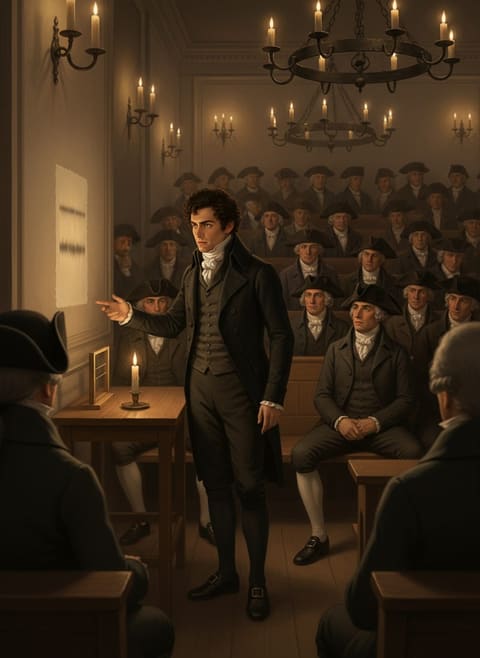
Yet, in the corridors of London's prestigious institutions, Davy's revelation fell on deaf ears. Medicine, steeped in tradition and wary of maverick discoveries, was reluctant to embrace the visions of a self-taught outsider. To his dismay, the very circles needed to propel his observations into practical use viewed his findings as little more than the curious musings of an eccentric provincial.
Despite the lack of immediate recognition, Davy's restless mind refused to remain idle. His tenure at the Pneumatic Institution in Bristol, and later at the Royal Institution in London, saw him continuing to push the boundaries of chemistry and invention. His eventual discovery of several key elements and compounds, including the isolation of potassium and sodium through electrolysis, would cement his legacy in other domains. However, his proposition for nitrous oxide's use in anesthesia waited patiently for a savvier age to rise upon it.
Read next: The Day a Clockmaker's Son Rewired How We See the Stars
Echoes of Laughter
It would take forty long years before Davy’s foresight found validation. The world had turned, and the clamor of the Industrial Revolution brought with it advances in medical techniques. Only then did surgeons begin to feel the pressing need to alleviate the pain and terror that accompanied their operations. It was in this climate that nitrous oxide reemerged from the shadows of Davy's overlooked predictions. In the mid-19th century, dentists and surgeons began to administer this elixir of calm, paving the way for modern anesthetic techniques.
Humphry Davy’s early experiments with laughing gas were a testament to his visionary grasp of science’s transformative power. His story, born from the unassuming beaches and tin mines of Cornwall, reminds us that the beating heart of innovation often originates from the most unlikely of backgrounds. He was a harbinger of ideas whose time had not yet come, a beacon in an age that was not quite ready to illuminate all corners of possibility.
In the laughter that echoed from his humble experiments, the world found not just a fleeting amusement, but a profound shift towards the compassionate practice of medicine we strive for today. Davy’s journey from the rugged Cornish coast to the forefront of scientific endeavor underscores the timeless truth that inspiration knows no bounds, and often it takes the bold imagination of one brave spirit to breathe life into the dreams of the future.