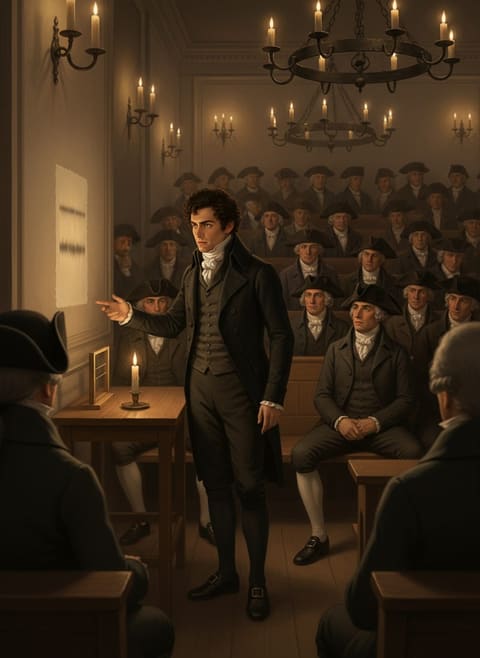
May 14, 1796. The dawn air in the Gloucestershire village was crisp and filled with the scent of blossoming hawthorns.
In this tranquil setting, the unassuming country doctor Edward Jenner was about to challenge the limits of medical knowledge. There was nothing in the outward appearance of Jenner's modest home that hinted at the revolution brewing within. Its stone walls stood quietly, mirroring the quintessential English countryside. Yet, on this particular day, the calm belied the stirrings of a breakthrough that would echo through centuries.
Jenner, a man of slight build but immense curiosity, leaned over a young boy named James Phipps. This wasn't just any child; James' father was Jenner’s gardener, and the boy had unwittingly become part of an experiment that defied the ridicule of England's medical establishment. The boy's innocent eyes met Jenner's calm and determined gaze. This was no ordinary medical test—it was the culmination of a theory that had ignited vicious skepticism and even a modicum of ridicule among Jenner’s peers.
Smallpox, the scourge of societies around the world, instilled fear with its horrific symptoms and merciless spread. It respected no class or creed, casting a long and terrifying shadow across continents. Its hold was relentless, its devastation, profound. And yet, Jenner believed he had found a simple way to defy it, inspired not by scholarly texts but by the rustic wisdom of country folk. He had noticed that milkmaids who contracted the milder cowpox seemed immune to the ravages of smallpox. This observation, ignored by others, kindled Jenner's scientific imagination.
Read next: The Day a Weaver's Son Mapped the Invisible World
His thoughts might have wandered to the bucolic pastures where these milkmaids worked, their hands brushed regularly by the soft noses of cows who harbored a benign affliction. He connected the dots between cowpox and immunity to smallpox. To some, it was a folk tale; to Jenner, it was potential ground-breaking science. His radical proposition? Use the cowpox virus to create immunity to its deadly cousin.
Jenner's plan was disarmingly simple but audacious. He took material from a cowpox blister on Sarah Nelmes, a local milkmaid, and applied it to an incision on James Phipps’ arm. It was a quiet yet monumental moment as the essence of an age-old disease was hoped to fuel humanity's salvation. And yet, in a society dictated by scientific rigor, where observational wisdom was often overshadowed by academic prestige, the good doctor was about to set a new standard.
The aftermath of his actions would not be immediate. The waiting period was one of palpable tension, laden with hope and apprehension. Days passed. The boy developed mild fever and discomfort, symptoms Jenner expected, yet nothing that escalated to the terror of smallpox. Weeks later, Jenner exposed James again, this time to smallpox, a dire situation fraught with anxiety for both of them. But to the awe of many—and perhaps none more so than Jenner himself—the feared disease did not take hold.
In that moment, under the quiet skies of Gloucestershire, smallpox’s death knell had begun to sound. This seemingly modest act was, in truth, the opening chapter to a narrative that would transform public health across the globe. Jenner had developed the world’s first vaccine. Derived from the Latin 'vacca' for cow, the very name of this groundbreaking intervention paid homage to the humble origins of the vaccine.
The skepticism of the medical elites was soon tempered by the irrefutable success of Jenner’s method. His findings circulated beyond the confines of English borders to the grand cities of Europe and beyond, igniting a paradigm shift in medical science. Slowly, what was once the kernel of an idea blossomed into worldwide practice. The small cottage surgeon from Gloucestershire had changed global medicine with an insight offered to him by the countryside’s rural tapestry.
Read next: The Day a Clockmaker's Son Rewired How We See the Stars
Yet, this change did not occur overnight. Jenner faced resistance, partly from skeptics who doubted the reliability of what they perceived as rural folklore, but also from those with deeply inflexible views of established medical norms. Many doctors vehemently opposed his findings, citing them as unscientific or too incredulous to be taken seriously. But as the years wore on and Jenner’s method proved time and again to save millions from disfigurement and death, voices of dissent were gradually subdued.
In the 18th-century world, where superstition often intertwined with scientific endeavor, Jenner’s vaccine stood at the crossroads, symbolizing a new dawn in clinical observation and empirical science. It was a medicine born not from sterile laboratories but from the symbiotic relationship between man and nature, between rural environ and scholarly pursuit.
Today, as we cast our gaze back over the centuries, the seeds sown by that particular day in May can be observed in the global eradication of smallpox commemorated in 1980 by the World Health Organization. We see it in the myriad vaccines now counted on to safeguard populations worldwide. Jenner’s resolve and ingenuity remind us of the profound impact one determined individual can have on the fabric of history and humanity. Though mocked, his vision prevailed, not through might but through the gentle, persistent persuasion of evidence and efficacy.
In an era where new health challenges arise with daunting regularity, Jenner's story serves as a reminder of human resilience and the potency of informed inquiry. It stands as a quiet testament to the capacity for pivotal change that can emerge from the most unexpected of places, influenced by whispers of wisdom shared across generations and against the grain of accepted knowledge.