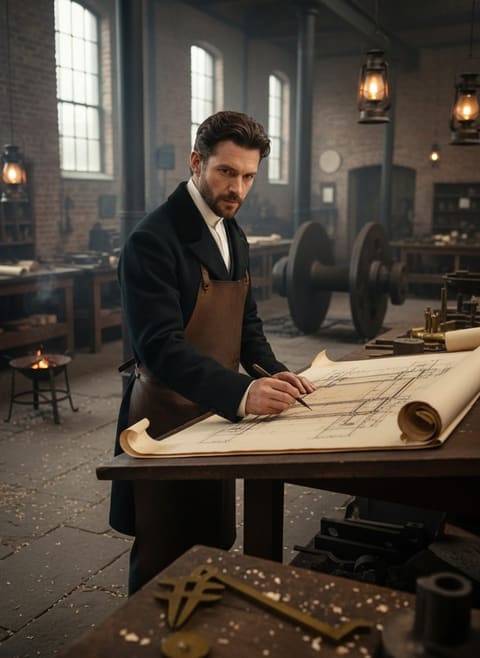
The small London workshop hummed under the canopy of a dim, penetrating silence. The only sounds were the soft crackling of a candle's flame and the gentle rasp of copper wire winding in careful loops. William Sturgeon, the shoemaker's son, guided the wire with meticulous precision around an iron bar fashioned into a horseshoe. His hands moved with a dexterous certainty, a choreographer of unseen forces. In the stillness, the air thrummed with anticipation — would this be the moment his tireless tinkering would come to life?
Sturgeon leaned over the makeshift bench, eyes narrowing as he connected the wire ends to a battery, his world enveloped in a near total silence courtesy of his deafness. Even at a young age, he had realized sound would not be the path by which he could decipher the world; instead, he relied on the language of mechanics, the palpable motions of the physical universe. What he lacked in hearing, he compensated with a prodigious understanding of science, all self-taught under flickering candlelight.
The dim workshop belied the magnitude of what was occurring within its confines. Sturgeon completed his final connection, and for a heartbeat, the world seemed to hold its breath in unison with him. Then, with a silent spark, everything changed. As electricity coursed through the wire, the iron bar sprang to life, the needle on his test apparatus flicked into motion — Sturgeon had given birth to an entirely new phenomenon: the first working electromagnet.
This breakthrough might have been silent, unnoticed by the London streets outside, but it was anything but small. It was the first tremor of a seismic shift that would reorder the world. Every electric motor that lived — in trains, in cars, in the appliances that quietly hum homes into motion — drew lineage back to this humble beginning. Yet, Sturgeon's journey to this pivotal point was as remarkable as the invention itself.
Born into poverty, William Sturgeon was not afforded the luxury of formal education. His schooling was, for the most part, conducted beneath the soft glow of flickering candles, his textbooks the sparse scraps of literature he could acquire. His deafness, far from a debilitating handicap, became a crucible forging his relentless curiosity. He became enamored with science through sheer wonderment at the world, each discovery a bridge to an unexplored domain of knowledge.
Read next: The Day a Weaver's Son Mapped the Invisible World
Though his beginnings were modest, Sturgeon was undeterred, his fervor for understanding the mysteries of nature unwavering. He learned from anything and everything around him, much like the currents he would one day harness exaggerating the subtle magnetism of iron. Lacking a formal mentor, Sturgeon fashioned his education from experiments and writings, a diligent student of the world.
1821 was a year steeped in transition and contradiction, a time when London's streets buzzed with the energy of the Industrial Revolution. Steam power was king, iron-clad behemoths belching smoke as they crawled across the burgeoning rail networks. It was an era dominated by innovation but only for those of privilege, not for those with quiet aspirations like Sturgeon, constrained by circumstance yet boundless in imagination.
The genius of William Sturgeon's electromagnet was entwined with his distinct ability to perceive beyond conventional limitations. Until his work, the idea of a dynamistic force subdued into practical usage was little more than speculative fiction. Yet, in this compact invention, a thread of copper and a fragment of iron infused with the force of electricity, Sturgeon wove possibilities that would weave through the fabric of modernity.
The significance of this discovery extended beyond mere scientific novelty. It signaled the opening of a new chapter, an invisible force that could be controlled, shaped, and applied to machines of unfathomable potential. This principle laid the groundwork for devices that ferry whispers across oceans, automobiles that span continents, and industries that light up entire cities.
Read next: The Day a Clockmaker's Son Rewired How We See the Stars
As Sturgeon marveled at the moving needle, perhaps he allowed himself a moment to ponder the doors now ajar. His quiet accomplishment would soon echo through the lofted halls of science and industry. It wasn't just the movement of a needle but the catalysis of a technological revolution, the ripples of which would reach far beyond the constrained walls of his quiet workshop.
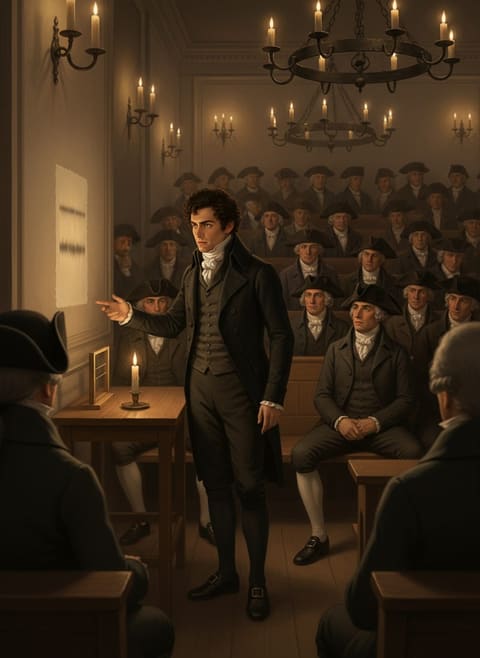
Sturgeon's tale did not conclude at the moment of his innovation. It was only the beginning of a curious odyssey, one that saw him spread his newfound knowledge, teaching others who would stand where he stood, envisioning further into the future. His penchant for outreach and sharing continued to illuminate minds that might have found themselves imprisoned by their own obscurities.
Embedded within his life's work was a powerful message: that barriers, whether social, educational, or physical, like his deafness, could be transcended. In Sturgeon's hands, an ordinary object like a horseshoe and some copper wire became extraordinary, and his story whispered to struggling inventors and scientists across generations. The undercurrent of determination, spurred by insatiable curiosity, remains a timeless anthem.
Today, as electric motors hum smoothly within the very framework of our everyday existence, William Sturgeon takes on a form seldom celebrated in loud accolades but profoundly significant nonetheless. His story reminds us that even in the humblest of settings, revolutionary moments are waiting. And though history may temporarily forget such figures, their legacies carry—silent like electric currents through copper windings, illuminating the possibilities around every corner.