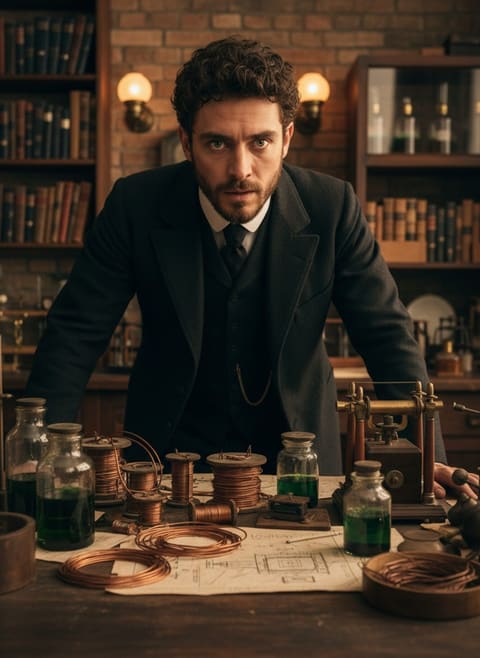
Edward Jenner was not your typical revolutionary. But his actions would incite a medical rebellion.
The Whisper of a Revolution
May 1796 in rural Gloucestershire was a time when the air was thick with the heady scent of wildflowers, and the verdant landscapes played backdrop to the hum of everyday life. In this serene English countryside, something extraordinary was about to transpire far from the grandeur of London's medical halls. Edward Jenner, a local doctor known for his quiet demeanor and keen observation skills, was about to defy the prevailing doctrines of the medical elite.
For years, Jenner had harbored an audacious theory. He noticed that milkmaids, frequently in contact with cows, often seemed immune to the dreaded smallpox—the scourge of the Georgian era which left its survivors scarred and disfigured, if not claimed by death. The culprit, Jenner surmised, was their previous exposure to cowpox, a much milder disease contracted from the cattle. His mind whirred with possibilities as he considered the implications of this natural protection.
The Courage to Experiment
To test his revolutionary hypothesis, Jenner needed to take a step that risked not only reputation but the life of a young boy. This boy was James Phipps, the son of Jenner's gardener, who would become a defining figure in medical history. The day was May 1796. With James’s future hanging in the balance, Jenner proceeded with an act most would consider folly. He took a lancet and made two small cuts on James’s arm, inserting matter taken from cowpox lesions on the hand of a milkmaid named Sarah Nelmes.
Read next: The Day a Weaver's Son Mapped the Invisible World
The medical establishment in London branded Jenner's ideas as reckless at best and disastrous at worst. The notion that a benign disease like cowpox could confer immunity to a deadly illness was ridiculed far and wide. Yet, what seemed like madness was grounded in a simple, yet provocative observation. Jenner was undeterred by the snickering circles of London's learned men. His belief in empirical evidence and methodical observation overrode the scoffs and derision.
The Outcome That Altered History
The days following the inoculation were fraught with tense anticipation. James experienced only mild symptoms akin to a light fever, recovering swiftly within days with no sign of smallpox developing. But the true test lay ahead—could this boy now withstand exposure to the deadly disease? Once James had recovered, Jenner exposed him intentionally to smallpox, knowing the risk and praying for a miracle. To the astonishment of onlookers and skeptics alike, James remained perfectly healthy.
This success marked the dawn of a new approach to medicine. Jenner published his findings, initially facing a swirl of suspicion and scrutiny from the fringe to the epicenter of the medical community. Yet, slowly, empirical validation forged allies amongst the skeptics, laying the foundation for what would eventually become the practice of vaccination, a term Jenner coined himself, derived from “vacca,” the Latin word for cow.
The Ripples Across Time
The impact of Jenner's experiment rippled far beyond Gloucestershire, challenging the medical world's norms and transforming public health forever. As word spread and the practice was refined, what had begun as a solitary provincial endeavor soon burgeoned into a worldwide movement. The implications were profound—vaccination not only saved countless lives but also laid the groundwork for the ethos of preventative medicine, exponentially expanding humanity’s lifespan and combating diseases on a global scale.
Read next: The Day a Clockmaker's Son Rewired How We See the Stars
While the immediate horizon after Jenner's breakthrough was filled with debate, doubt, and gradual acceptance, it ushered in an era defined by scientific inquiry and humility before nature’s secrets. Medical conventions shifted, prioritizing evidence and results over tradition and authority. Ultimately, Jenner’s work exemplified the power of perseverance in the face of overwhelming skepticism, a pioneering spirit that would define future scientific advancements.
Why This Story Still Matters
Today, Edward Jenner's bold experiment stands as a seminal moment in the annals of medical history—a testament to the power of observational science and the courage to question established norms. The stakes Jenner faced—a solitary boy, an untried hypothesis, and a skeptical world—continue to remind us of the perpetual dance between knowledge and discovery, one leading humbly to the next significant leap forward.
In a world where medical advances still face scrutiny and the rapid evolution of science challenges our understanding, Jenner’s legacy remains a touchstone. It urges both humility in our knowledge and boldness in exploration, embodying the enduring spirit of inquiry that pushes humanity towards a healthier future.