The small village of Berkeley in Gloucestershire lay quiet under a layer of mist one May morning in 1796. The air was crisp and carried the sweet scent of blooming wildflowers, while a gentle breeze rustled through the leafy trees. As the sunrise bathed the village in golden light, a greater moment was dawning. In a modest room with an oak wooden table, a country doctor named Edward Jenner prepared to challenge one of the deadliest enemies humanity had ever faced: smallpox. A routine that would normally involve prescribing potions and poultices was about to take a radical turn. For this was no ordinary day; this was the day when a simple needle would punctuate history.
The Hum of Dissent
In 1796, the British countryside was both beautiful and brutal—its pastoral elegance often overshadowed by hardships of disease and survival. Despite the tranquil surroundings of Gloucestershire, a silent terror lurked in every corner: the smallpox virus. With its terrifying pustules and high mortality rate, it had ravaged societies since ancient times. To even entertain the thought of defying such a formidable foe was considered folly. Yet, Edward Jenner was a man who dared to think differently.
Educated yet intrinsically curious beyond the constraints of conventional medical wisdom, Jenner observed an intriguing pattern among local milkmaids. He had heard tales of these women, whose faces, unlike those of others, bore a glowing, unmarred complexion, even in the wake of smallpox epidemics. They often credited this immunity to their affliction with a lesser-known illness: cowpox. This observation led Jenner to an audacious hypothesis—could exposure to cowpox render someone immune to smallpox?
Faced with skepticism from peers who dubbed his idea as no more than a farmer’s tale, Jenner was unmoved. Zeroing in on his hypothesis, he garnered support among a progressive circle, eager to witness any deviation from accepted practices that had, up until now, failed to contain the smallpox scourge effectively. The hum of dissent paired with blasts of courage seemed to fuel his conviction—pushing him toward the brink of a groundbreaking biomedical moment.
Read next: The Day a Weaver's Son Mapped the Invisible World
The Needle's Edge
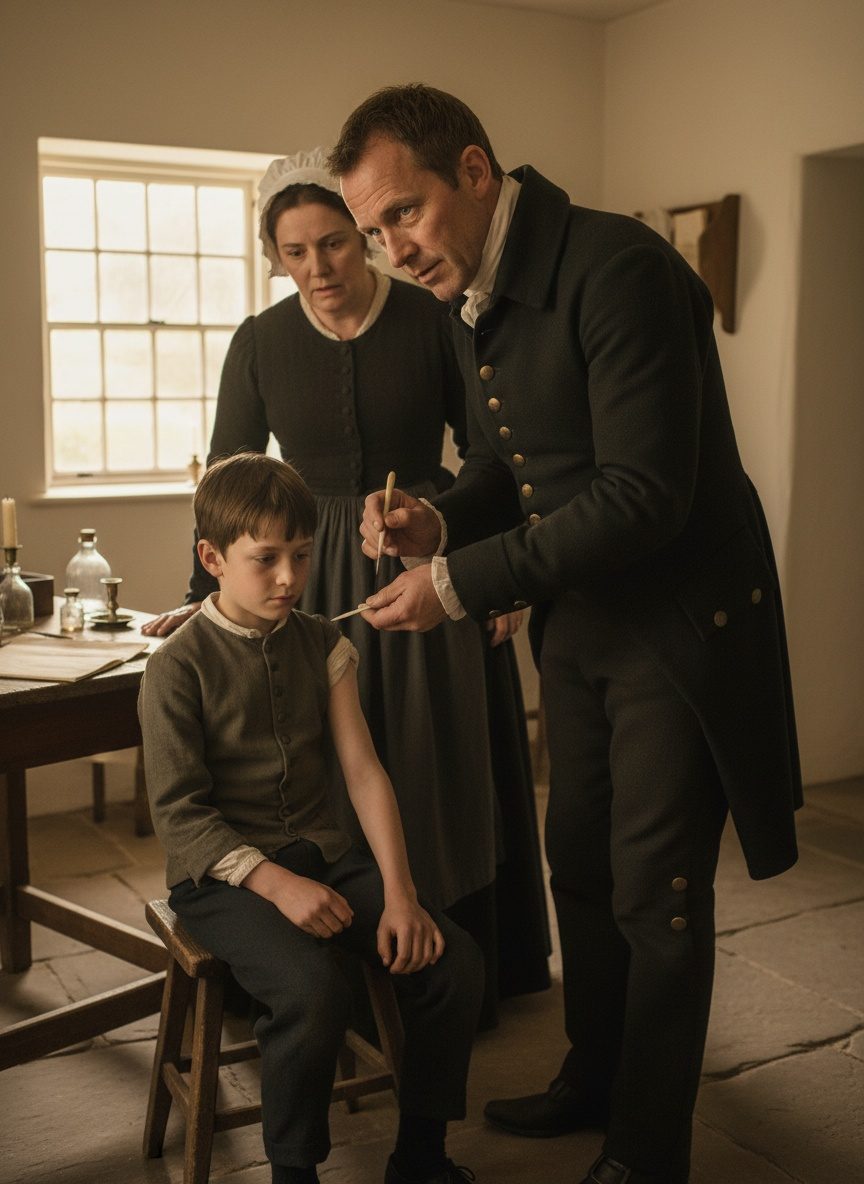
Jenner’s gambit required a subject, and he turned to a boy named James Phipps. The place was a modest barn in Berkeley, where the scientific holy grail lay in unsuspecting repose inside the humble udder of a cow. It was May of that year when Jenner collected matter from a cowpox blister on the hand of a milkmaid named Sarah Nelmes. This was no ordinary day in James’s life; it was an irreversible leap into the unknown, armed only with the trust placed in a country doctor with unyielding faith in his own beliefs.
The air inside the room was heavy with anticipation. Jenner’s hands were steady as he dipped the needle into the vial of cowpox matter before introducing it into James’s arm. The action was simple, yet the stakes were astronomical. Then came the wait, a tense period filled with checks and notes as Jenner observed the boy for signs of cowpox—watching every rash and every fever with both anxiety and hope.
Read next: The Day a Clockmaker's Son Rewired How We See the Stars
Once James Phipps recovered from the cowpox, Jenner presented the ultimate trial; he exposed the boy to the smallpox virus. Time seemed to stretch endlessly as Jenner waited for symptoms that he hoped would never come. Days passed, each one a canvas painted with mounting worry, yet not a whisper of illness disturbed James's spirited youth. Jenner’s theory had withstood its most crucial test; the boy was immune to smallpox. A quiet victory reverberated with loud implications for humankind—one child, one needle, and a world on the brink of change.
The End of Tyranny
Though Jenner had set a precedent against smallpox, he knew his battle had only just begun. Skepticism lingered like shadows cast by gaslight, doubts creeping around corners despite the promising results that soon spoke for themselves. Eager to expand investigative boundaries, Jenner documented his results meticulously and shared his findings far and wide. The medical community, even reluctant ones, were soon swayed by empirical evidence that echoed through hospitals, homes, and schools—the transformative power of vaccination.
As the news of Jenner's success traveled beyond Gloucestershire, his idea of vaccination proliferated throughout the expanding British Empire and eventually, the world. The human race was up against a force that had, for centuries, eluded every other means of control. Now, what had seemed invincible was suddenly being unarmed by the simplest of methods—a modest needle, some cow matter, and an unwavering conviction. By the dawn of the 19th century, Jenner's work had inspired a global movement that would ultimately lead to the eradication of smallpox in 1980.
Edward Jenner’s journey from a provincial doctor to the harbinger of an era that redefined global health was paved by curiosity and courage. His method bore the fruits of one man’s undeterred resolve to see beyond the plagues of his era—ushering in a new epoch that gave millions a shield against mortality. In a world confronting ever-evolving viral threats, Jenner's legacy is a powerful reminder that ingenuity and determination can wield formidable change. At a time when the humblest heart could envision a future liberated from tyrannical scourges, Jenner’s triumph echoes, reminding us of the potential held within a single, well-aimed idea.