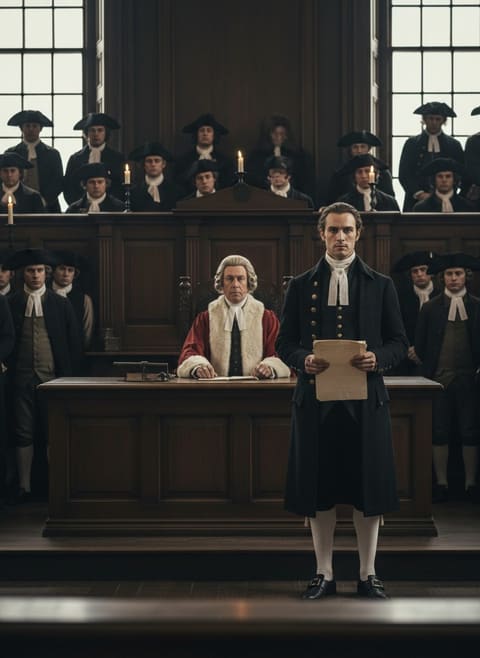
Granville Sharp was just a clerk in a government office. But that didn't stop him from launching an unexpected fight against the sophisticated network of the British slave trade.
The Morning That Changed Everything
On a typical morning in 1765, as Londoners bustled along the crowded streets, Granville Sharp, known then mostly for his carefully penned documents and unyielding sense of justice, stumbled upon a scene that would alter his life and, indeed, history. An African man lay beaten and worn on the street, an embodiment of the brutality tightly woven into the fabric of colonial London. This man was Jonathan Strong, an enslaved person, abandoned and left to fate's mercy by his owner, a man named David Lisle.
Sharp, moved by the spectacle of human despair, did not hesitate. Despite lacking legal training or social clout, he carried Strong to his home and, alongside his brother, nursed him back to health. The encounter might have ended there; after all, London was a city bustling with its own, often impervious, rhythms. But for Sharp, this newfound friendship became something much greater—a cause that would ripple throughout the English legal system and start to sow early seeds of abolition.
Paper Battles and Courtrooms
Two years after Strong's recovery, David Lisle discovered him in London. He swiftly moved to reclaim his "property" despite having abandoned Strong to his fate. Lisle's boldness wasn't surprising; he was backed by the weighty, invisible hand of slave trade economics, a force of profit that could obliterate many obstacles in its path. Yet, Lisle hadn’t counted on Sharp's tenacity.
Read next: The Day a Cornish Surgeon Walked Into a Condemned Cell
Granville Sharp, the clerk with no legal training, faced a monumental challenge. The very idea of challenging the law was daunting but not irredeemable. Fueled by moral outrage and an outstanding commitment to justice, Sharp delved into an uphill legal struggle for Strong's freedom. His knowledge of the law was self-taught, pieced together late nights after his clerical duties, while London slept.
On several occasions, Sharp stood in court, speaking against seasoned barristers, enmeshed in a legal defense crafted by nothing more than his dogged determination and belief in equality. Each appearance was both an act of courage and groundbreaking resistance. These were not simply sessions in court but rather the front lines of an ideological battlefield, where definitions of personhood and property clashed with seismic importance.
The Unraveling Begins
Sharp's pursuit extended far beyond Strong's personal tribulation. As the legal battles unfolded, it became evident to the public that the entire concept of slavery was vulnerable—an unanticipated precarity poised against the well-read illuminations of an unpaid legalist.
The eventual victory in the Strong case was more than a personal triumph for Sharp. The court declared that Lisle had no claim over Strong within English jurisdiction, a decision which, though quiet in its delivery, heralded the cracking foundations of the institution of slavery in Britain. The judiciary's ruling offered an unintended weapon to abolitionists; the ground was fertile for debate, discussion, and perhaps even legislative change.
Read next: The Day a Vicar's Son Walked Into a Debtor's Cell and Freed Them All
Sharp's defense of Strong inspired shifts among social circles, ramifying through those uncomfortable with the human cost of the slave trade or seeking a more righteous compass for Britain's path in history. His relentless quests pushed Parliament to reconsider its stance on the morality of owning another human being.
Echoes Beyond the Courtroom
Granville Sharp's impact extended far beyond the corridors of law. His actions were laden with implications that began to poke holes in the very concept of slavery, inspiring change-makers worldwide. Those who might have looked at the institution of slavery as unassailable now saw a glimmer—proof that legislation, like the human chains it enforced, was not infallible.
In this story, Jonathan Strong is not a mere symbol of victimization but a representation of an era’s refusal to ignore injustice. Strong and Sharp together transformed a society increasingly defined by black-and-white definitions into a canvas of gray—a canvas with room for hope, humanity, and future voices for freedom.
Granville Sharp was indeed just a clerk with the qualities of an everyday hero—one who saw a critical moment in history not as an insoluble predicament but as an opportunity to challenge the status quo. This transformation paved the way for the many battles against slavery that followed, shaping radical changes worldwide in the fight for human dignity.