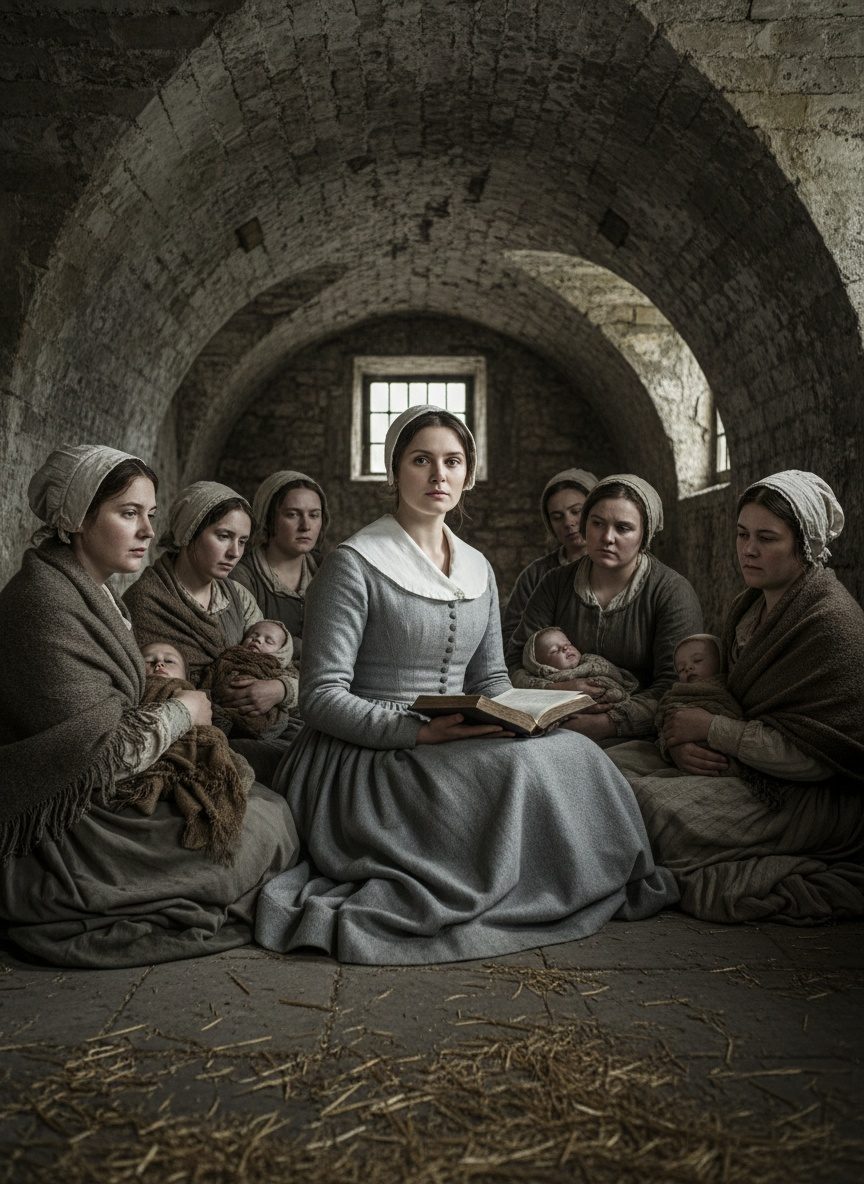
She was a Quaker, raised in simplicity and peace. Yet when Elizabeth Fry stepped into Newgate Prison in 1813, she confronted chaos that would have sent others fleeing.
Newgate Prison was a reminder of everything broken about Georgian society. Hidden away like a festering wound in the heart of London, it housed the forgotten souls whom the proper society hoped would remain invisible. Three hundred women cramped in two, cold, stone-walled wards. The stench of unwashed bodies, mingled with the reek of waste and despair, hung heavy in the air, assaulting the senses of all but those who had resigned themselves to such misery. It was a pit of hopelessness, where women convicted of theft mingled with murderers, and children who knew no other life scrambled through the filth underfoot.
To walk into such a place alone, as Elizabeth did, required more than mere courage. It called for an indomitable sense of purpose—a hallmark of the Quaker faith. Armed with neither wealth nor worldly power, Fry carried the gentler weapons of quiet resolve and the belief in the inherent worth of every soul. The chaos within Newgate echoed its chaotic management—a reflection of how society itself had turned a blind eye to its own discarded.
Elizabeth Fry did not merely stand on a soapbox outside the prison walls, decrying the evils within. She stepped through those walls and immersed herself in their reality. Maybe the guards scoffed; perhaps they thought her presumptuous. But once she sat among the women, cross-legged on the ice-cold floor, all that must have melted away as faces hard with fear and distrust softened. She spoke to them not as prisoners, but as women, drawing out stories of lives derailed by poverty and hunger, petty thefts spun into lifetime punishments.
Read next: The Day a Cornish Surgeon Walked Into a Condemned Cell
Her presence became a ray of unexpected light piercing the gloom. These were forgotten women of Newgate, accustomed only to indifference or scorn from a public that preferred its narratives neat and tidy. Elizabeth’s empathic demeanor inspired them to open up, to voice desires long buried beneath the hard crust of survival. What these women needed, Fry realized, was not merely temporal comfort, but a chance to reclaim dignity—one step towards humanity and hope.
Shockingly, there existed no basic arrangements to separate the guilty from the young and natural innocents—a glaring gap Fry set out to correct with a will unyielding. Women slept in shifts. Mothers nurtured children upon their laps, teaching them whatever small bits of knowledge or comfort they had. But without resources or any semblance of education, what hope could their futures offer?
Elizabeth Fry returned the next day. And the next. With every visit, she brought her relentless energy and vision for change. Though society closed its eyes and ears to the cries echoing from Newgate, Elizabeth’s voice began to pierce through the fog of apathy. Her efforts materialized in practical changes—handed down in scraps of care such as soap, clean clothes, and eventually, the framework for a school within those grim walls, where children learned their letters amid the dark confines of confinement.
The foundation she set was not one just of education but of reform. Elizabeth’s work called for advocates who turned up, time and again, challenging a prison system deeply rooted in a bedrock of decay. Those dismissed as irredeemable or incorrigible were not beyond salvation, her unwavering presence insisted. Every woman, every child, had potential waiting to be nurtured, tapped, and treasured.
Read next: The Day a Vicar's Son Walked Into a Debtor's Cell and Freed Them All
As Elizabeth persisted, her efforts transformed into a campaign, not merely for the prisoners of Newgate, but for prison reform nationwide. Ignited by her compassion and conviction, the British populace began to stir with the faint echoes of conscience. Public attention focused, sparking debates and legislative reviews that had long avoided the light of day. Attitudes began to shift; the need for justice tempered with humanity had taken root.
Elizabeth Fry's story speaks across the centuries—a persistent refrain of the power of one person’s unwavering compassion. Even amid the confines of stone walls, with the weight of a flawed world bearing down, light can filter through the smallest openings. As those walls echoed with cries of despair and rage, Fry infused them with the echoes of songs and lessons, tender strands of connection that transformed a quagmire of hopelessness.
The tale reminds us that within any society, the urge to look away from its dark corners must be resisted. Hope thrives where courage lights the way, and where a single individual's modest beginning can ripple into waves of profound change. For Elizabeth Fry, stepping into Newgate wasn’t just about changing one corner of a city; it was about changing the way an entire society perceived its moral and civic responsibilities. In that dark and crowded silence, her whisper could be heard—justice, tempered with mercy, is a reflection of our very humanity.