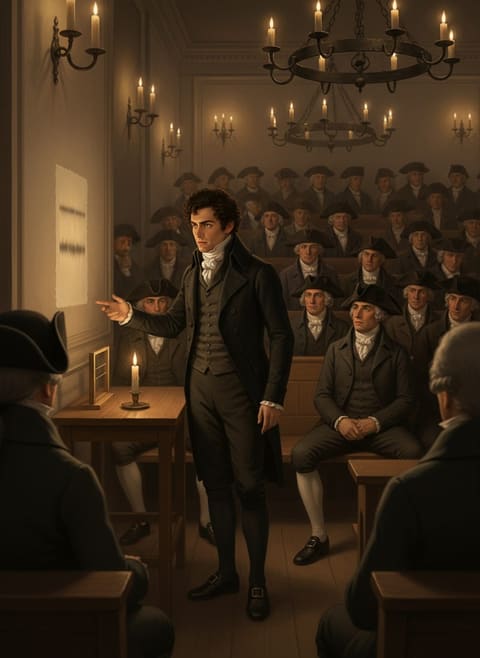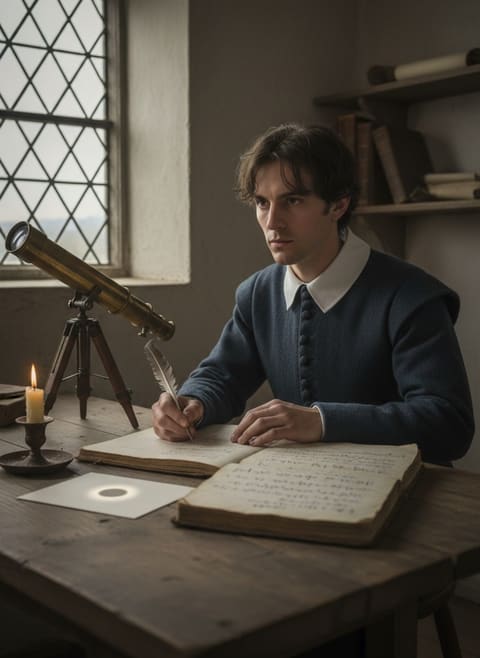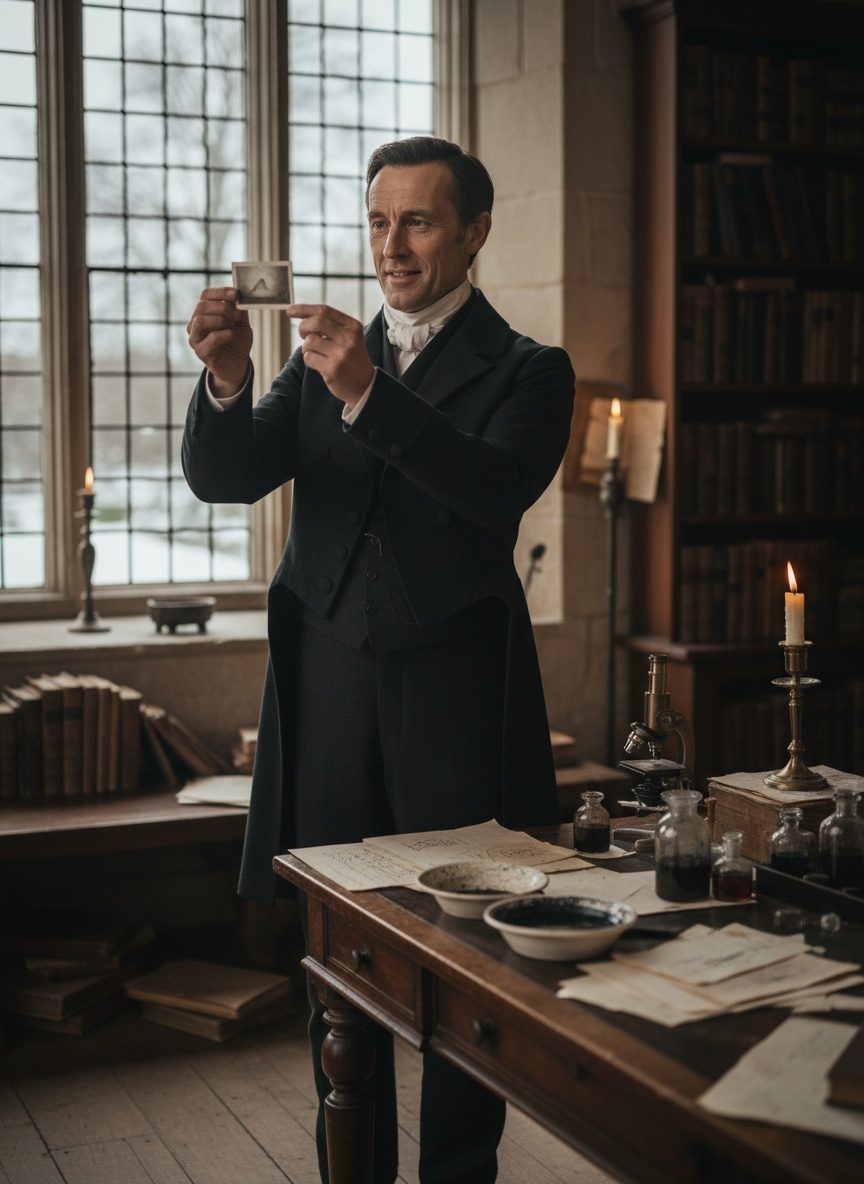
The winter of 1840 was cloaked in a chill that made the stone walls of Lacock Abbey seem to shudder with the biting Somerset wind. Inside, the flicker of candlelight was more than just a source of warmth; it brought the room to life with its dance upon the wooden panels. Outside, weak winter sunlight crept through the lush greenery that bordered the estate, and a scattering of birds darted across a slate-grey sky. In a world long before the hum of engines or the chatter of radio, the air was punctuated only by rustling leaves and the distant bleat of grazing sheep. This day, however, was to be anything but ordinary. As William Fox Talbot stood in his study, he held history in his hands. A delicate slip of paper bore an image that the world had never seen before, capturing not just a window and a tree, but the very essence of a moment made eternal.
What Talbot achieved in the seclusion of Lacock Abbey changed the course of human history, for in that instant, light had met chemistry to create the genesis of photography. He was no stranger to innovation; experiments and investigations were as much a staple of his life as the estate itself. The atmosphere within the grand abbey stirred with intellectual rigor, its halls lined with books and its rooms witness to countless musings and ponderings. Yet even Talbot could hardly have foreseen the full magnitude of his invention.
The journey to that pivotal morning was paved with curiosity and a profound dissatisfaction with personal limitations. Talbot was well aware of others across Europe dabbling in similar alchemies. Louis Daguerre in France had recently publicized his own process—the daguerreotype—a laborious and intricate method demanding a polished silver plate and precarious exposure. Talbot sought something simpler, more replicable, and found it in paper soaked with silver salts. The path was fraught with failure initially, much of his early work succumbing to the inexorable march of time as sunlight faded nascent images back into oblivion.
Yet it was at Lacock, amid the abstract play of light and shadow against formidable stone, that the idea known as the calotype took form. With remarkable clarity, Talbot managed to permanently trap light on paper, creating negatives that could produce multiple positive prints. Humanity's collective memory was no longer bound to oral tales or written records; photographs offered a new sensibility, a visual storytelling untethered from subjective memory's distortion. This captured landscape or portrait bore witness to authenticity — factual evidence of existence.
Read next: The Day a Weaver's Son Mapped the Invisible World
The ramifications burgeoned quickly beyond the English countryside. As the technology evolved, photography became entwined with perception, art, and even truth itself. It held the power to document, to prove, and to produce an intimacy with the distant that had never been possible before. Portraiture came within reach of the masses, chronicling faces that might otherwise have lingered only in memory. Historian and laborer alike found their likeness preserved in silver bromide grains, democratizing personal legacy.
For Talbot, this innovation was not simply a technical triumph but also a philosophical one. He philosophized that every object cast light and thus, in some way, imprinted upon the world. His words sprang from a place where science and poetry coalesced, where technology carried a modicum of mystique. And as much as the calotype technique resonated from his English confines, it rippled outwards, mingling with other burgeoning advances across Europe and beyond.
Read next: The Day a Clockmaker's Son Rewired How We See the Stars
Yet the true victory of Talbot's work was not without its contestations. Legal battles over photography’s patents ebbed and flowed across borders. The notion of owning a process by which nature paints her own image on paper challenged notions of authorship and innovation. These disputes, oddly enough, drummed up curiosity, promoting further exploration and ultimately aiding in the technology’s improvement and accessibility. Soon, Talbot was but one voice in a growing chorus of photographers, each contributing to the discipline’s rich tapestry.
In every photograph taken today, whether it be an artful black-and-white composition or a fleeting snapshot caught on a smartphone, there exists a trace of Talbot’s calotype. Photography's progression—each shutter click that followed Talbot’s breakthrough—tells countless stories of wonders both mundane and magnificent, from the moon landing to everyday moments. We dignify our surroundings with photographic consistency, using the medium to explore both truth and imagination—a dialogue begun on that cold winter morning at Lacock Abbey.
And so, as we thumb through albums or scroll through digital galleries, let us remember how a distinctly Victorian curiosity married introspection with innovation. It was from the tranquil snapshots of Lacock Abbey that photography embarked on its odyssey, navigating uncharted waters of human experience. William Fox Talbot’s view from a Somerset window has become our shared gaze into the infinite, urging us to contemplate what light and a bit of paper might continue to reveal. The world captured in an instant—proof that the smallest, simplest inventions can illuminate paths previously unseen, transforming not just how we observe the world, but how we understand our place within it.