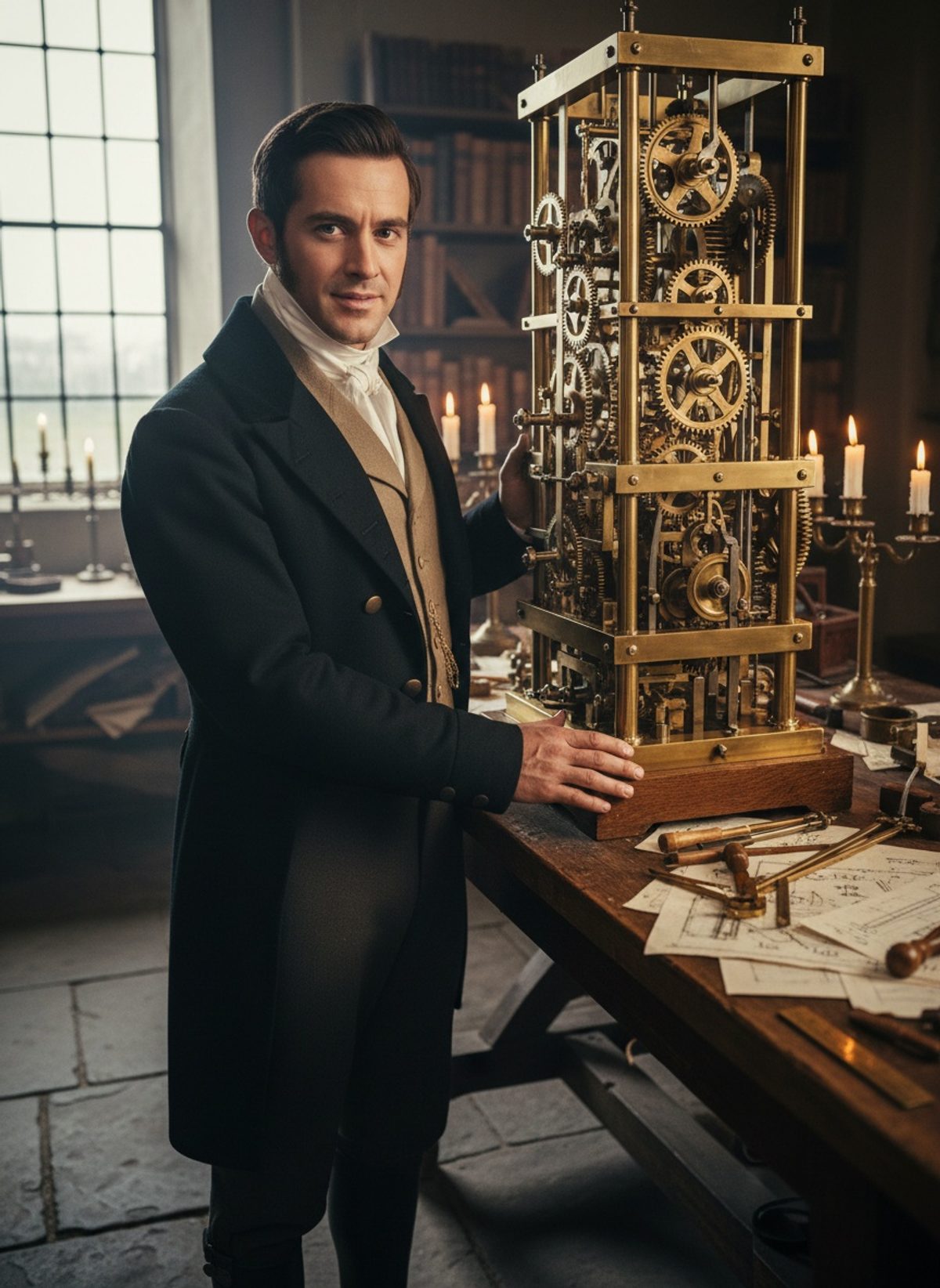
The whirr of gears echoed in the dimly lit workshop, the air thick with the smell of oil and metal. Charles Babbage leaned in closer, his eyes alight with intensity as his fingers traced the intricate brass fittings of his creation. Hunched over this strange contraption, he noticed the quiet anticipation in the room. Today, a machine would make history by solving problems with the precision of a mathematician wrapped in clockwork skin.
The Workshop Odyssey
London, 1822. Within the heart of the city, far from the bustling streets and industrial clamor, a quiet revolution was taking place. A Cambridge mathematician—born to the simple life of a weaver’s son—Charles Babbage stood amidst a chaos of gears and sprockets. The room pulsed with the hum of ingenuity, a place where iron and imagination collided. It was here that Babbage dared to dream of a machine that could calculate complex mathematical tables—the Difference Engine.
The idea was radical and perhaps even inconceivable to the minds of those crowded in the dingy London workshop. Yet, for Babbage, this brass prototype represented more than a mere assemblage of metal; it was the herald of a new era. Destined to obliterate human error, the Difference Engine promised perfect computation. However, it wasn't just a product of mathematics—it was born from a lifelong frustration with inaccuracy in navigational and astronomical tables that jeopardized sea voyages and scientific endeavors alike.
A Dream Shaped by Numbers
To understand the significance of Babbage's invention, one must peel back the layers of his youthful curiosities. From the moment Babbage first discovered mathematics, a passion ignited within him—a passion unbridled by conventional wisdom. As a student at Cambridge, he grew weary of the arithmetical dullness that clouded the academic discourse. He sought a different truth, a way to liberate numbers from the perils of human fallibility.
Read next: The Day a Weaver's Son Mapped the Invisible World
His dream sprang from a confluence of personal genius and the zeitgeist of scientific advancement. Within this nexus, the Difference Engine was conceived—intended to perform fixed operations on numbers and churn out tabulated results. It was to be a marvel of Victorian engineering—a precursor to the machines that would later redefine human potential. At a point in history when Great Britain hungrily devoured technological advances, the world remained blissfully unaware of the intellectual juggernaut Babbage had set in motion.
The Unveiling of the Mechanical Prodigy
The day of unveiling arrived under a blanket of anticipation. As the onlookers gathered, a heavy silence cloaked the room, punctuated only by the rhythmic clinking of Babbage’s toolwork. Then, with meticulous precision, he began to demonstrate the capabilities of his Difference Engine. The machine thrummed to life, each cog turning with a purpose, resonating with the promise of what was to come. This was a machine that didn’t just act—it reasoned, computed, and calculated.
Read next: The Day a Clockmaker's Son Rewired How We See the Stars
The audience, composed primarily of scholars and engineers, could hardly fathom the implications of what lay before them. To their eyes, it was a perplexing lattice of polished brass, but to Babbage, it was an extension of his mathematical soul. As the Difference Engine solved its first equation flawlessly, a gasp rippled across the room. Yet, amidst the marvel, a lingering sense of bewilderment cast a shadow. Most left without grasping the revolutionary significance of what they had witnessed—arithmetical problem-solving had been forever transformed.
Ripples Through Time
Charles Babbage's Difference Engine, though not yet fully realized in his lifetime, planted the seeds for modern computation. The meticulous brass mechanisms represent the genesis of a journey that would eventually lead the world to the age of computers and digital technology. Fast forward to today, and it’s easy to draw a direct line from Babbage’s vision to the devices that form the backbone of our daily lives—from the smartphones in our pockets to the complex servers driving global networks.
In the grand tapestry of history, few could have foreseen the profound impact of that fateful unveiling in a cluttered London workshop. It’s a tale nestled in the folds of time, quietly awaiting discovery by those willing to look beyond the surface. Babbage’s legacy is not merely a testament to Victorian ingenuity but a reminder of the ingenuity that transforms obscure dreams into the bedrock of advancement. His mechanical progeny may have emerged amidst the clamor of an indifferent world, but its echoes reverberate in every click, every command, and every computation conducted today.