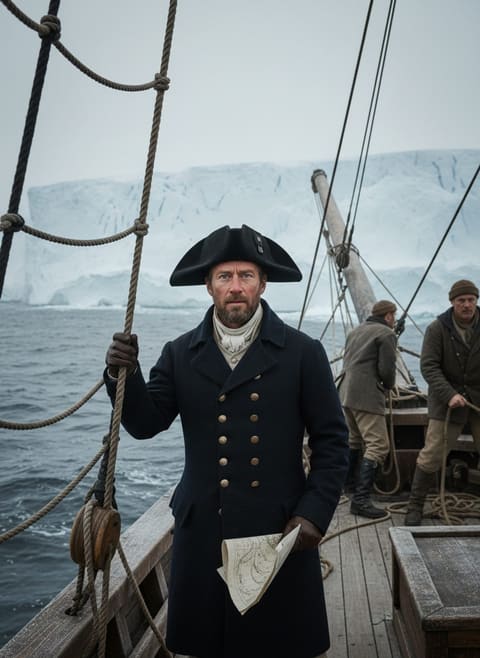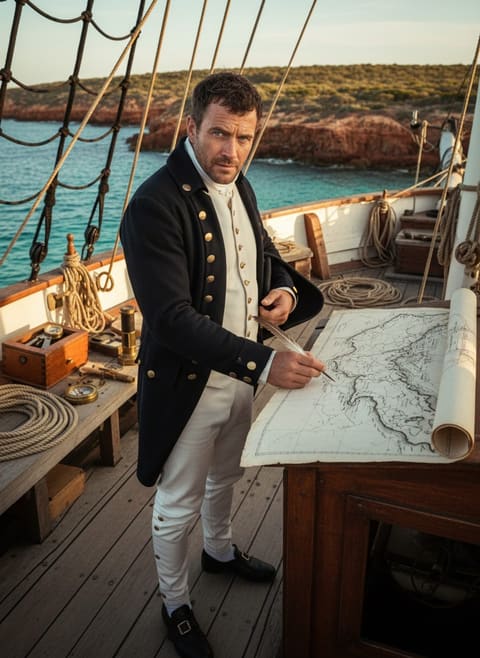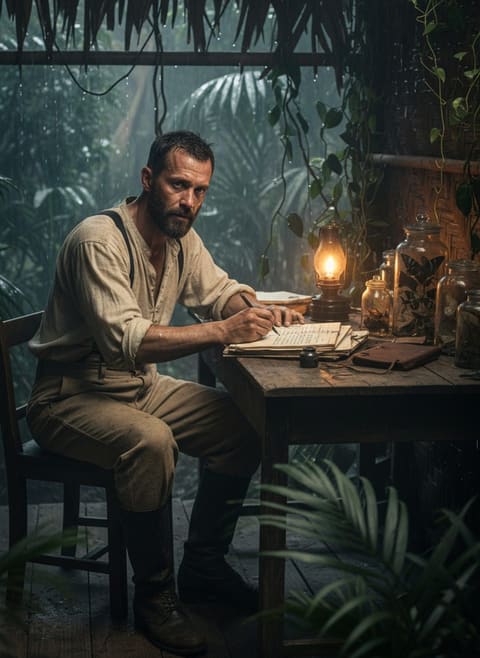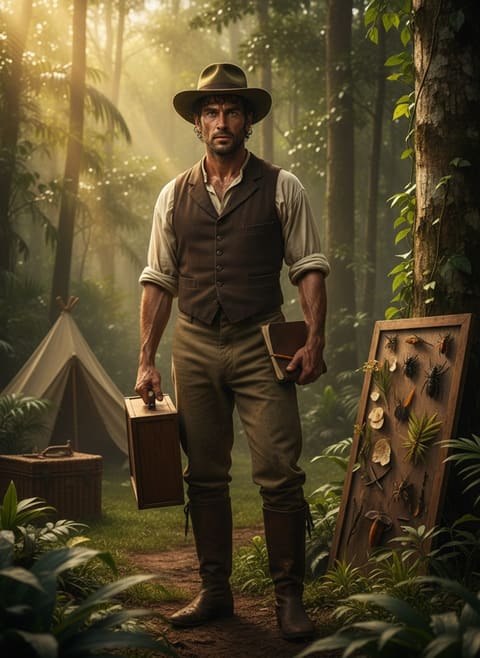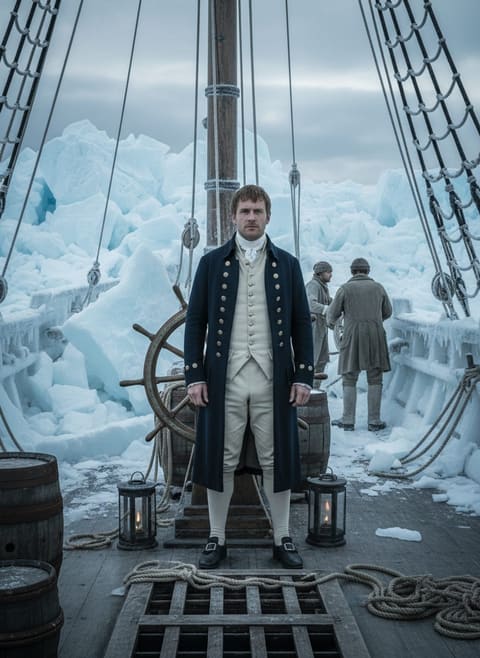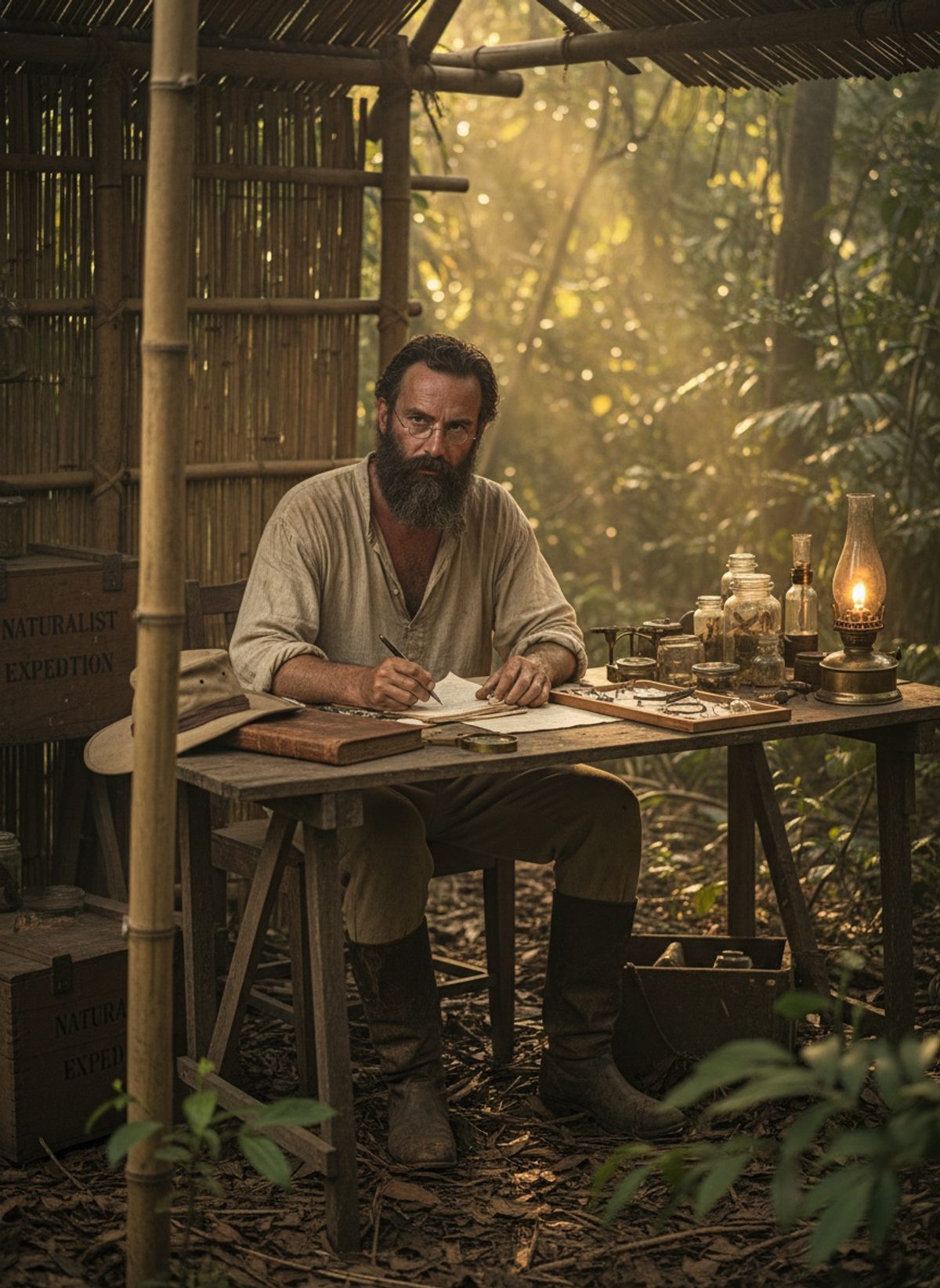
Most people have never heard of Alfred Russel Wallace. They should have. Born in the small Welsh town of Usk in 1823, Wallace would embark on an odyssey that would reshape the scientific understanding of life on Earth. Today, we delve into the largely untold story of the man whose solo expedition to the world’s lushest realms of biodiversity eclipsed some of the grandest adventures known to the Georgian Era.
Alfred Russel Wallace’s journey began in an unassuming fashion, far from the exotic locales of the Amazon or the Malay Archipelago. Raised with little financial means, Wallace’s foundational life in rural Wales starkly contrasted the vast territories he would later explore. From an early age, a profound curiosity about the natural world gripped him, and this insatiable passion steered him toward a life dedicated to discovery. While Joseph Banks had sailed with Captain Cook decades prior, leaving an indelible mark on the field of natural history, Wallace’s venture into the wild frontiers of scientific exploration was destined to carve his name into the annals of history, albeit on a path less traveled, less acknowledged.
In 1848, with nothing but ambition and an earnest drive to observe the natural world, Wallace set sail for the Amazon Basin. The lush rainforests, teeming with uncharted biodiversity, beckoned to him with their unsolved mysteries. Teaming up with fellow naturalist Henry Walter Bates, Wallace began an exhaustive cataloging of the region’s flora and fauna. This arduous expedition was not without its trials; the oppressive humidity, unrelenting insects, and the vastness of the jungle formed both his environment and adversary. Yet, it was here that the seeds of his revolutionary thoughts on the process driving species diversity began to take root.
Tragedy nearly halted his pursuits when a fire engulfed his return vessel to England in 1852, resulting in the loss of his invaluable collections from the Amazon. Many might have conceded defeat, but Wallace, ever resolute, took this setback as a mere chapter in his journey. By 1854, he embarked on an expedition to the Malay Archipelago, a network of islands presenting a kaleidoscope of ecosystems even more diverse than anything encountered before. For eight years, Wallace crossed this fragmented realm alone, persevering through tropical storms and treacherous terrain.
Read next: The Winter Walk That Mapped the Top of the World
It was amid this kaleidoscope of landscapes and wildlife that Wallace honed his theory on the adaptation of species. With each island exhibiting unique variations among similar species, the puzzle pieces of natural selection began to fall into place. Engaging with indigenous peoples and meticulously documenting variations he observed, Wallace expanded his understanding of the interconnectedness of life, predation, and the struggle for existence. By observing closely how beetles and birds adapted to their respective environments, Wallace mirrored the process of selection weaved by the invisible hand of nature.
The theory that Wallace cultivated in these foreboding jungles stemmed not from academic institutions or scientific conferences but from a purely empirical method grounded in exhaustive field research. Facing the rhythms and dangers of the natural world alone, Wallace refined a theory so profound that when he penned a paper on the topic and sent it to London, it would reach Charles Darwin. The impact was seismic. Darwin, who had been quietly wrestling with his own formulation of the idea, was taken aback. Here, remarkably, was another naturalist — from Wales, no less — who had independently arrived at a similar, groundbreaking conclusion.
Read next: The Day a Scots Surgeon Reached the End of the World
The historic collaboration between Wallace and Darwin, initiated by that pivotal letter in 1858, led to a joint presentation of their findings to the Linnean Society of London, forever altering the trajectory of biological science. While Darwin's "On the Origin of Species" would become one of the most celebrated scientific works, Wallace maintained a lifelong reputation as the co-discoverer of natural selection, though he never sought the limelight. Driven by a profound sense of scientific inquiry rather than recognition, he continued to contribute valuable insights into biogeography and environmental conservation.
The tale of Alfred Russel Wallace is one of arduous perseverance against the limits of human endurance, marked by an undying quest for knowledge. It is an exploration narrative rarely feted, yet it looms large in the shadow of Darwin’s fame. One might reflect upon the narrow trails of the remote islands he traversed and wonder at the sheer scale of his endeavor. Beyond the sheer collection of specimens — numbering over 125,000, a figure unheard of by today’s standards — his revelations pushed the boundaries of the known world and brought to light the profound complexities of evolution.
This story of a Welsh naturalist who dared to map not only the geographical landscapes of the Earth’s rooftop but the very blueprint of life invites us to ponder the thin, fragile thread that realism shares with discovery. Wallace’s legacy echoes through the corridors of modern science, reminding us that the pursuit of knowledge often begins in the most unlikely places and under the guidance of those whose names may not adorn every textbook, but whose influence is omnipresent. The journey of Wallace underscores a timeless truth: great discoveries do not always begin where one might expect, nor are they always made by the most heralded among us. The whispers of the wild, once mapped by his hand, continue to shape our understanding of life itself.