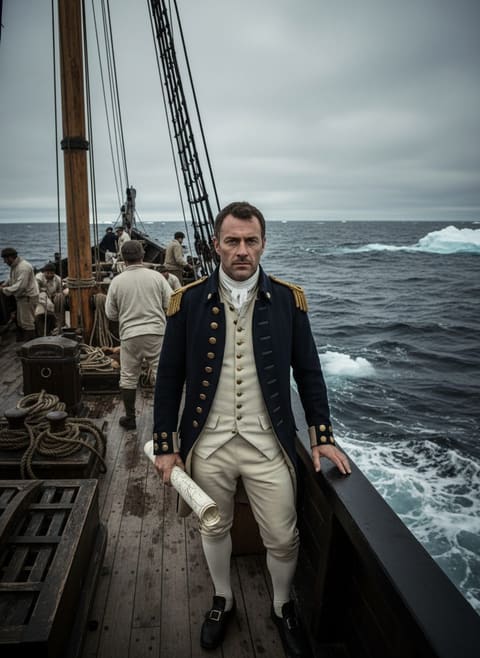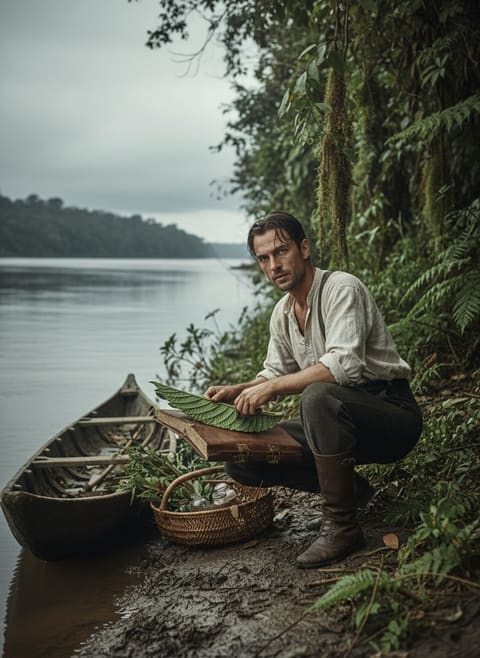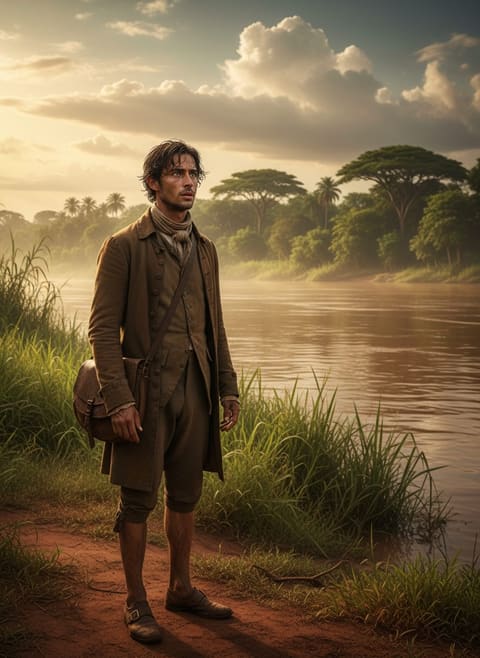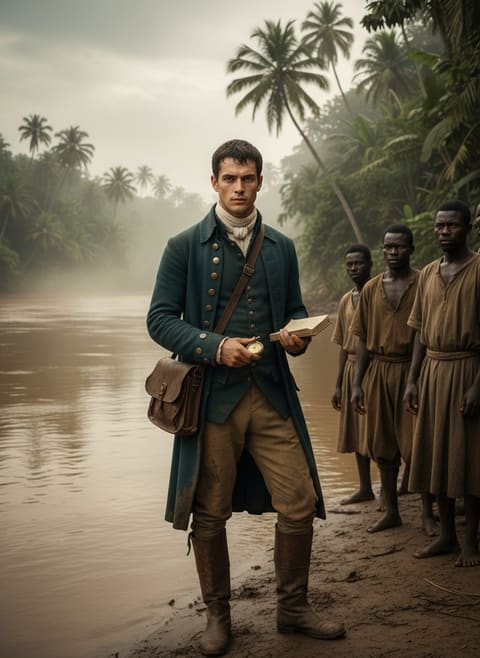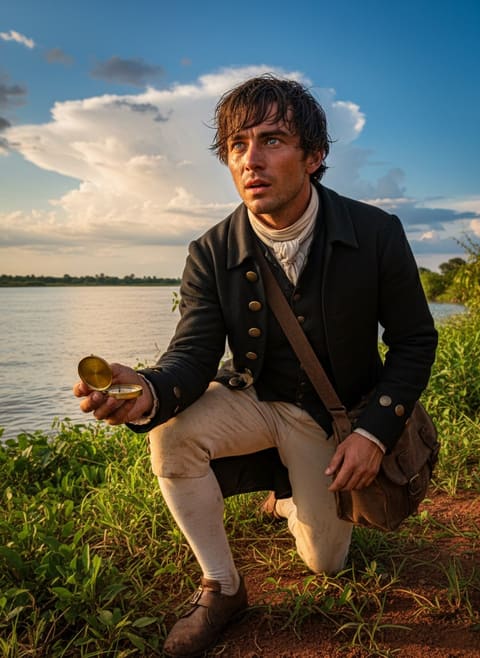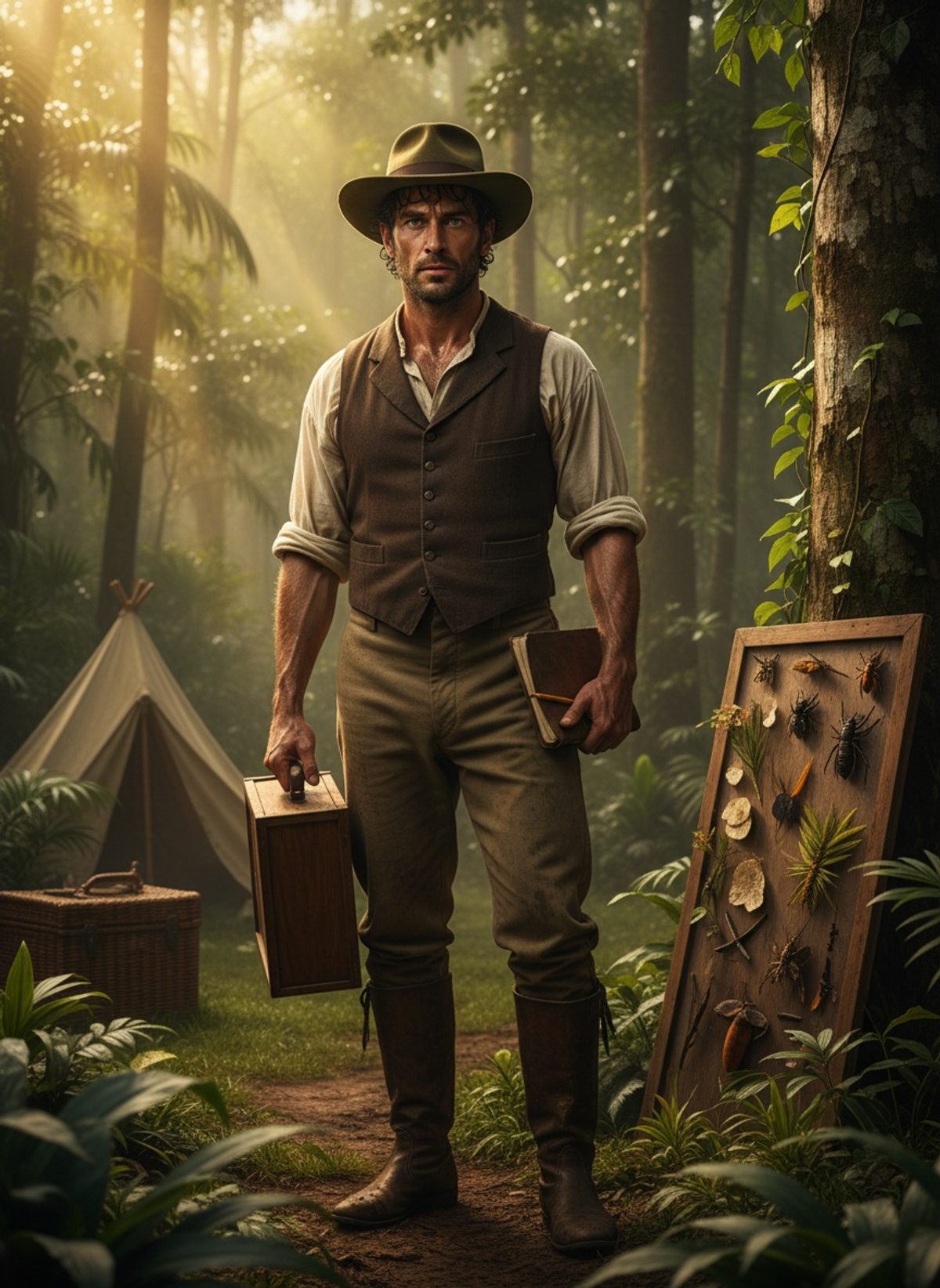
1855. The thick air was suffused with the acrid smell of burning vegetation as smoke curled lazily upwards from the dense canopy of Borneo’s jungle.
Into the Flaming Heart of the Jungle
In an era of ornate Victorian salons and their scientific circles, Alfred Russel Wallace stood apart — a self-educated naturalist, armed with boundless curiosity and immense grit. Lacking the patronage of large academic institutions, and brandishing no degree from a prestigious university, Wallace was an anomaly amid the educated elite. Yet, it was this very outsider status that emboldened him to delve into the uncharted territories of the world, places mapped by few hearts and fewer feet.
The year was 1855, and Wallace found himself on the island of Borneo in the Malay Archipelago, a region teeming with unexplored flora and fauna. This vast tropical expanse was a playground known only to its local tribes, and now to the adventurous Wallace. While navigating the impenetrable foliage, a sudden conflagration threatened to consume the virgin forest. The fire crackled ominously, an entity both destructive and mesmerizing. Most would see retreat as the only wise course of action. But in Wallace’s burning conviction, the secrets of nature were more alluring than the perils before him.
Undeterred by the inferno, Wallace moved forward with the determination of a man possessed by the quest for knowledge. Each step into the incendiary thicket was a gamble, yet one bearing the potential for discovery that he knew could alter scientific history. Enveloped by smoke, sweating under the intense heat, he emerged with specimens of creatures no European had ever laid eyes on. His collection included brilliantly colored butterflies, exotic beetles, and other beings distinct in their morphology, breathing testimonies to nature's unending ingenuity.
Read next: The Day a Scots Surgeon Walked Into the Heart of Africa
The Discovery that Trembled the Scientific World
Back in England, Charles Darwin was wrestling with the implications of his studies, hesitant to commit to print the foundational ideas that had gestated within his mind for two decades. Little did he know that halfway across the globe, a man of lesser resources but equal fervor was unfurling empirical wonders that would nudge the scholarly pendulum of evolution.
Wallace's observations were nothing short of revolutionary. His specimens were not merely trophies collected from an expedition; they were substantive evidence challenging the pre-ordained narratives of creation. In his correspondence with Darwin, Wallace articulated a theory akin to what Darwin privately called “natural selection.” While the history often credits Darwin for his pivotal work, it was Wallace's arrival at similar conclusions, substantiated through daring practical exploration, that prompted Darwin to share his magnum opus. The world was on the cusp of being introduced to *On the Origin of Species*.
While Darwin’s name loomed large across the tabula of historical memory, it was the raw, on-the-ground observations drawn from Wallace’s specimens from Borneo’s charred jungles that invigorated Darwin’s courage to publish. There was a momentary tension, where lines were crossed, and the shared credit was debated, but the overall contribution to science endured. Behind the legend of Darwin stood the less-heralded but equally critical figure of Wallace, a testament to the value of sometimes braving literal and metaphorical fires to discover truth.
Nature's Secrets Risked and Won
Emerging from Borneo's harrowing blaze, Wallace's specimens found their way to collections where they sparked intrigue and inspection. As a result, this era of Victorian exploration was expanded. Those specimens were not merely insects and creatures; they were symbols of a complex and interconnected natural world, harbingers of an evolutionary story yet fully comprehended by science's curators of the time.
Read next: The Day a Devon Captain Charted the Pacific and Changed the World
The episode of Wallace walking into the fiery depths of Borneo stands as a story layered with paradoxes. The wilderness, loath to give up its secrets without peril, was simultaneously a crucible in which Wallace’s profound contributions to science were forged. His actions delineated the quintessential spirit of discovery where the pursuit of knowledge outweighs the comfort of security — a notion resonant with modern explorations of the unknown.
Wallace's solitary confrontation with adversity was a clarion call. It beckoned the scientific community to not merely rely on theoretical postulates or armchair musings, but to embrace the world’s most daunting frontiers. The audacity in Wallace’s pursuits served as a precursor to an era where exploration would not just be about mapping lands, but also about charting the very laws of nature.
This tale of courage amidst flames is not a mere vignette from the annals of exploration. It underscores a timeless truth: the path to understanding is often fraught with obstacles that must be faced, rather than evaded, to unveil the intricate tapestry of our natural world.