The autumn air clung with a crispness that foretold of London’s coming chill, its familiar scent of coal smoke and damp stone seeping into every crevice. The small room where he stood was dimly lit by the sallow glow of a single oil lamp, casting flickering shadows across the cluttered workbench. In this cramped space, the hum of the bustling city outside faded to a murmur; here, the future waited silent and unassuming. It was September of 1821, and with nothing more than a couple of wires, a magnet, and a bowl of mercury, Michael Faraday was about to turn the gears of history.
The Humble Beginnings of a Yorkshire Visionary
Born in the rural confines of Newington Butts, Michael Faraday’s journey to this pivotal moment was as improbable as it was remarkable. The son of a blacksmith, Faraday's upbringing in Yorkshire was far removed from the scholarly corridors of the universities that shaped the learned minds of his time. He was apprenticed at 14 to a local bookbinder in London, a trade that would open more intellectual doors than could possibly be anticipated.
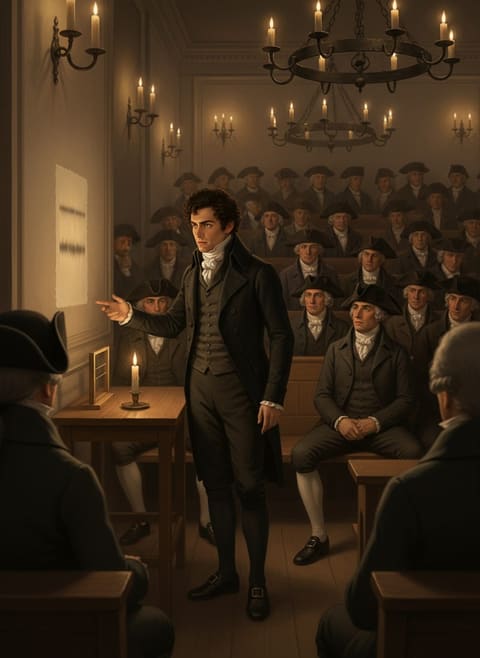
As Faraday meticulously bound and leafed through the many volumes of his master’s shop, he did more than just work with his hands; he absorbed the words and ideas that filled the pages. Science was not just read; it was a calling whispered through the crinkling of paper against palm. One of the turning points came when he secured a ticket to hear Sir Humphry Davy lecture at the Royal Institution. Captivated by Davy's charismatic discourse on chemistry, Faraday scribbled copious notes, bound them into a book, and sent them as a gesture of admiration. This bold step led to Faraday’s appointment as an assistant at the Royal Institution.
Despite his lack of formal education and a background that seemed at odds with such lofty pursuit, Faraday’s innate curiosity and relentless determination propelled him into realms of experimentation that would redefine scientific understanding. But it was in a moment so simple, so starkly unspectacular to an uninformed eye, that Faraday would unlock the hidden potential of electricity. His nervous anticipation on that crisp September day echoed the stifling weight of being on the brink of extraordinary discovery.
Read next: The Day a Weaver's Son Mapped the Invisible World
Sparks of Genius in a Mercury Pool
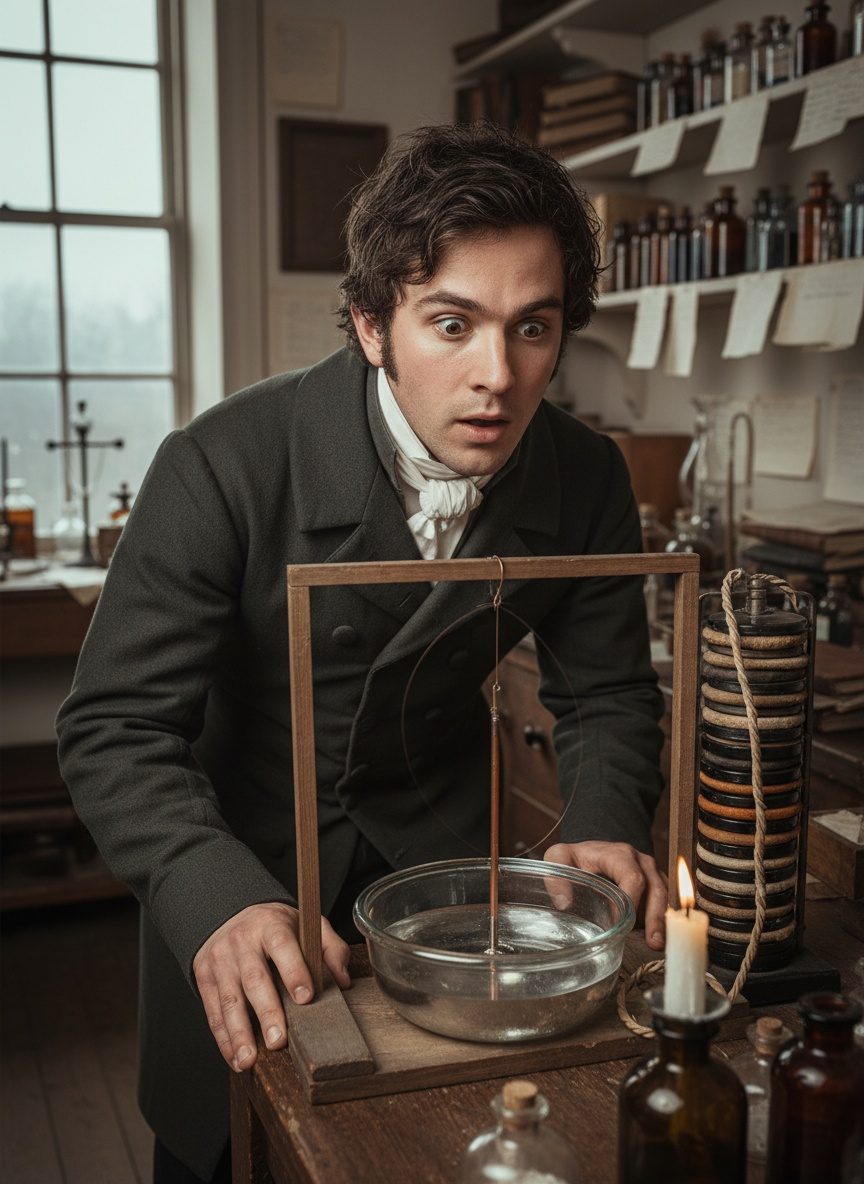
At the heart of Faraday's groundbreaking experiment lay his fascination with electromagnetism—a subject barely understood and sparsely explored in the early 19th century. Armed with the learnings he had gathered like a magpie scavenging for shiny trinkets, Faraday set about exploring the largely untapped interplay between electricity and magnetism. His experimental setup was rudimentary yet ingenious: using a mercury bath, a magnet, and a piece of wire, Faraday intended to illustrate how electricity could produce continuous motion.
The room was clamorous with the silence of anticipation. With a steady hand, he carefully suspended the wire so that when an electrical current was passed through it, the wire spun around the magnet submerged in mercury—simple in appearance, yet revolutionary in impact. For the first time in human history, an electric current was used to create continuous mechanical motion, the essential principle behind the electric motor.
In the quietude following his success, Faraday might have marveled at the sight: the very wire that spun gracefully and obediently, echoing the majesty of universal laws brought to heel by human intellect. It was a sight that perhaps even troubled him in its implications, the future unspooling before his eyes like so many of the bound papers on his workbench. Yet in that moment, Faraday kept his discovery largely to himself, perhaps understanding unknowingly the vast ocean he had stepped into, his mind held captive by the calculation of what was to come.
Read next: The Day a Clockmaker's Son Rewired How We See the Stars
The Hidden Catalyst of an Electrified World
Though the world beyond that dimly lit room remained unaware, that solitary moment of revelation rippled outwards, eventually shaking the very foundations of technological advancement for generations to follow. What transpired in that small London room was not just the birth of the electric motor, it was the dawn of the electrical age. From that event arose the transformative power that would energize cities, mechanize industries, and illuminate countless lives.
Reflecting on the modest beginnings and the enormous destiny shaped by a single experiment, one might ponder the underestimated power of curiosity and the unexpected paths knowledge can take. Faraday's brief encounter with patenting and establishing a claim was overshadowed by his vision and belief that science should serve society—a stance that cemented his legacy as a pioneer of modern electrical engineering.
In today's world, where every flick of a switch is a testament to the possibilities once imagined only in fairy tales, it is vital to remember that it was a Yorkshire lad, with shaking hands and boundless ambition, who first made a wire spin in mercury. He bridged the past with the future, reminding us of the inventive spirit that can spring from the most unlikely of places and bring light to the furthest reaches of innovation. As we repeatedly rediscover, sometimes the world’s quietest rooms hold the loudest echoes of history’s greatest changes.