Frank Bourne was a young sergeant who helped lead a legendary defense against thousands of Zulu warriors. Yet, decades later, his passing went almost unnoticed by a world celebrating victory over tyranny.
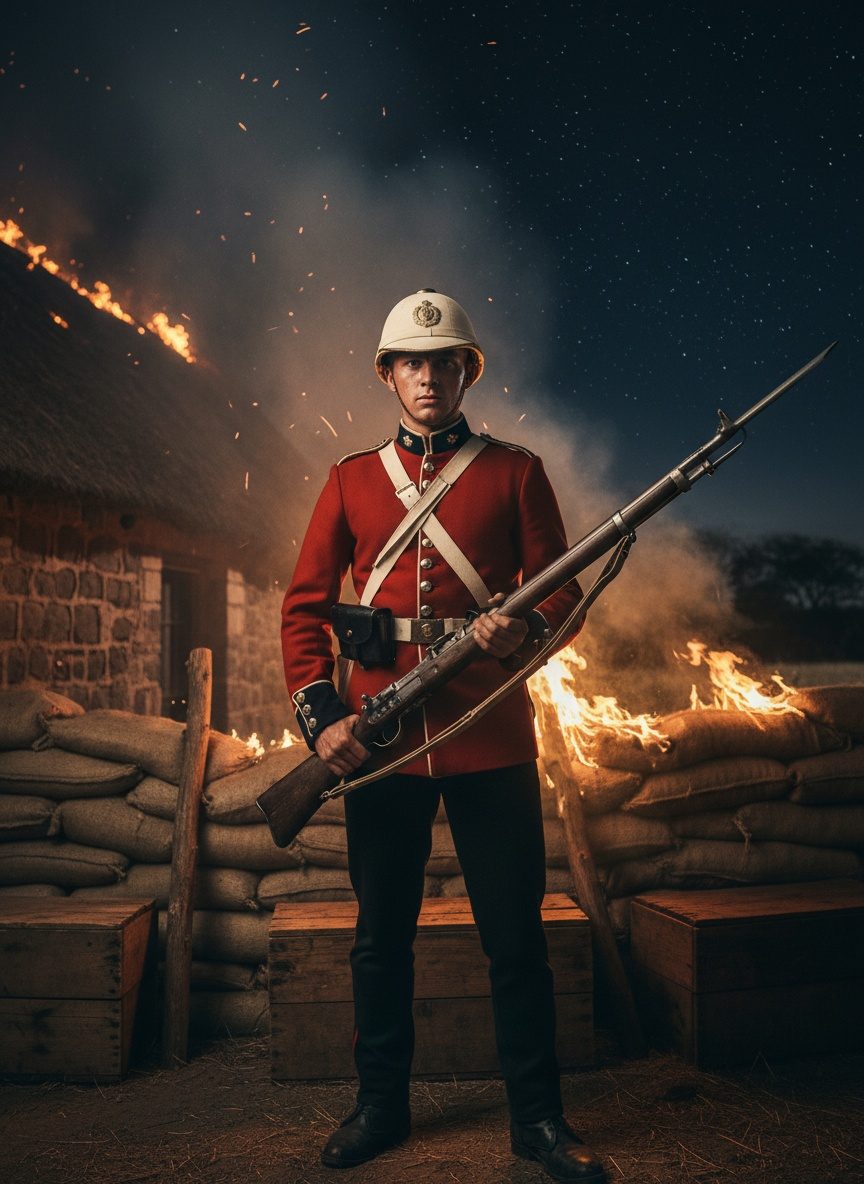
On the night of January 22, 1879, 24-year-old Frank Bourne found himself in a desperate situation. Within the flimsy walls of a mission station at Rorke's Drift, he and 138 fellow British soldiers faced a tidal wave of 4,000 Zulu warriors. The earlier defeat at Isandlwana had left them stranded, with no illusion of relief coming. The stark reality was that survival depended solely on their own courage and resolve, girded only by scarce resources and the thin wooden barriers around them.
The scene was one of apprehensive calm before thunderous chaos. As day turned to dusk, the Zulus, renowned for their fearsome combat skills, swarmed the defenders with chilling war cries that seemed to pierce the soul. As the air filled with gunfire and the acrid smell of gunpowder, Bourne and his men fought intensively, staving off wave after wave. In those dim-lit hours, every moment felt like an eternity — but the defense was resolute, defying not just the numerical odds, but also the swelling tide of fatigue and fear.
Such resilience was not without reward. By the following day, the successful defense of Rorke's Drift had morphed into legend—an inglorious chapter turned into heroic lore, thanks in part to Queen Victoria's favor and the increasingly nationalistic press. Eleven Victoria Crosses were awarded, underscoring the valor displayed. Bourne, though recommended for this prestigious honor, received the Distinguished Conduct Medal and a rare commission from the ranks, recognizing his exceptional leadership and steady nerve in the midst of chaos.
Read next: The Day a Cornish Surgeon Walked Into a Condemned Cell
For Bourne, this chapter of military life was merely one thread in a larger tapestry. He subsequently rose through the ranks, eventually achieving the rank of Lieutenant Colonel. His story would take him through continents, each posting adding layers to the man who would witness seminal changes across the globe. From colonial theaters to the cataclysmic battlefields of the Western Front, his life unfolded against the backdrop of a changing era.
The jumps between epochs in Bourne's life resemble the shifts in world history. Born in the age of Queen Victoria and her empire, cut in the mold of imperial soldiers, by late adulthood he was thrust into the industrialized brutality of the Great War. The relentless artillery duels of World War I must have surely tested his mettle anew. But once more, resilience won out. Against the horror of the trenches, there he stood, no longer the young sergeant but a seasoned officer, guiding younger men through their own gauntlets of fear and courage.
Read next: The Day a Vicar's Son Walked Into a Debtor's Cell and Freed Them All
However, history is not always kind nor its stories linear. By 1945, when much of the world he had known was dramatically morphing, Bourne was one of the last guardians of a fading era. His death on May 8th — a day England erupted in celebratory relief at the end of the Second World War — went largely unheralded. As people poured into the streets, rejoicing the capitulation of Nazi Germany, Bourne's quiet end perhaps mirrored an old warrior's silent contemplation, intersecting with the chorus of a nation intent on new beginnings.
There is a poignant symmetry that can be drawn between Bourne's life and the arc of the British Empire itself. His story is interwoven with tales of valor and endurance at the Empire's zenith, only for his last breath to coincide with its spiritual decline. This juxtaposition speaks not only to the personal journey of a man who endured and adapted through immense change but to the larger narrative of a world tumbling from imperial eminence into modern uncertainty.
Today, the name Frank Bourne is a footnote in the annals of history. Yet his life was a reflection of resolve, complexity, and the silent heroism that often shadows the larger brushstrokes of history. His experiences remind us that the echoes of battles past are marked not just by their participants, but also through the passage of time and remembrance, long after the smoke clears, embraced in the quiet resolute hearts of men like Bourne.