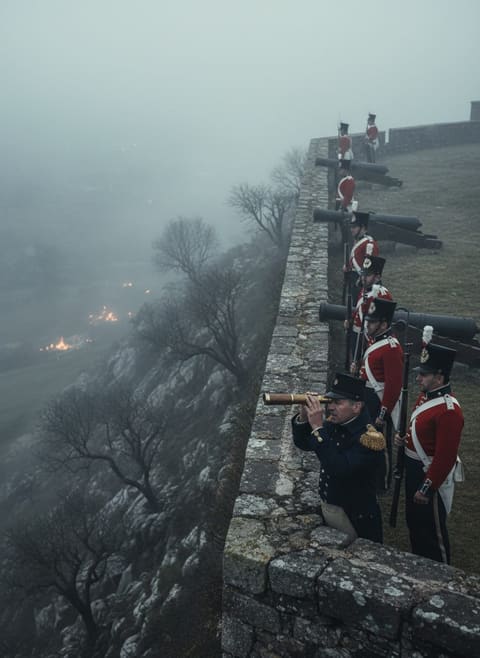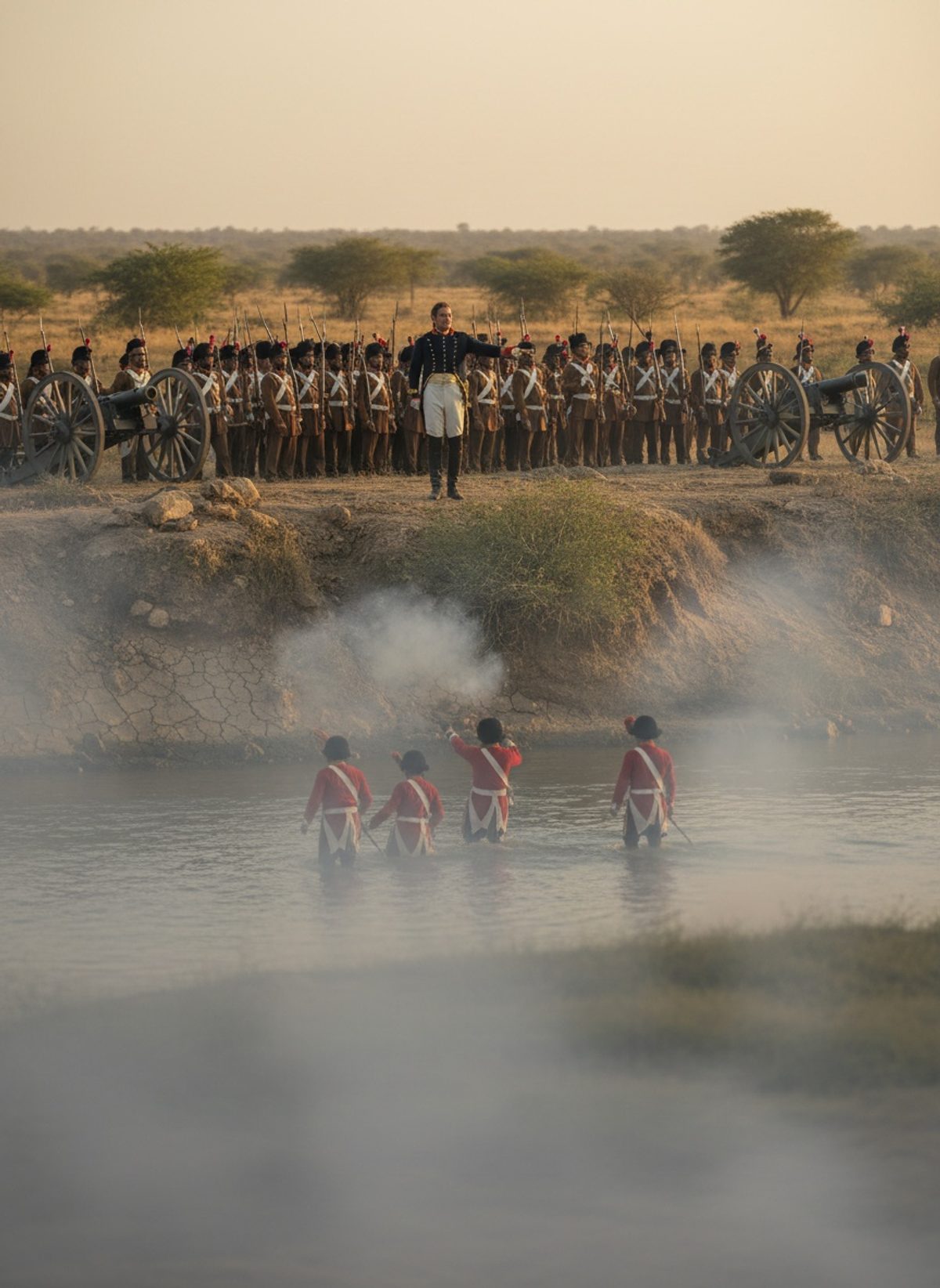
The cannonballs whirred overhead with a fiendish scream, their smoky trails weaving through the chaos of battle. From his position, Anthony Pohlmann surveyed the melee with a calculative eye, his years of military instinct unfurling in split-second decisions. Around him, the Maratha infantry—sturdy and steadfast—awaited his orders amidst the crescendo of musket fire and the deafening roar of artillery. He was a man caught between worlds: a deserter from the British ranks, now orchestrating a dance of death against his former compatriots. It was the Battle of Assaye, 1803, and in a moment's notice, Pohlmann’s commands could potentially tip the scales of imperial destiny.
Raised in Hanover, Pohlmann's early life offered no hint of the military prowess he would wield thousands of miles away in India. Yet, like many of his countrymen, he found himself swept into the British Army, a cog in the expansive wheel of Empire. Initially, he was just another sergeant in the King's service, learning the art of war in the stiff, red-clad regiments of the Crown. But somewhere between duty and disillusionment, Pohlmann made a fateful choice—to desert the stripes and rank of the British military and pledge himself to the Marathas, a confederacy of fiercely autonomous states battling for survival and supremacy in a subcontinent under British encroachment.
To the British, he was a traitor. Yet, to the Marathas, he was an invaluable asset—an officer versed in European tactics, revolutionizing their military approach. Rising swiftly through the ranks, he proved himself a master of the double-dealing intricacies of both military strategy and Indian politics. By 1803, when the British East India Company mounted its campaign against the heartland of the Maratha Confederacy, Pohlmann was no less than a general, commanding a force of 50,000 men, equipped and trained to parry the colonial thrust.
The Battle of Assaye pitched two strategic masterminds against each other, but while history celebrates Major-General Arthur Wellesley, the future Duke of Wellington, as a luminary tactician, it was Pohlmann who orchestrated a near rout of the British lines. Under his leadership, the Maratha troops maneuvered swiftly, performing the audacious maneuver of pivoting 50,000 men on the battlefield—a feat of coordination under fire that took even the most battle-hardened adversaries by surprise. It was this execution of the textbook-perfect wheeling motion that almost dismantled the British advance in a single pivotal moment.
Read next: The Merchant Who Funded Slavery From a Bristol Counting House
Pohlmann had crafted a battlefield tapestry that stretched the British forces thin, exploiting the river's natural defenses and Wellesley’s lack of artillery. The battlefield buzzed with activity, elephants wheeling cannons, soldiers in disciplined formations, and horses charging—all under Pohlmann’s strategic oversight. For a moment, it seemed as if the profound wisdom of a patriarch of a foreign land would triumph over a well-prepared colonial force, reversing the course of British expansionist ambition in India.
Yet, as the dust and smoke began to obscure the day, fortune balanced the scales in favor of Wellington. Underestimating the tenacity and sheer will of the British infantry, Pohlmann faced a counterattack that strained his defenses. Wellesley’s forces pierced through the Maratha lines at critical points, turning the tide with dogged resilience. In the brutal hours that followed, where swords clashed and the cries of the wounded filled the air, the outcome hung in uncertain equilibrium before finally tipping.
Read next: The Day a Freed Slave Wrote a Letter That Shook Britain
The valor and perseverance of British officers and their men forced a retreat, yet it was far from a decisive defeat for Pohlmann. Despite their retreat, the Maratha forces demonstrated a mastery of European warfare tactics learned under Pohlmann. His ability to synthesize these foreign strategies into effective Maratha resistance stands as a testament to his skills and the complex web of colonial alliances in South Asia.
Pohlmann's legacy, though overshadowed by the eventual British victory, poses an intriguing question of loyalty and identity in a colonial world. Here was a Hanoverian, once part of an empire's machinery, who reimagined the very nature of opposition against that empire. His story is a powerful reminder that the pages of history often neglect those figures who dared to circumvent the simple dichotomies of hero and villain. In the narrow accounting of empire, it becomes easy to overlook such an individual who, with the specter of immense cultural pressure, found a way to redefine his purpose and impact history in a complex theatre of global politics.
In reflecting on Assaye, where cannon smoke may have been forgotten by time, but its echoes linger in the corridors of history, we must remember Anthony Pohlmann—not as a footnote in British victory, but as a central player in the struggle for the heart of the Indian subcontinent. The Hanoverian deserter turned general enriches our understanding of not only the dynamics of the Second Anglo-Maratha War but the enduring human saga of ambition, adaptation, and agency on an ever-expanding world stage.