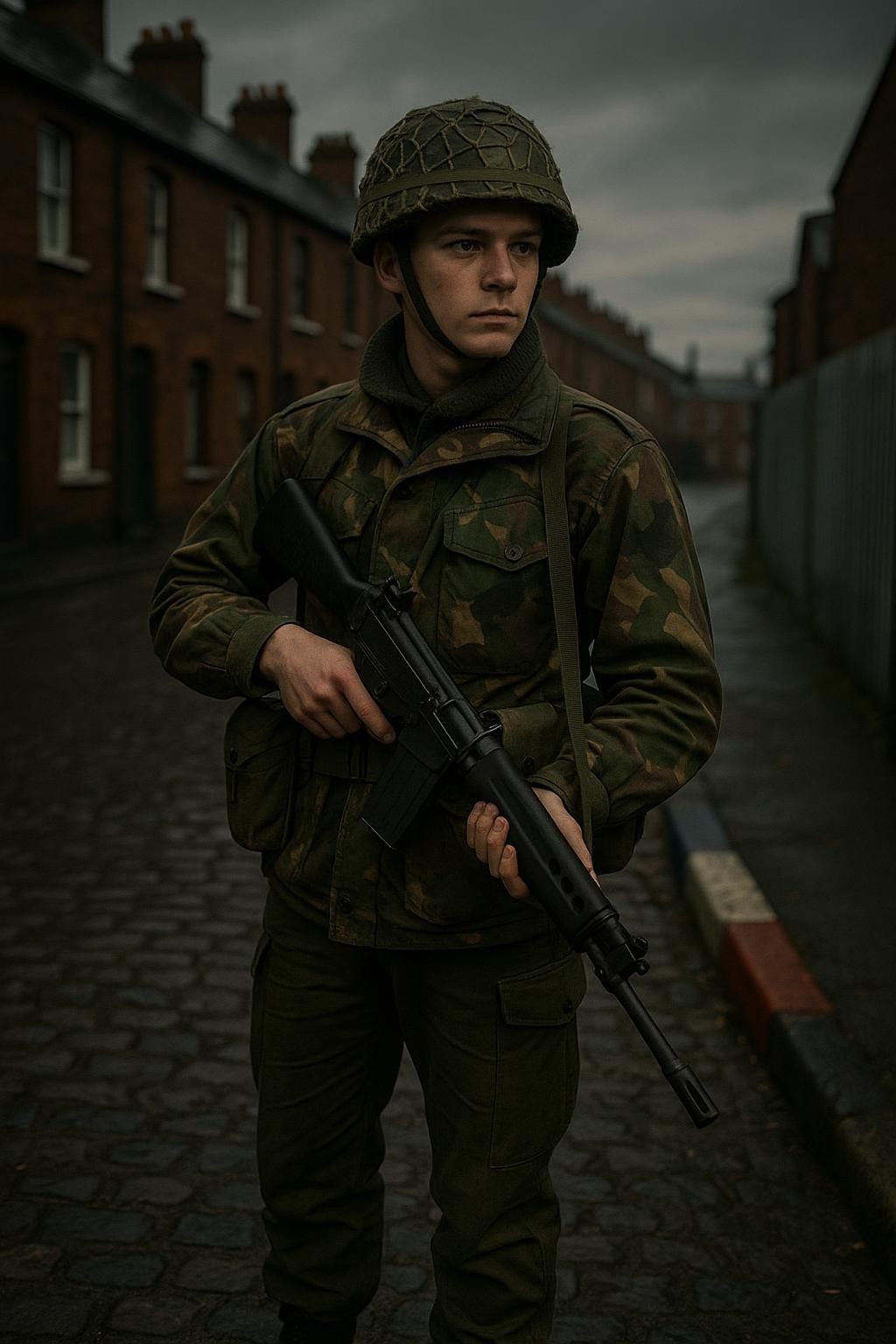
He was nineteen. He had never been given a choice about serving in Northern Ireland.
Into the Unknown: A Teenage Soldier’s New Reality
The year was somewhere in the turbulent 1980s, during a period of violence known to history as The Troubles. A young British soldier found himself far from the comforts of home, patrolling a part of the United Kingdom most of his compatriots knew only from grim news reports. These weren’t distant, exotic lands but familiar streets darkened by the shadows of conflict—a far cry from any expectation of adventure he might have had when enlisting.
Dubbed Operation Banner, it was the British Army's deployment to Northern Ireland, and it stretched over three decades as the longest continuous operation in British military history. Commonly, it was known as a modern kind of trench warfare — with danger lurking at every turn, and the enemy hidden in plain sight. Unlike the structured battles learned about in textbooks, this was a conflict where sudden ambushes were frequent and trust was a rare commodity.
A City Divided: Belfast’s Hidden Frontlines
One could walk from one end of Belfast to the other in less than a day. Yet, for the soldiers, each block was an invisible yet formidable boundary, scored indelibly with lines of division. Decades of tension had marked these streets, and they were mapped in the minds of the locals in ways no military intelligence report could capture. Here, Catholic and Protestant neighborhoods opposed one another like rivals in a ceaseless struggle.
Read next: The Day a Cornish Surgeon Walked Into a Condemned Cell
Every brick wall and every corner pub held secrets. If you stopped just long enough to catch your breath, you could feel the weight of unseen eyes calculating angles and trajectories. Snipers knew the maze well, playing a deadly game of cat and mouse with the soldiers below. It was a city that had oil drums for barricades and murals that immortalized martyrs and villains on either side of the ideological divide.
The Unseen Battle Scars
At nineteen, our young squaddie—in the parlance of the infantry—wore the weight of his newfound responsibilities heavily upon his shoulders. In a six-month tour, every call to arms was emotionally charged, every footstep clattered ominously in the silent understanding that any moment could be his last.
But the battles weren’t just external. The cacophony of political rallies, riots, and the constant threat of improvised explosive devices (IEDs) was mirrored by an invisible struggle within—against fear and the temptation to become numb. The small metal tokens in his pockets were reminders of fleeting comforts: a bus pass from home, a sharpened pencil stub. Each offered a connection to a simpler, safer time.
Shared Pillars of Brotherhood
This era, often reduced to statistics and timelines, is punctuated by stories of young men thrown into the quagmire together—strangers bound by shared fears and hopes. Many formed bonds stronger than any they’d known, forged in the cauldron of unpredictable days and unyielding nights.
Read next: The Day a Vicar's Son Walked Into a Debtor's Cell and Freed Them All
They traded small acts of gallantry in silence. A tin of condensed milk secretly shared, a pat on the back wrongfully delivered for courage unspoken. With every return to their base, the mundane and the profound became inextricably linked. In shared duty, they found a latticework of resilience; in each other's experiences, the solace their minds desperately craved.
After the Banner: The Silence Beyond the Conflict
When the tour was done and the spirits of Belfast and South Armagh became memories, many soldiers went home to a nation oblivious to the specifics of their service. Stories of friendly football matches transitioned to hushed conversations about near misses and unexpected horrors. The younger generation of today finds it hard to comprehend—how soldiers could return without applause, blend back into the mundane with secrets untold.
Sitting around family tables, these veterans often carried with them the heavy silence of unspoken memories. It is a gift and trauma simultaneously—to have been a witness and to also move on when history quietly calls it a closed chapter. But perhaps it is these exchanges in hushed tones, between tea cups and television rooms, that remind us of a time not to be forgotten, lest it be repeated.
Today, Belfast tells a more vibrant story, its powers of reconciliation carving a hopeful future amid its storied past. Yet the echoes of Operation Banner still reverberate, in the tales of those who walked its perilous streets with courage that’s woven into the fabric of what it means to be human. And so, the tale of a nineteen-year-old squaddie from the 1980s remains a poignant chapter of the history they left out of textbooks—a narrative as much about survival as it is about the enduring resonance of forgotten voices.