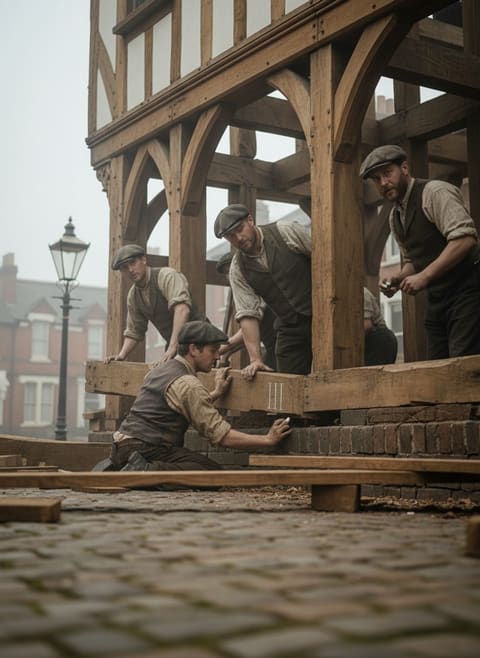
The air hung heavy with the scent of clay and glaze, as the sun dipped below the Staffordshire hills, casting long shadows across the factory floor. Here, in this cacophony of industry at Etruria, the birthplace of England's ceramic revolution, flames from the kilns danced like specters on the soot-streaked brick walls.
The clattering of workers’ tools mingled with the low hum of conversation, punctuated by the occasional crescendo of pottery wheels spinning to life. This was no ordinary evening in the world of pottery. Tonight, the master himself, Josiah Wedgwood, would walk the floor, meticulously inspecting each piece crafted by his workers' hands—and smashing any that fell short.
The Measure of Perfection
Josiah Wedgwood was a man who lived by extremes. A pioneer among industrialists, he had been marked early in life by the harsh specter of smallpox—a disease that left him with only one functional leg. Yet this hardship seemed only to sharpen his resolve. Within the walls of Etruria, perfection was the creed.
Legend has it that Wedgwood would pick up a piece of pottery, examine its form, its glaze, its every detail, and if it did not meet his unyielding standard, he would cast it to the ground himself. Shards scattered underfoot became a grim reminder of the price of imperfection.
Read next: The Night a Ironmaster's Son Bridged a Gorge Nobody Believed
His demands were not born simply from vanity but from a fervent belief that the beauty of craftsmanship lay in its precision. Wedgwood was relentless in his pursuit to uplift the ordinary.
He envisioned a world where even common people might own something exquisite, crafted with the same care and regard for beauty as anything gracing a noble’s table. The sight of him, hunched over a pot, was enough to invoke apprehension among his craftsmen. Here was a man who did not just set the standard—he embodied it.
An Iron Will in Ceramic
However, Wedgwood's tyranny of quality was not matched by tyranny of spirit. His determination was softened by a revolutionary spirit that sought to democratize beauty. He saw the pottery trade as not just a means of production but as a platform for innovation and social change.
He introduced significant advancements in production techniques, harnessing the power of mechanization while retaining the human touch. Patterns and designs that once required painstaking handwork were made with new efficiency, pushing the boundaries of how ceramic art was understood.
Imagine, then, the atmosphere—alive with anticipation and a tinge of fear—as Wedgwood moved from table to table. Workers dared not breathe as he tightened his monocle on another freshly fired piece. Each pot, plate, or teacup became a testament to the process they had honed. Yet, for those marked for destruction by Wedgwood's discerning eye, there was an undeniable thrill. The smashing of a pot was both an epitaph and a propellant, spurring craftspeople to heights previously unimaginable.
The Philosophy of Everyman’s Artistry
It is crucial to understand the broader social canvas upon which Wedgwood painted his ambitious dreams. During the Industrial Revolution, most art was reserved for the elite, an indulgence of the privileged few. But Wedgwood's vision was radical; he saw the power of art as universal.
He strived to cast away the divide between art and the common person. This, he endeavored, would not be through lowering standards, but by lifting craftsmanship to levels that even the gods could admire—and placing it squarely in the hands of the middle class.
Read next: The Architect Who Built Manchester a Skyscraper of Light
At the heart of Wedgwood’s empire, his works bore an indomitable seal: an emblem of his name inscribed into the clay itself as a promise of excellence. It was a mark that declared to the world this piece was worthy, not simply by the creator's standards but by human standards. But such a promise relied heavily on the severe discipline and courage he imprinted upon his team with each broken pot.
Legacy Etched in Shards
The story of this ritual destruction encapsulates a valuable lesson that echoes far beyond the ceramic workshops of the 1780s. It is about the convergence of uncompromising quality and universal accessibility. Josiah Wedgwood, through his actions, showed that excellence did not belong to the privileged alone but could be a shared human endeavor. By smashing those imperfect creations, he wasn’t just breaking pottery—he was breaking barriers, redefining both the purpose and scope of craftsmanship.
As the echoes of his work reverberate through history, we remember not just the empire he built or the innovations he pioneered. We are reminded of his belief in human potential, the possibility that everyday people could create extraordinary beauty.
As the shards of unworthy pots crunched beneath his wooden leg, the sound marked more than a rejection; it was the rumble of change, forging a path to redefine art in the age of industry. This idea still inspires creators today, urging them toward greatness not for personal gain, but for the broader elevation of human artistry. What a legacy Josiah Wedgwood left, breaking the mold in every sense of the term.