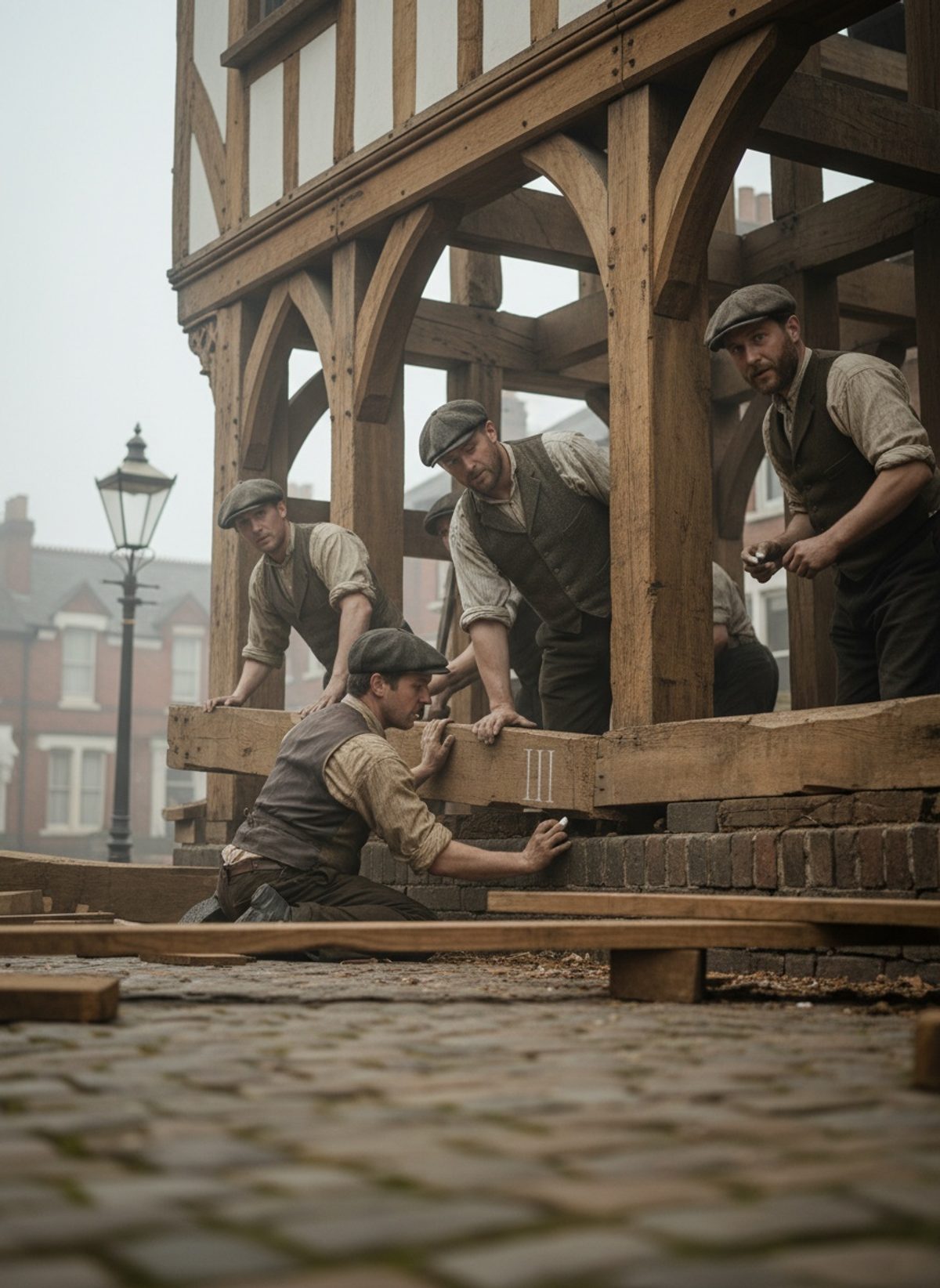
July 17, 1911. A quiet murmur rose from the cluster of onlookers gathered on the edge of the Birmingham park. The scene unfolding before them was one that seemed plucked from a Tudor tale, rather than the heart of a burgeoning industrial city.
For centuries, the timber-framed house had stood as a silent witness to the ebb and flow of life on a cobbled street that no longer existed. By 1910, Birmingham was mired in a transformation, one marked by sweeping changes that obliterated not only the old architecture but the memories they held. Slum-clearance schemes were in full swing, and the future beckoned with ruthless efficiency. Hundreds of buildings, each brimming with history, were marked for demolition—done in by progress and necessity. Yet, among this parade of disappearing relics, one structure defied its fate in a manner most unexpected.
The 17th-century timber house had become a symbol, not of defiance through legal channels, but through the hearts and minds of the local populace. Voices, passionate and persistent, clamored not for its salvation in situ but for its very essence to be carefully dismantled, beam by beam, and reconstituted elsewhere. It was an act none foresaw, a community rising with a personal crusade to preserve a piece of their shared past, even as the soil beneath them shifted.
The workers who heeded this call did so with reverence. Each plank and timber was tagged and catalogued meticulously on that July morning, marking not just an architectural feat but also an urban narrative writ large in splinters and pegs. The operation itself was a testament to human dedication and ingenuity—reconstructing a bygone era in a new environment, a majestic phoenix reborn as a cricket pavilion in the park. As the final piece was set in place, it stood not only as a shelter but as a tangible tapestry of community care across the ages.
Read next: The Day a Weaver's Son Gave Factory Children a Voice
The park, which once might have heard the crack of willow on leather, now served as an unlikely curator of history. Around the pavilion, sounds of children playing jostled comfortably alongside the ghosts of long-gone residents of the street. Anomalies and strange juxtapositions were now the norm—Victorian cricketers ducking into a Jacobean antechamber to change before a match, and Edwardian patrons sipping tea beneath beams that had witnessed 300 years of Brummie history.
For some, entering the pavilion was like stepping into a time machine. Each creak of the floorboards might have been a whisper from past residents, figures clothed in the fashion of yesteryear bustling through spaces now fitted with the tools of sport and leisure. Here, the everyday past intermingled effortlessly with contemporary pursuits, each timeline enriching the other in a dialogue of cultural continuity. The unusual spectacle of playing a quintessentially English game encased in walls shaped by another era added layers to its charm—a living exhibit of England's architectural resilience.
In resettling the house as a pavilion, perhaps unwittingly, a new tradition had taken root. The idea of relocation and preservation in this way captured imaginations and seeped into public consciousness. If a street could vanish but its soul remain intact, reborn even, what tales might others hold in their impermanent shadows? Each match played under its watch became not just a sporting event but part of an ongoing narrative, where sport and history convened on the manicured grass.
Read next: The Day a Collier's Son Gave the Mines a Light
From this curious tapestry sprang countless tales and personal anecdotes. Veterans of cricket could point out the peculiarities of the design elements—odd nooks and forgotten corners now highlighted by sunlight streaming through ancient windows. Young cricketers, none aware that the hatch they tapped for luck had once offered a view onto a bustling 17th-century street, declared in innocence their attachment to the structure as their lucky charm. Translating history into luck was as British a custom as any and only added to the pavilion’s mystique.
As the years drifted by, the pavilion continued to serve as an emblem of endurance amid the relentless march of progress around it. It recalled not just a singular act of preservation or architectural derring-do but a larger tale about the forms in which memories and identities choose to survive. Where a street had disappeared, this single building carried the narrative, fibers and all, into bright new summers. In an age characterized by centrifugal forces pulling societies from their moorings, here was a story of spontaneous unity with lessons still pressing today.
What, then, does this improbable rebirth tell us? It speaks of resilience, of a community’s undying commitment to honor the lives and histories that came before. It reminds us that our past is not always shackled to its point of origin—it can be lifted, transported, and woven anew into the fabric of our lives. In doing so, it ensures that the spirit of places, as much as their geographical footprints, endures. In this singular act of communal preservation, a cricket pavilion became a guardian of that memory—a living monument to what once was and the stories that time might have demanded we forget.