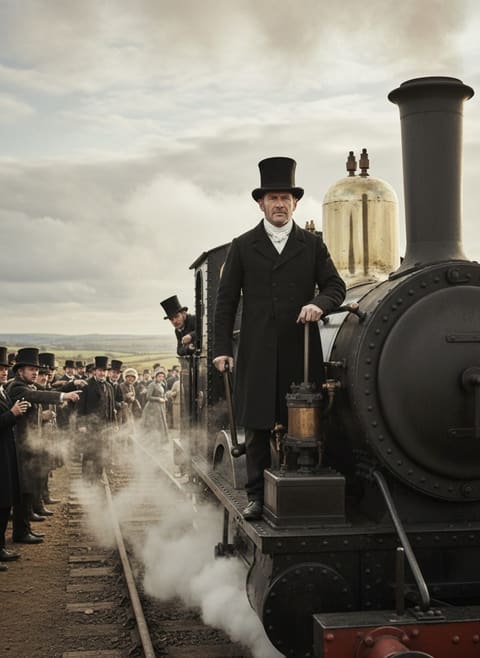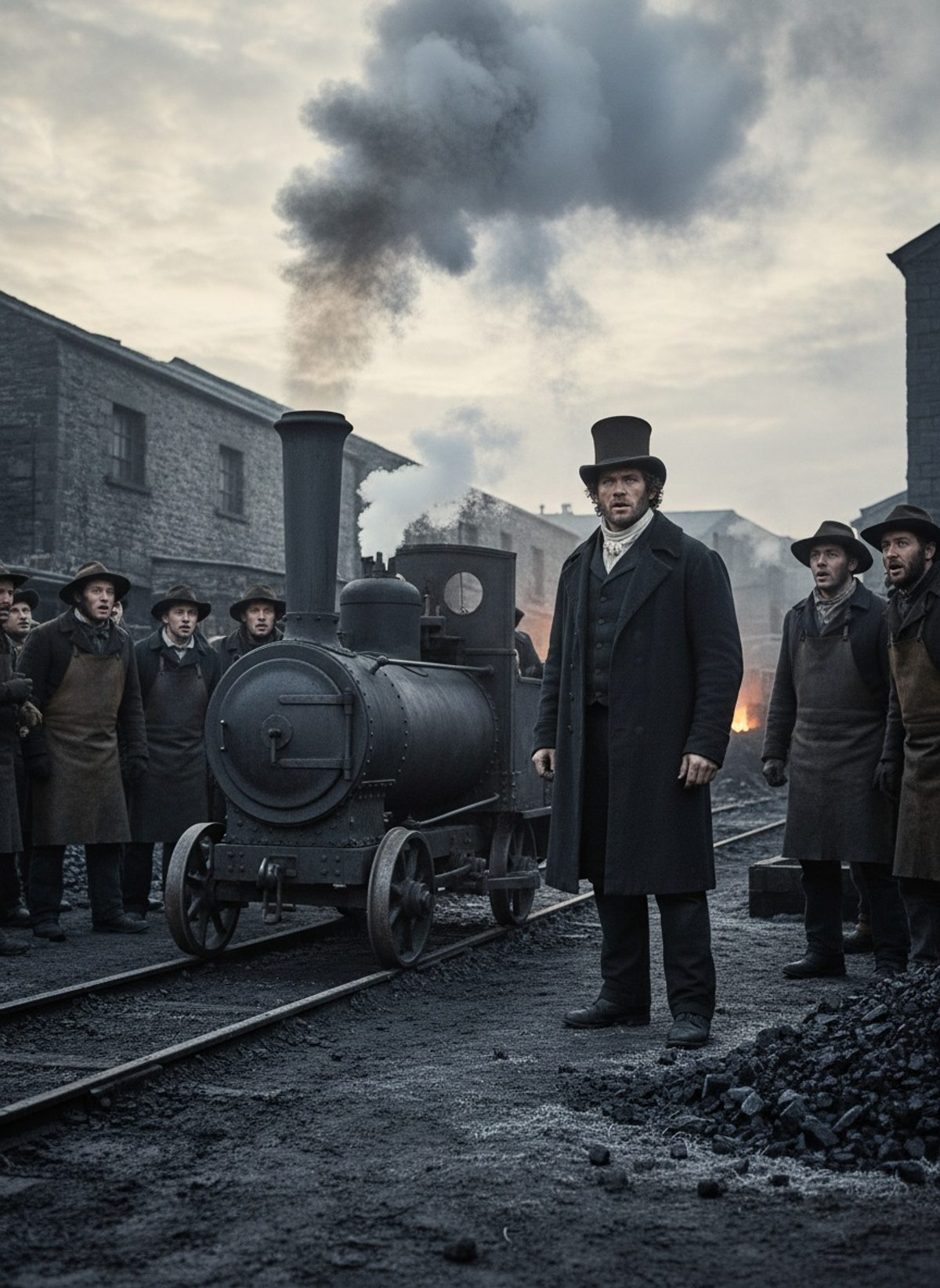
February 24, 1804. The sky was barely beginning to lighten over the Merthyr Tydfil ironworks.
The Unlikely Pioneer
In the pre-dawn hush of South Wales, an odd metallic hulk sat broodingly on the newly laid iron rails. This was no beast of burden, yet its existence challenged the very era of horse-fueled power. Richard Trevithick, the Cornish visionary who stood beside it, was a son of the industrial age, ready to convert the raw potential of steam into locomotive force. Unlike his contemporaries, Trevithick was not afraid to dream beyond the constraints of the known world. Growing up amid Cornwall’s mining domains, he had learned to master the immense and explosive power of steam engines, a skill he honed into an art form that few dared to comprehend.
Trevithick's vision sparked against a background of skepticism. His grand design of a high-pressure steam engine faced a chorus of doubters questioning its feasibility and safety. Where others saw risks of explosions and inefficiency, Trevithick perceived a new frontier. For him, harnessing steam to drive an iron vessel was not simply a challenge but an inevitability.
Born into a family of miners, Trevithick understood the weight of tradition but was never shackled by it. His relentless ingenuity and willingness to deviate made him both a pioneer and a rebel in minds of his contemporaries. His audacity to build something capable of self-propelled motion without conventional draft animals was seen by many as folly—but Trevithick was about to prove them wrong in the misty light of Merthyr Tydfil.
Read next: The Day a Blind Weaver's Son Gave Children Back Their Hands
The Iron Beast Awakens
As Trevithick climbed aboard the machine, the anticipation was palpable. Those assembled at Penydarren, a smattering of onlookers and ironworkers, could scarcely breathe discernable scents of hesitation and hope mingling in the cool air. The landscape was an iron canvas, a testament to man’s growing ambition to control nature. The engine itself, a ten-ton behemoth, sat like a dormant beast, ready to defy its own weight with a heart of fire.
The firebox kindled, and steam pressure began to build. Trevithick monitored his creation with attentive calculation, gauging pressures and temperatures, orchestrating the symphony of mechanical elements to come. Smoke belched skyward as the pistons groaned with anticipation, each crank and piston gearing towards the advent of an untested reality. When the wheels finally turned, the world shifted irrevocably.
This understated moment captured the dawn of a revolution. Steam hissed and swirled, iron wheels clanked against the wrought iron tracks, and onlookers marveled as Trevithick’s locomotive—a machine that defied convention and gravity—lurched forward under its own power. The locomotive tugged along ten tonnes of iron, crossed short spans of terrain and clattered tumultuously along the Welsh tracks, leaving incredulity and exhilaration in its wake. Here was proof of concept, a shift from theoretical musings to tangible innovation, succinctly manifesting Trevithick’s ability to bridge imagined possibilities and realized inventions.
The Steam-Paved Future
As dawn painted itself across the horizon, Trevithick’s locomotive completed its journey. The brief but significant sojourn cemented a foundation for what was to become an integral facet of modern society. This iron horse laid the tracks for a future where steam locomotion redefined mobility and commerce, heralding a new epoch of human achievement.
Read next: The Day a Mill Owner Paid His Workers Not to Work
Despite Trevithick's success on that February morning, the path forward was fraught with challenges. While the locomotive bravely heralded a new era, the world was not quite ready for its leap into the mechanized age. Issues with track durability and the sheer weight of the behemoth presented obstacles early on. Yet, Trevithick had unlatched a colossal idea—a precursor to transportation and industrial innovations that would soon reframe human expectations of distance, speed, and economic expansion.
Over the centuries, Trevithick’s accomplishment on that chilly morning merged into the broader tapestry of the Industrial Revolution, his name often overshadowed by the more immediate and comfortably traditional advances that followed. Nonetheless, his daring ingenuity forged pathways, both literal and figurative, for pioneers who would bring the promise of the locomotive to fruition on a grander scale.
In our own era, when speed and connectivity reign supreme, the story of Trevithick's locomotive remains a poignant reflection on the courage required to transform the impossible into the inevitable. It was here, in the steaming belly of a metal beast, that a singular man from Cornwall lit the fuse of progress, igniting locomotion and potential that crisscrosses continents and history alike. His morning ride not merely changed his small world but redrew the map of possibility for all humanity—a reminder of how one bold vision can ripple through time, forever changing our journey.